E-Paper



Number Theory: 3 things to watch out for in the 2 assembly election results
.
Updated on: Oct 8, 2024, 01:26:45 IST

 Prefer HTon Google
Share via


Copy link

The results of assembly elections for Haryana and the union territory of Jammu and Kashmir will be declared today. In Haryana, the elections are being seen as a direct contest between the ruling Bhartiya Janata Party (BJP) and the Congress. In Jammu and Kashmir, which is holding assembly elections for the first time since 2014, delimitation (and the fact that five legislators will be nominated by the LG) has introduced an element of uncertainty in the election results even though the contest is primarily between the Congress- National Conference alliance on one side, and the BJP on the other. What are the key messages to watch for in the election results? Here are three things which are worth watching out for today.
What to watch out for
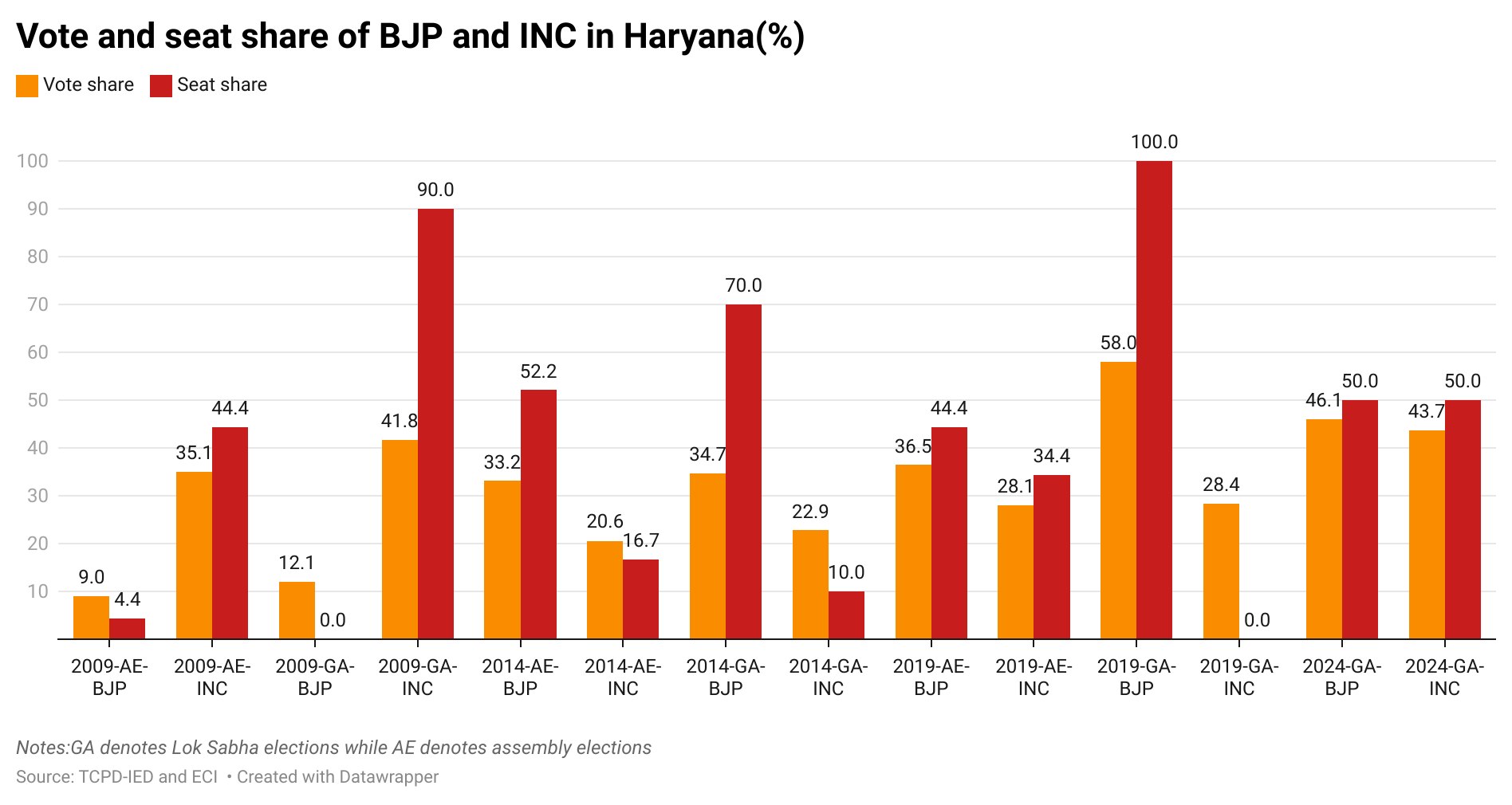
 Will the Congress be able to build on its Lok Sabha revival in Haryana?The Congress is fighting these elections in Haryana to recapture power after a gap of ten years. The 2014 Lok Sabha elections were a shocker for the Congress in the state when it saw its vote share and seat share drop by 18.9 and 80 percentage points compared to the 2009 Lok Sabha elections. The 2014 assembly elections, which were held a few months after the 2014 Lok Sabha polls, saw an almost similar performance by the Congress in terms of vote share and seat share. While the Congress regained some of its lost support in 2019 Lok Sabha elections, its seat tally went from one Lok Sabha constituency to zero. However, the Congress managed to double its seat share in the 2019 assembly elections with a similar vote share as the 2019 Lok Sabha polls. The 2024 Lok Sabha polls saw a big Congress revival when its vote share jumped by more than 15 percentage points compared to the 2019 Lok Sabha election despite contesting only nine out of the ten Lok Sabha constituencies in the state. In terms of contested vote share, the Congress’s improvement over 2019 Lok Sabha is even greater (20 percentage points). The party also won five seats. Will the Congress retain its 2024 Lok Sabha vote share in these assembly elections? Its vote shares in the Lok Sabha election and the immediate assembly election have been pretty similar in the last three election cycles. How many assembly constituencies will the Congress win with this kind of a vote share? If the BJP also retains its 40% plus 2024 Lok Sabha vote share, then the seat distribution will be an interesting one. However, even a minor drop in the BJP’s vote share could lead to major seat share gains for the Congress as anticipated by most opinion polls.
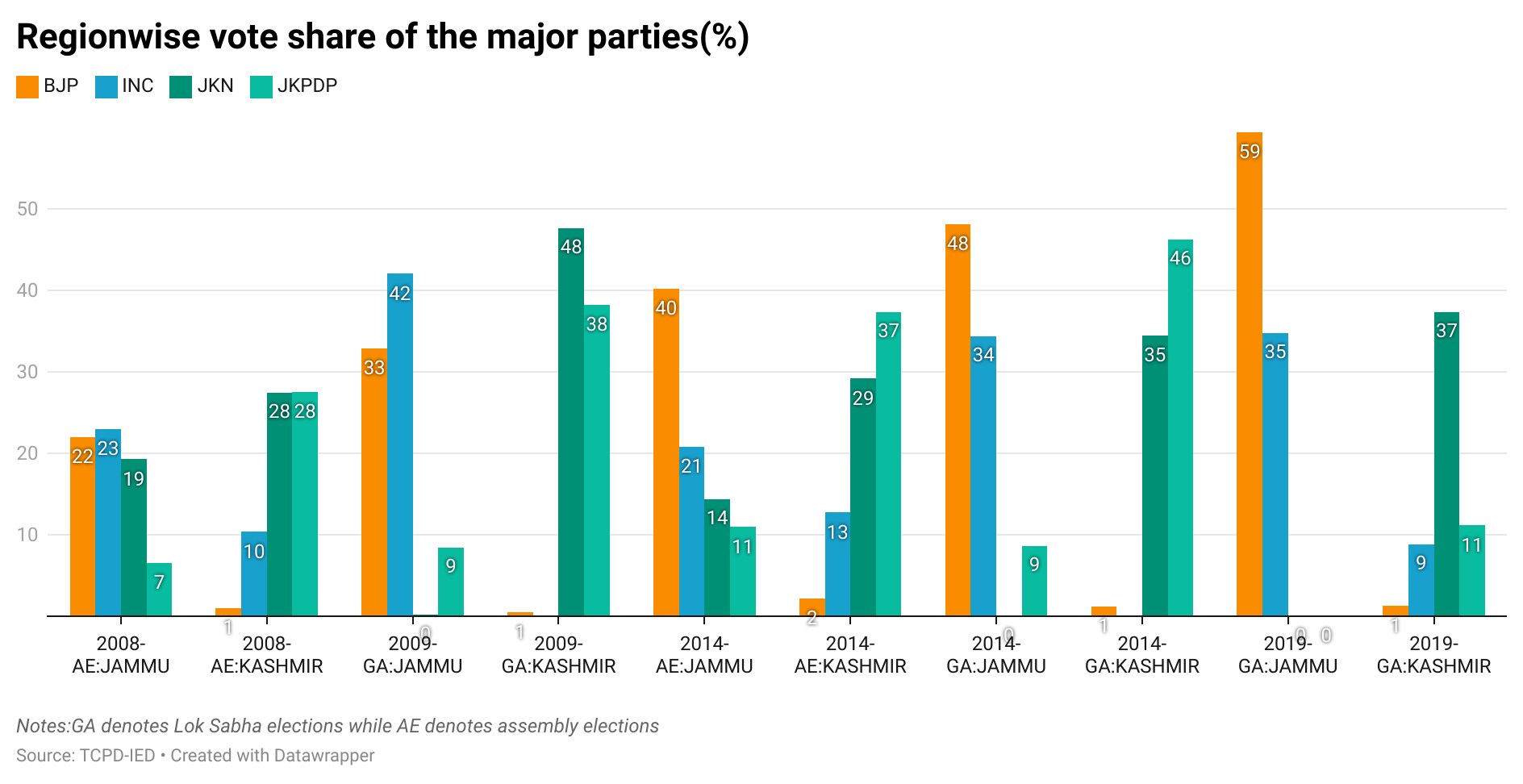
- Will the Jammu versus Kashmir divide become more entrenched this time?This will be among the most important questions vis-à-vis the political future of the union territory. In the one assembly election (2014) and three Lok Sabha elections (2014, 2019 and 2024) which have been held in Jammu and Kashmir in the last ten years, the BJP has won a majority of seats in the Jammu region while it has drawn a blank in the Kashmir region. Because parties which have done well in the Kashmir region have failed to do well in the Jammu region, in the assembly elections no party or pre-poll alliance has won a majority in terms of AC-wise results in Jammu and Kashmir. Whether the 2024 results will replicate this trend or not is an interesting question given the uncertainty introduced by delimitation which could have a large effect on constituency-wise election results.
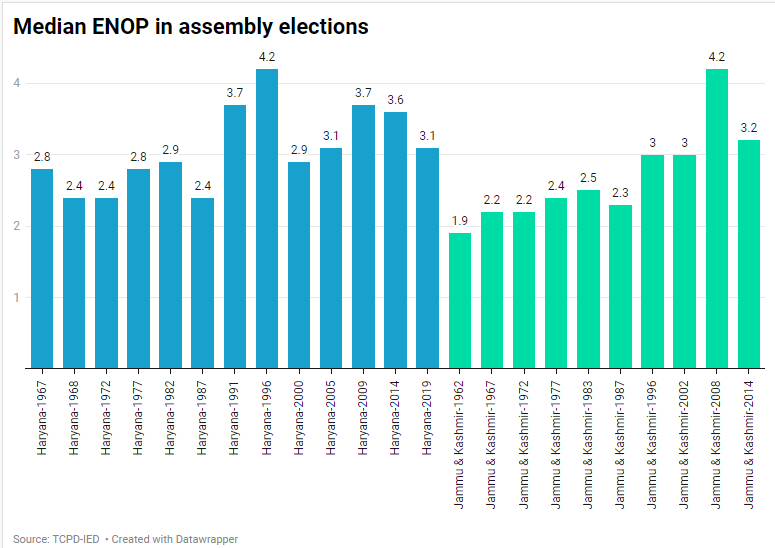
- Will Haryana become more polarised and Jammu and Kashmir more fragmented this time?This is another interesting question vis-à-vis the two elections. In Haryana, the elections are largely being seen as a bipolar fight between the BJP and the Congress with regional parties such as the Indian National Lok Dal (INLD) and its offshoot the Jannayak Janta Party (JJP), which won ten ACs in the 2019 elections, being relegated to the background. Jammu and Kashmir, on the other hand, has seen an independent candidate win a Lok Sabha constituency for the first time since the 1970s in 2024. The ongoing assembly elections have seen a lot of talk about independent candidates backed by the Jamat-e-Islami entering the electoral contest for the first time. And the People’s Democratic Party (PDP) which was a part of the PAGD alliance (People’s Alliance for Gupkar Declaration) including other Kashmiri parties after the abrogation of Article 370 in 2019, is not in the Congress-NC alliance. It will be interesting to see whether the median ENOP increases and decreases significantly for Haryana and Jammu and Kashmir compared to past elections this time. ENOP is defined as the reciprocal of the sum of squares of the vote share of all candidates in a constituency, and a higher value indicates greater political fragmentation in the elections. For example, if there are four candidates in a constituency and they receive 26%, 25%, 25%, and 24% of the votes, the ENOP value will be 3.99. If these vote share numbers change to 50%, 45%, 3%, and 2%, ENOP will fall to 2.2.