
 E-Paper



Number Theory: A peek inside India’s informal economy – II
..
Updated on: Mar 6, 2025, 17:53:52 IST

 Prefer HTon Google
Share via


Copy link

The first part of this story situated India’s informal sector firms in the country’s larger economy, described their basic economic status and also flagged what can only be described as satisfaction despite economic precarity. The second part will use unit level data from AUSUE surveys to show that most of these firms are largely family-run establishments with very little paid employment generation, especially of better quality. While things such as having stayed in the business for a long time do not appear to make a difference to the fortunes of these firms, they do appear to respond to larger state-wise differences in economic situation.

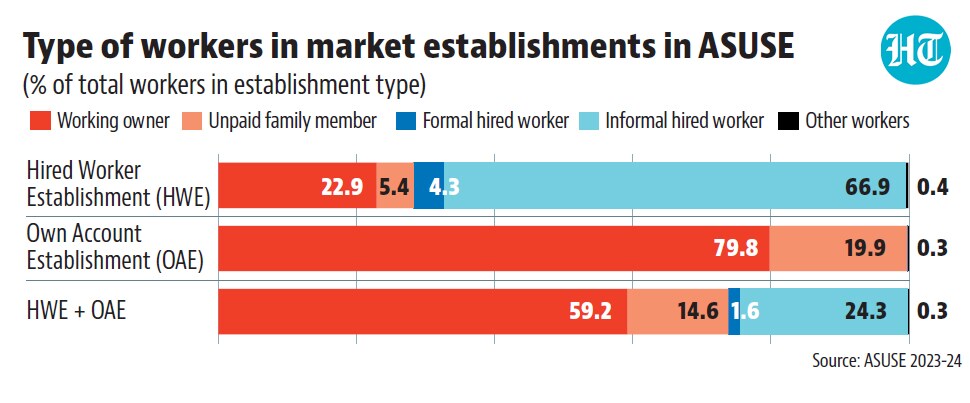
 59% of the workers in informal sector firms are just owners or their family members87% of informal sector firms in the 2023-24 AUSE data are own account establishments which means that they hire no workers and run with just the working owners and unpaid family members. Even among the remaining 13.4%, which are classified as Hired Worker Establishments (HWEs), 28% of the total workers are either the owner or unpaid family labour. The share of formally hired workers – they are expected to have paid leaves and other social security benefits – in informal sector enterprises as a whole was just 1.6% (4.3% in HWE). This clearly shows that there is very little quality employment generation in these firms. See Chart 1: break-up of workforce in OAEs, HWEs and total informal sector enterprises
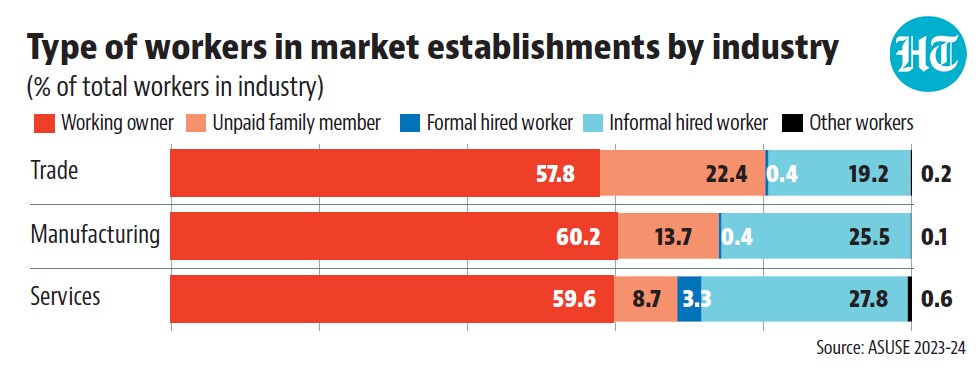
- Subsistence variety employment is spread across sectors in the informal economyTo be sure, one could argue that a lot of informal sector enterprises would be proverbial Mom and Pop stores and therefore one need not read too much into it. However, a broad sector-wise data analysis shows that the problem is more widespread. Even in manufacturing, almost three-fourths of the workers are either owners or unpaid family workers. What is really striking is the fact that the share of formally hired workers does not cross even 3.8% in any kind of manufacturing sector activity in ASUSE data. This number reaches its highest value in the education sub-sector of services (if one were to ignore the very small sector of non-captive electricity generation). See chart 2: sector-wise break-up of workers by worker type
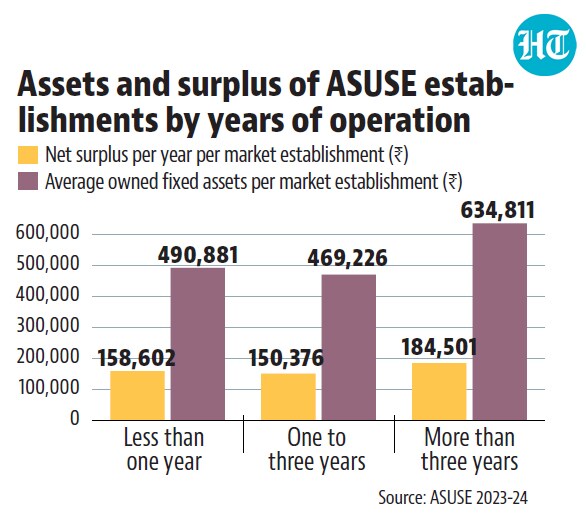
- Longevity seems to have very little premium in the informal economyThis is another striking finding from the data. ASUSE also classifies informal sector firms on the basis of the number of years they have been in operation. The classification itself seems to be a bit counter-intuitive with the oldest firm category extending beyond just three years. What the data shows is that there is very little difference in surplus or fixed capital per firm by their longevity in the market. This suggests that there is very little learning-by-doing premium generated upward mobility for such firms in the Indian economy. See Chart 3: surplus and physical capital by years in operation
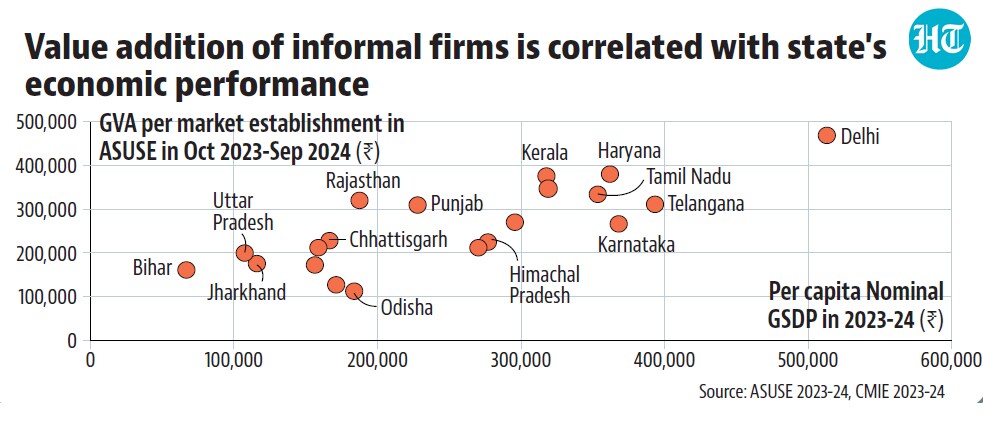
- But firms do show a relation with economies of their statesWhile all the evidence presented above nudges one towards the conclusion that India’s informal sector firms have very little economic dynamism at least one piece of data shows that they do not operate in complete isolation of the larger economic environment. A comparison of average GVA per informal sector firm in a state shows a strong positive correlation with per capita GSDP of that state. While the relationship merits a more serious analysis, it does tell us that dynamism in the informal sector is not divorced from the formal economy. Chart 4:



Unlock a world of Benefits with HT! From insightful newsletters to real-time news alerts and a personalized news feed – it's all here, just a click away! -Login Now!


