
 E-Paper



Number Theory: Are airfares higher than they should be in India?
.
Updated on: Mar 10, 2025, 08:46:48 IST

 Prefer HTon Google
Share via


Copy link

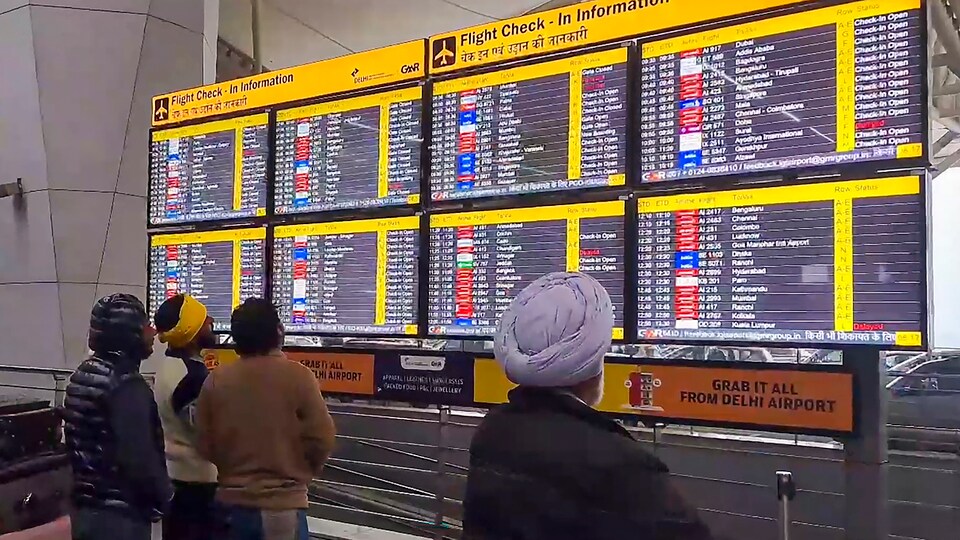
Expensive air tickets regularly make news headlines in India. While much of the noise is around seasonal spikes around festivals or gatherings such as the Kumbh, there is a more important question to be asked. Has normal travel air travel become more expensive in India in recent years? Here is what the data shows.
Are airfares higher than they should be in India?
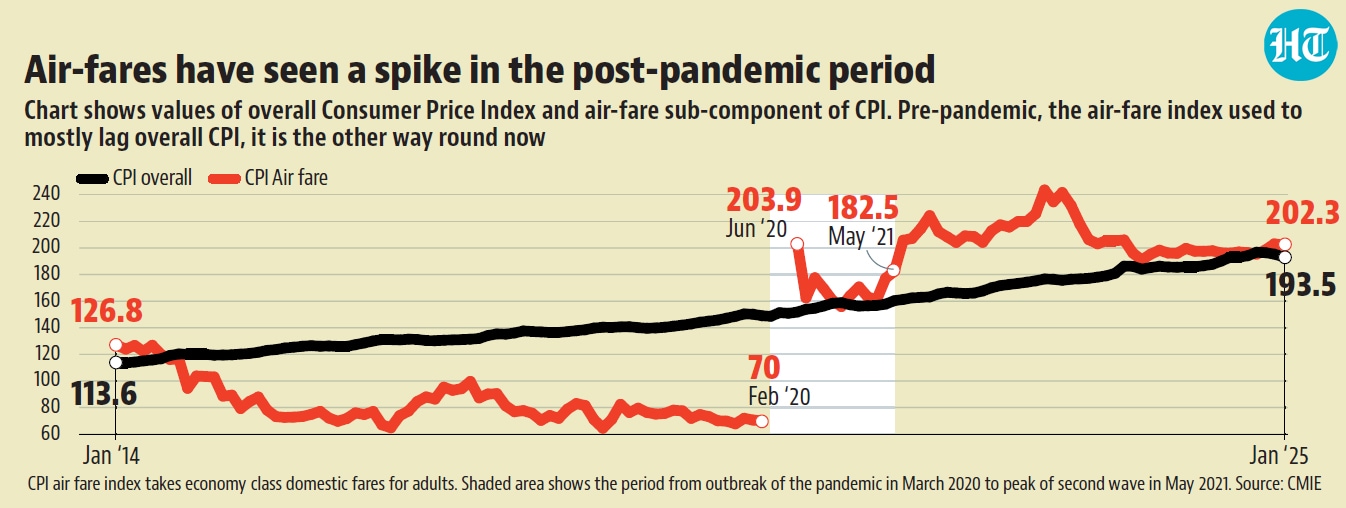
 Airfares and overall inflation show different trajectories post-pandemicIndia’s Consumer Price Index (CPI) includes a sub-component of airfares. This component, according to the Centre for Monitoring Indian Economy (CMIE) database measures economy class domestic fares for adults. A comparison of the overall CPI index and its airfare sub-component – monthly values are available since January 2014 barring three months during the pandemic – shows that the airfare index used to lag behind the overall index before the pandemic. It saw a sudden jump once flights were restored after the pandemic and has mostly stayed above the CPI index in the post-pandemic period. This confirms the running refrain; airfares have increased much more than overall prices post-pandemic.
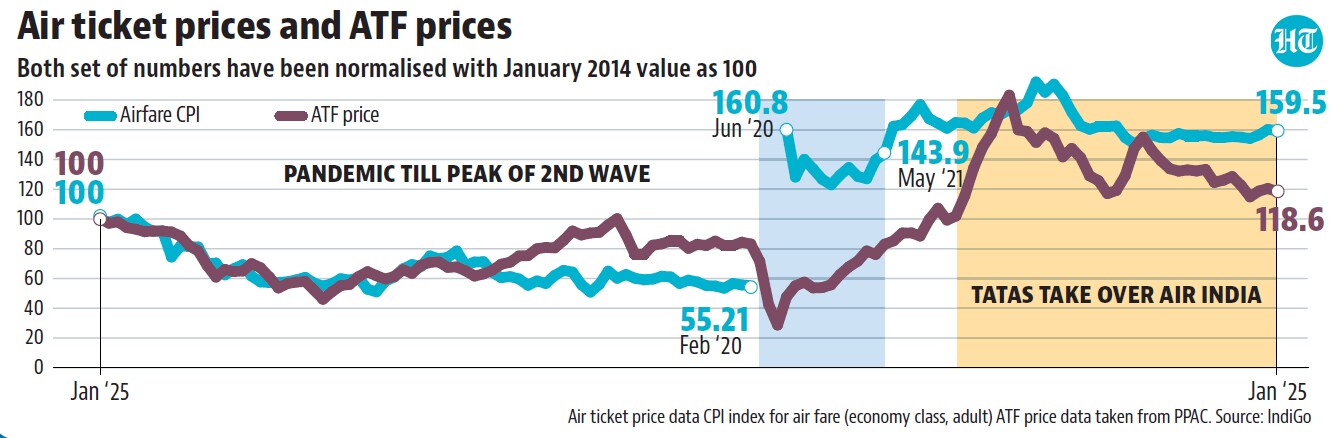
- Higher airfares in the recent past are despite low ATF pricesTheoretically speaking, airfares could have become higher because of higher input costs such as fuel. How have airfares and air fuel costs moved historically? One can answer this question by comparing air turbine fuel (ATF) prices and the airfare sub-component of the CPI. Pre-pandemic, airfares would not increase even when ATF prices went up. The sharp spike in airfares in the immediate aftermath of the pandemic was accompanied by an increase in ATF prices. While airfares did come down a bit when ATF prices fell subsequently, the two seem to have become delinked in the past year and a half with airfares staying flat despite a fall in ATF prices. It is important to underline the fact that domestic civil aviation has seen a significant increase in market concentration in the past couple of years after the Tata group acquired Air India. India now has a virtual duopoly in domestic aviation with only IndiGo and Air India (which now also runs Vistara) as the major players. To be sure, correlation (duopoly coinciding with airlines not bringing down airfares despite a fall in ATF prices) might not necessarily entail causation. But it is definitely worth flagging.
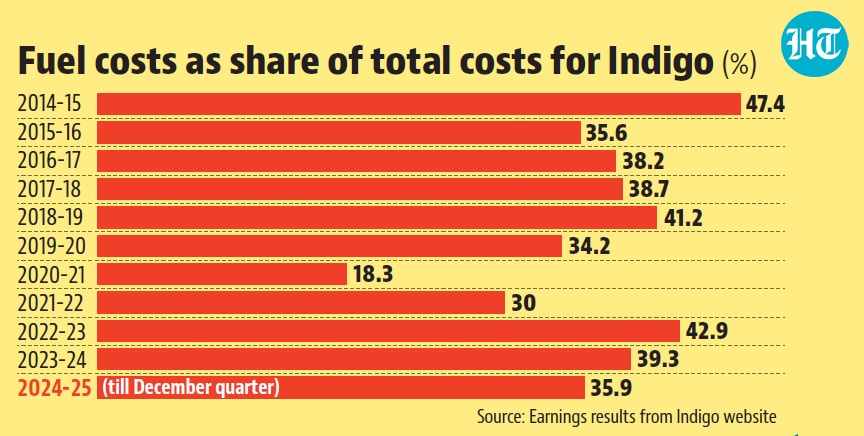
- Are fuel costs now less important for airlines?One could justify airfares not coming down despite low ATF prices if fuel prices have become a lower component of overall costs. India’s largest airline IndiGo publishes a break-up of its overall costs with and without the fuel component. A comparison of the trends from 2014-15 suggests that fuel costs saw a sharp fall in their importance during the pandemic – this is understandable given the fact that planes were stranded rather than flying – they have come back closer to historically normal levels in the recent past.
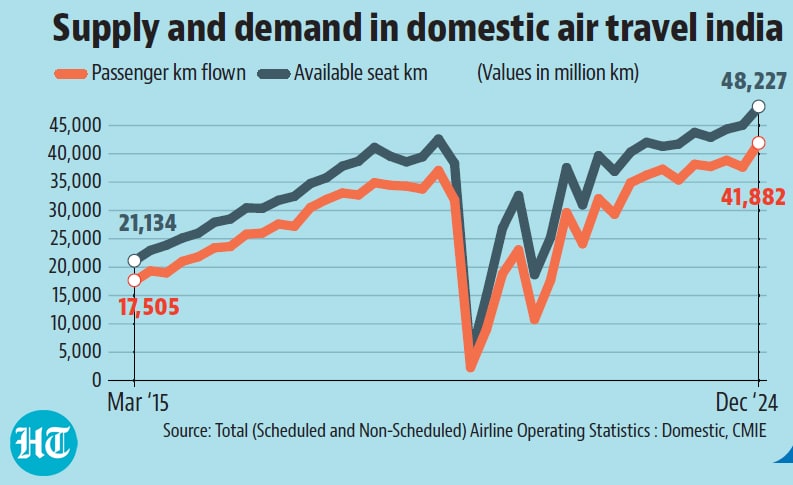
- Has civil aviation growth already peaked in India?The pre-pandemic period saw a sharp rise in demand and supply of domestic air travel in India. Data on passenger kilometres flown and available seat kilometres – best metrics for demand and supply of air travel – show this clearly. These numbers fell sharply during the pandemic, understandably so, and have recovered to their pre-pandemic levels. According to comparative data from the International Air Transport Association (IATA), India had the second highest growth in revenue passenger kilometres (RPK) – it is passenger kilometre flows – between 2019 and 2024, only behind China. However, the post-pandemic growth looks pretty muted when compared to the pre-pandemic trend in India.
- What we understand...The numbers given above raise an interesting question. India’s domestic aviation market is now more concentrated and growing at a slower pace than it was pre-pandemic. Is this a manifestation of higher airfares (data shows this unambiguously) crowding out new passengers? If true, this could be a textbook case of what economists describe as deadweight loss of monopoly where the market settles at a sub-optimal level. Or is it a reflection of the pandemic’s disruption cutting down a lot of business travel which has eaten into pre-pandemic demand? Has increased concentration helped airlines to not undercut each other in fare wars? These are questions beyond the scope of a simple journalistic analysis, but definitely worth engaging with in detail, perhaps by the ministry of civil aviation.


Unlock a world of Benefits with HT! From insightful newsletters to real-time news alerts and a personalized news feed – it's all here, just a click away! -Login Now!


