E-Paper



Number Theory: Are deaths by accidental fires rising in India?
Data from the World Health Organization’s Mortality Database shows that fire-related deaths in India are higher than a lot of countries.
Published on: May 29, 2024, 08:39:45 IST

 Prefer HTon Google
Share via


Copy link

The recent incidents of fire-related deaths at a children’s hospital in Delhi and a gaming arcade in Rajkot have brought to fore the glaring gaps in fire safety standards in the country. The magnitude of these tragedies notwithstanding, it is important to look at the macro trend when it comes to fire-related accidental deaths in India. The other important question to ask is how does our criminal justice system do when it comes to punishing people who might be responsible for such accidents. Here is what the data shows.

Are deaths by accidental fires rising in India?
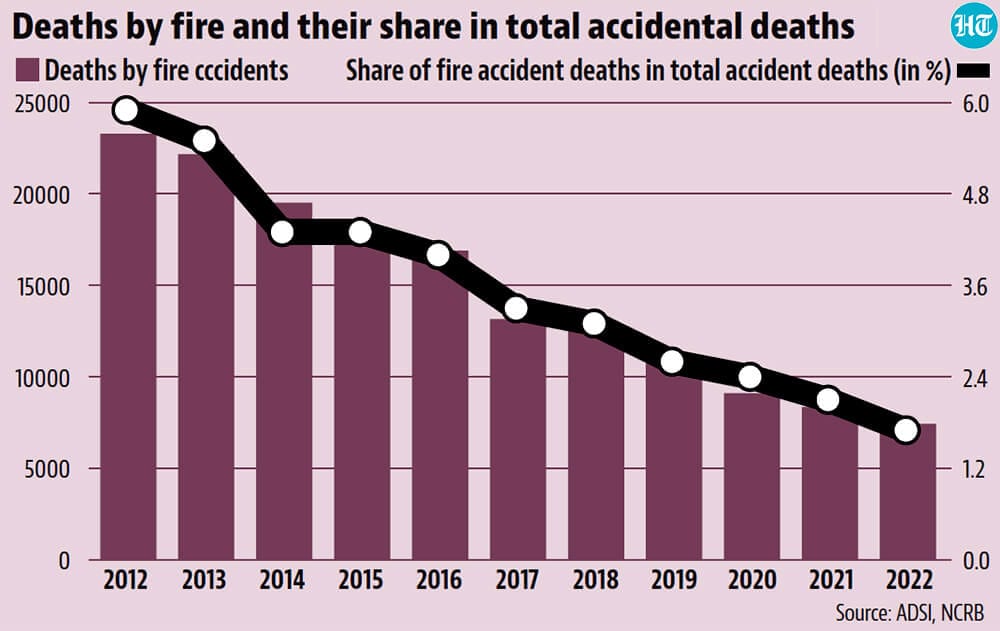
 Number of fire-accident deaths has fallen in the last decadeThe National Crime Records Bureau (NCRB), which works under the Union home ministry, publishes statistics on all accidental deaths in the country in its annual report on Accidental Deaths and Suicides in India (ADSI). The latest ADSI report gives data for 2022. Accidental deaths by fire are recorded separately in the report. The data shows that number of deaths in such fires has been falling almost consistently in the last decade. This number fell from 23,281 to 7,435 between 2012 and 2022 -- a year when accidental fires had a share of just 1.7% of total accidental deaths in India. The most commonly occurring cause in 2022 was traffic accidents which made up 45.1% of total accidental deaths. Past data shows that the share of accidental deaths by fire in total accidental deaths has also been falling in India.
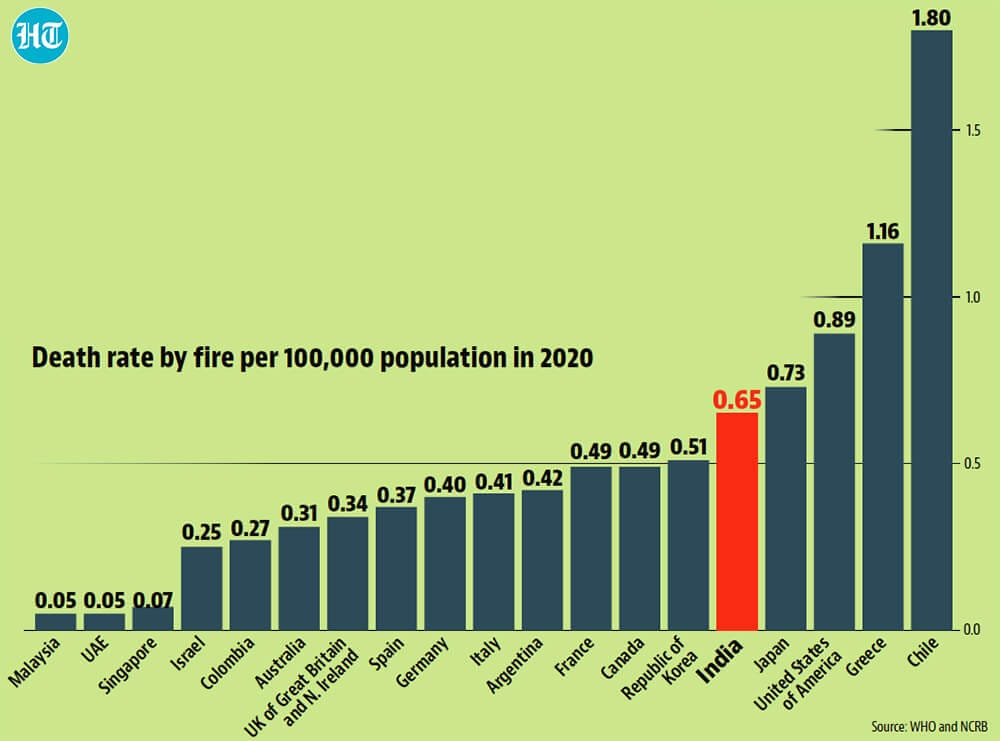
- How does India compare internationally in terms of fire-related deaths?To be sure, a fall in number of fire-related deaths does not necessarily mean an improvement in fire safety standards or such accidents being very low, as this could just be a result of fall from a high base. A good metric to judge this would be to compare population adjusted fire-related deaths in India with other large countries. Data from the World Health Organisation’s (WHO) Mortality Database shows that fire-related deaths in India are higher than a lot of countries but also better than some large countries including Japan and the US. The comparison has been made for 2020 because the WHO database does not have data for most large countries after 2020. To be sure, the WHO data counts deaths by fires in general, and not specifically for accidental fires, and does not give data for India. HT has adjusted the number of accidental deaths by fire from 2020 ADSI with India’s projected population for 2020 to make this comparison. While India’s numbers would be a slight undercount because it could exclude cases of death by arson, the difference is not expected to be very large.
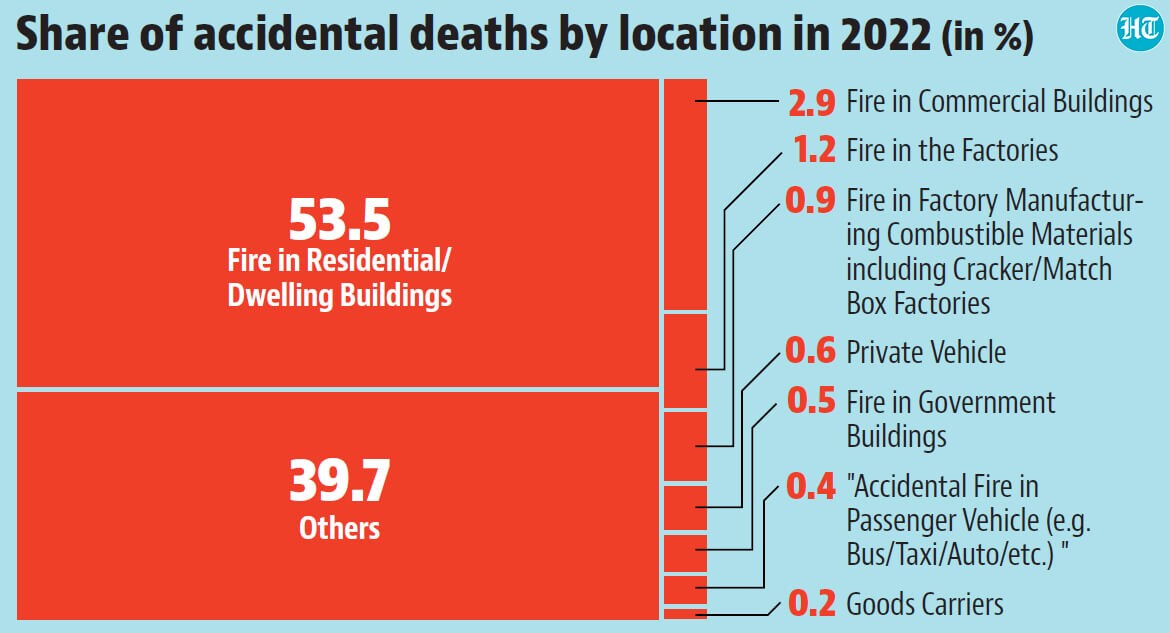
- Where do most fire-related accidents and accidental deaths happen in India?NCRB also provides data for cases of accidental fires by place of occurrence. In 2022, fire in residential/dwelling buildings accounted for over a half of the deaths by accidental fires. This was followed by fire in commercial buildings, which stood at 2.9% of total accidental fire deaths. For accidental fires in automobiles, private vehicles were the riskiest at 0.6% of deaths, followed by passenger vehicles such as buses and autos at 0.4%. Goods carriers had the least number of deaths at 0.2%. NCRB also includes data for fire in school buildings, fire in mines, and accidental fires in trains. The share of deaths for these three cases in total fire-related deaths was almost nil in 2022.
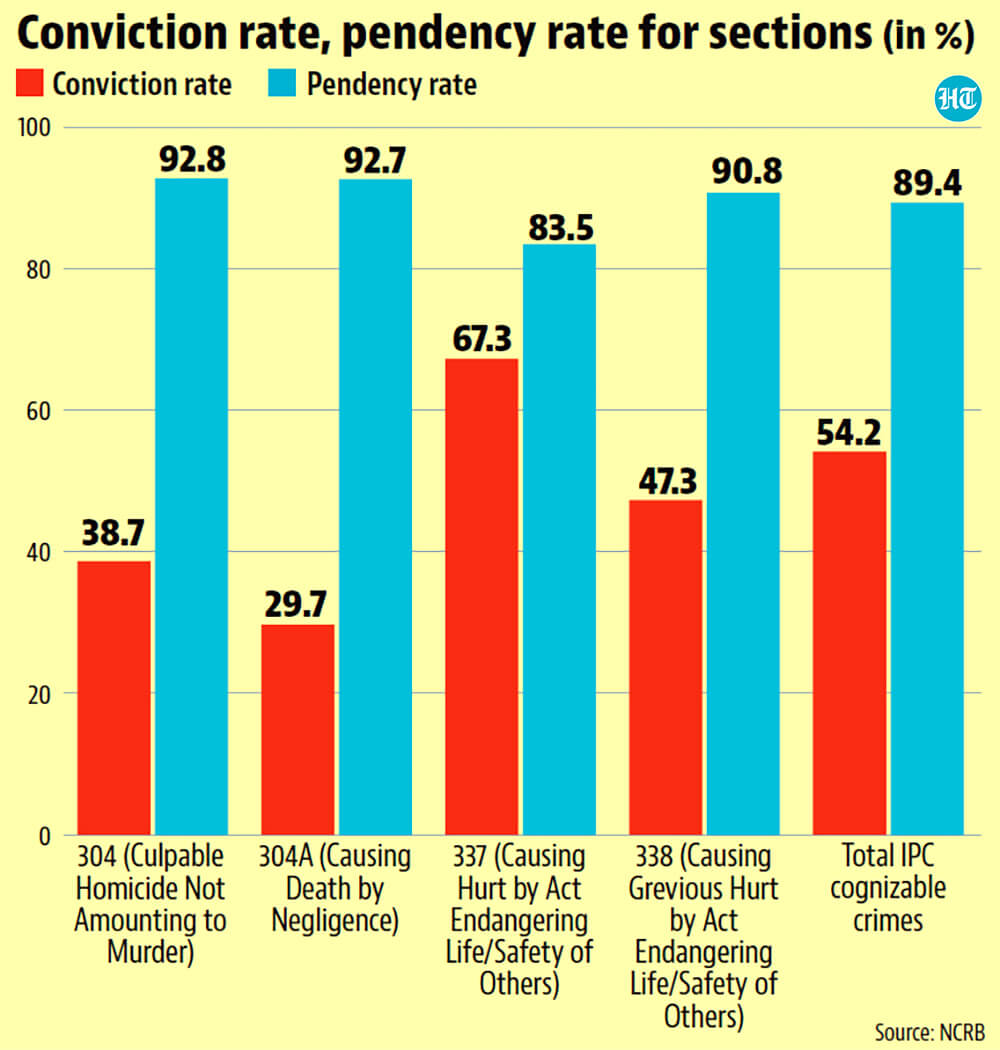
- How does the criminal justice system do in punishing people guilty of such accidents?In both the fire accidents in Delhi and Rajkot, the local police have filed charges against the accused under the Indian Penal Code (IPC) Sections 337, 338, 304, and 304A, among others. While these sections are not exclusive to fire-related accidents, statistics about the criminal justice system’s ability, or lack thereof, to do justice in such crimes can give us an idea about fixing responsibility for such cases. The conviction rate and pendency rate for these sections can also give us an idea about whether such convicts are punished, and the extent of delay in settling such cases. Conviction rate is defined as share of cases in which conviction happens in total cases for which trial was completed. Pendency rate is defined as cases pending at the end of the year divided by the sum of cases pending from last year and cases added in a given year. In 2022, the conviction rate was 38.7% for section 304, 29.7% for 304A, 67.3% for Section 337 and 47.3% for section 338. The conviction rate for total cognisable IPC crimes was 54.2%. The real problem, however, could be high pendency. The pendency rate of cases under sections 304, 304A, 337 and 338 stood at 92.8%, 92.7%, 83.5%, and 90.8% respectively in 2022. The pendency percentage for total cognisable IPC crimes in 2022 was 89.4%. To be sure, the data above is not related to only fire-related accidents. And the pendency percentage in the last couple of years could have become distorted because of the pandemic delaying regular court proceedings in 2020 and 2021.