E-Paper



Number Theory: Can Champai Soren help the BJP in Jharkhand polls?
If the BJP has to wrest Jharkhand back from the JMM, it needs to focus on the larger challenge of undoing the tribal consolidation behind the JMM.
Published on: Aug 30, 2024, 08:20:57 IST

 Prefer HTon Google
Share via


Copy link

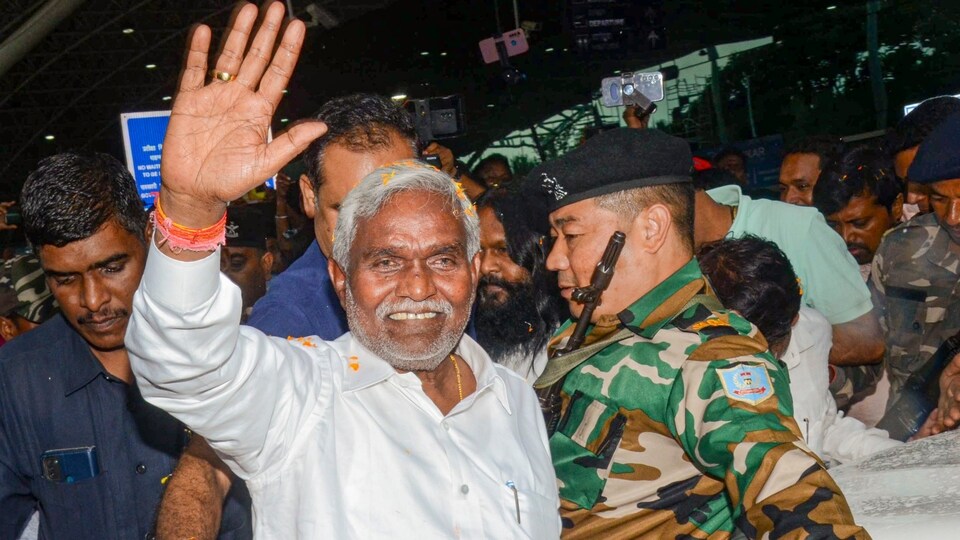
Former Jharkhand chief minister and senior Jharkhand Mukti Morcha (JMM) leader Champai Soren is set to join the Bharatiya Janata Party (BJP) on August 30. Champai Soren’s parting of ways with the JMM is the result of the party reinstating Hemant Soren as the chief minister when he was granted bail after being in jail for five months. Will Champai Soren’s recruitment help the BJP defeat the JMM and its allies in the state elections? Here are four charts that aim to answer this question.
Can Champai Soren help the BJP in Jharkhand polls?
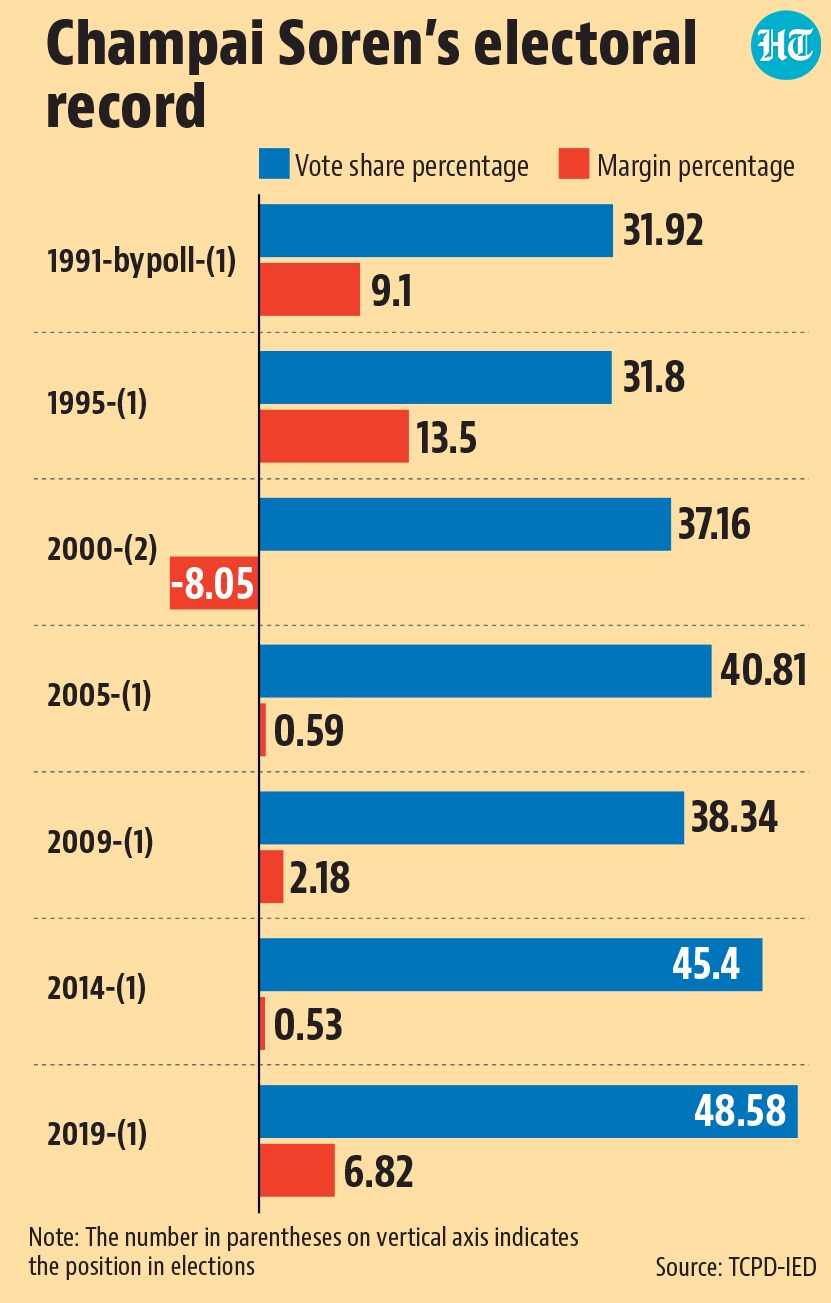
 What is Champai Soren’s own electoral record?Champai Soren is a veteran leader of the JMM and the movement of creation of Jharkhand as a state. Does this legacy mean that he is also an electoral heavyweight? The best way to answer this question is to look at Champai Soren’s electoral record. He has contested seven assembly elections so far: 1991 (bypoll), 1995, 2000, 2005, 2009, 2014 and 2019. The first three were held when Jharkhand was still a part of Bihar, and the latter four after it became a separate state. Champai Soren won his first two elections with a relatively comfortable margin, lost the third and just managed to pull through in 2005, 2009 and 2014 elections before increasing his victory margin again in 2019. In all these elections except in 1991, his main opponent was from the BJP, finishing second in all elections except 2000, which the opponent won.
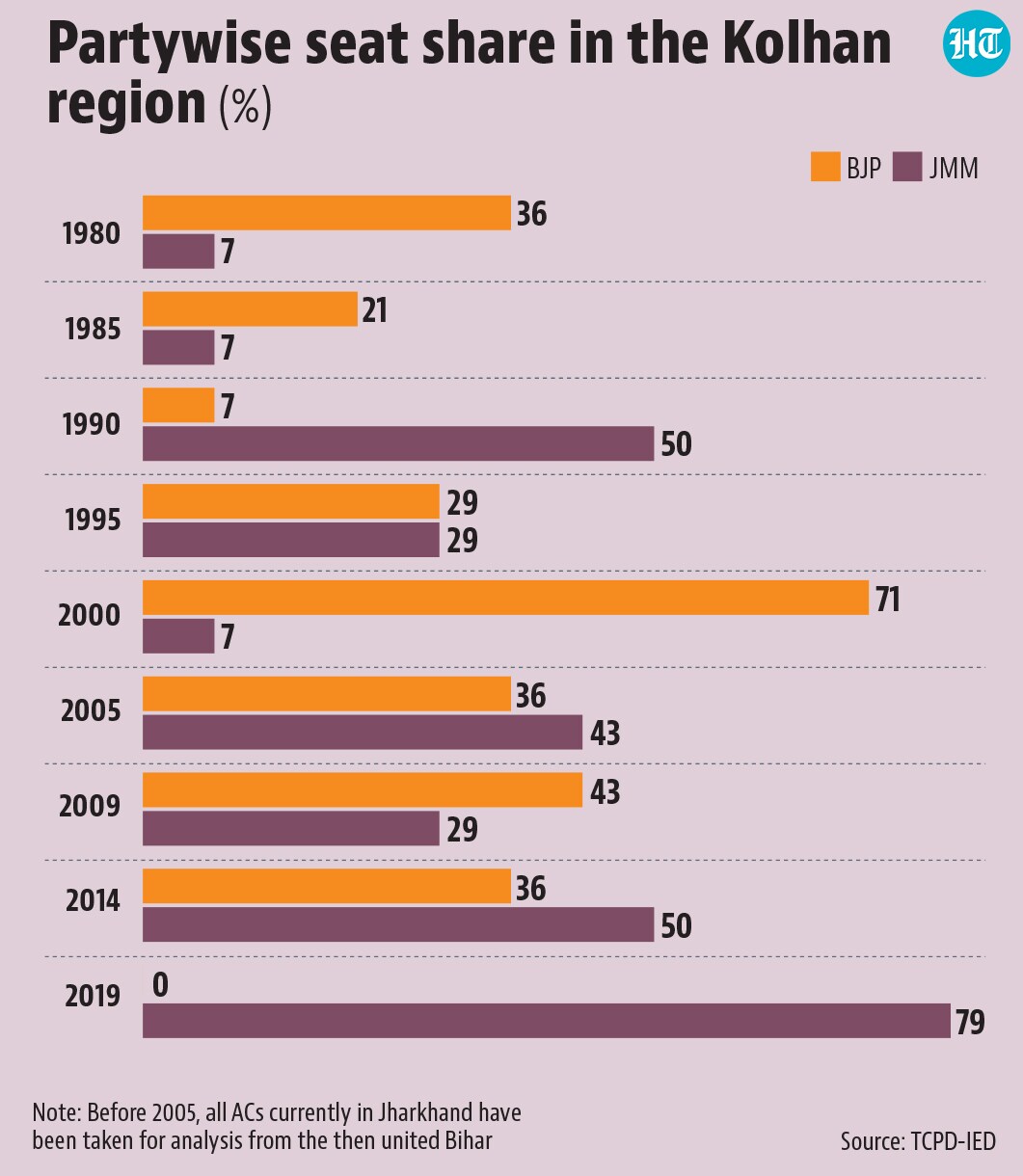
- Will Champai Soren joining the BJP hurt the JMM in the Kolhan region?Jharkhand’s electoral dynamics, like other states with significant tribal populations, depends on its political geography. Ashoka University’s Trivedi Centre for Political Data (TCPD) divides the state into five subregions. In ascending order of number of assembly constituencies, these are Palamu (9), Kolhan (14), South Chotanagpur (15), Santhal Pargana (18) and North Chotanagpur (25). Hemant Soren and his family, which has always led the JMM, come from the Santhal Pargana region in the state. Champai Soren comes from the Kolhan region which has the second highest share of Schedule Tribe (ST) population according to the 2011 census ( 41.96%). The share of ST population in other sub-regions of the state is 51.1%,28.1%,18%, and 9.5% in South Chotanagpur, Santhal Paragana, Palamu, and North Chotanagpur divisions, respectively. The JMM and its allies won 13 out of the 14 ACs in the Kolhan region in the 2019 assembly elections. The only other AC in the region, Jamshedpur, saw the sitting chief minister Raghuvar Das of the BJP losing to former BJP leader Saryu Rai, who contested as an independent. JMM’s performance in Kolhan region in past elections has fluctuated and the BJP has won more seats in the region in four out of nine assembly elections since 1980.
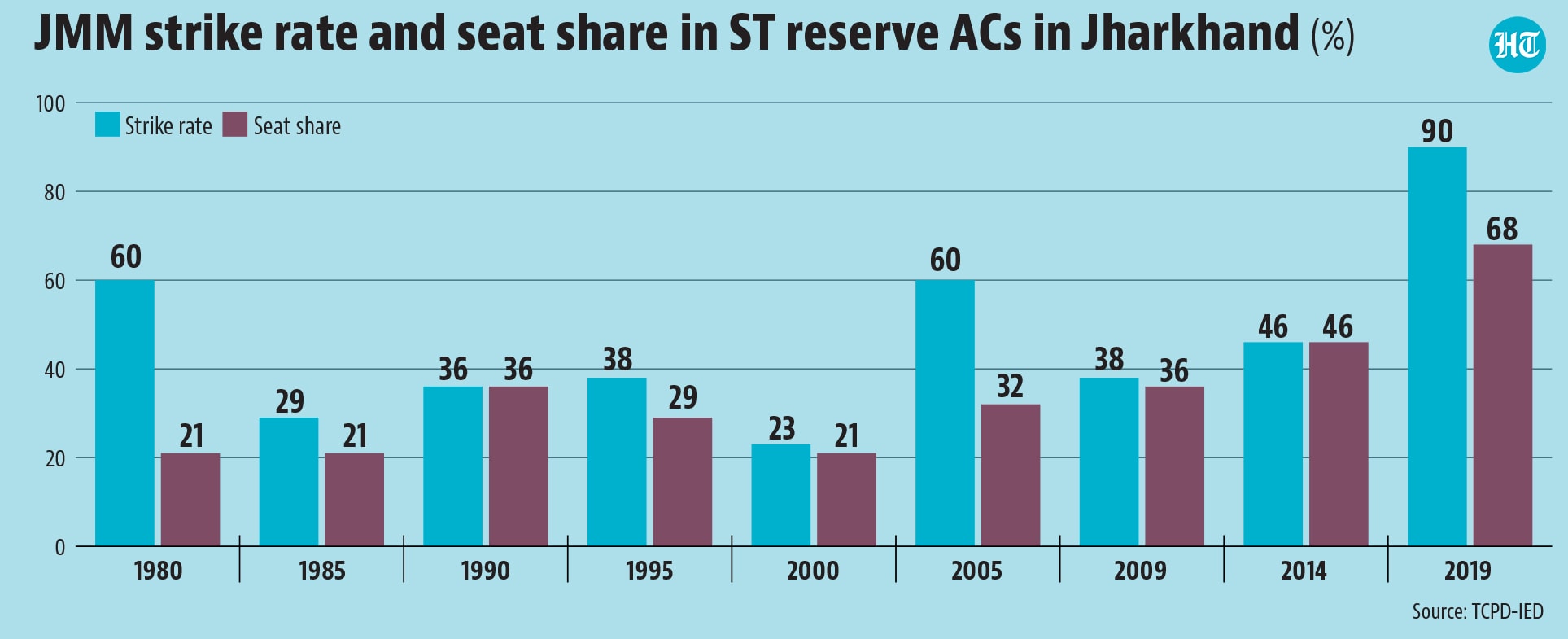
- JMM’s 2019 victory was a result of an exceptional performance in ST-reserved ACsThis is an important point to keep in mind while reading Jharkhand politics today. The biggest reason the JMM-led alliance won the 2019 elections in the state was its 89.3% strike rate in the 28 ST-reserved ACs in the state. In the remaining 53 ACs, the BJP and the JMM alliance were actually neck and neck in terms of seats with 23 and 22 wins respectively, with other parties winning the remaining eight. In fact, a long-term analysis of ST-reserved ACs in Jharkhand shows that the JMM’s performance in these in 2019 is its best ever. This suggests that the JMM’s 2019 landslide in ST-reserved ACs was more a result of a churn in state’s politics rather than the doing of some individual politician.
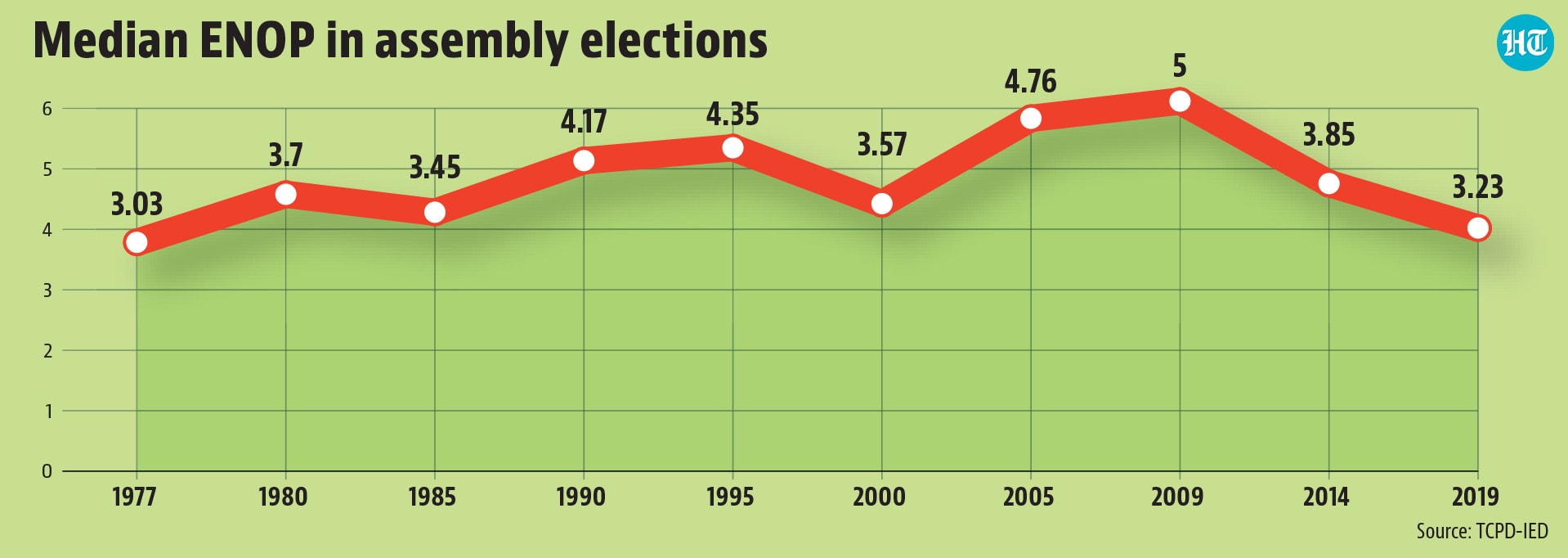
- BJP’s appointment of a non-ST CM in 2014 could have triggered a larger consolidation behind the JMM2014 were the first assembly elections in Jharkhand when a pre-poll alliance (BJP and All Jharkhand Students’ Union Party) managed to win a simple majority. However, this was also the first time in the state’s history when a non-ST became the chief minister . When seen in this backdrop, the JMM’s exceptional showing in ST-reserved constituencies in the 2019 assembly and 2024 Lok Sabha elections suggests a massive tribal consolidation against the BJP. This tribal consolidation might have helped the JMM . In fact, a comparison of median ENOP for Jharkhand shows that 2019 was the least fractured election in the state after 1977 with median ENOP value being the lowest. ENOP is the reciprocal of the sum of squares of the vote share of all candidates in a constituency, and a higher value indicates greater political fragmentation in the elections. For example, if there are four candidates in a constituency and they receive 26%, 25%, 25%, and 24% of the votes, the ENOP value will be 3.99. If these vote share numbers change to 50%, 45%, 3%, and 2%, ENOP will fall to 2.2.
- What we understand...If the BJP has to wrest Jharkhand back from the JMM, it needs to focus on the larger challenge of undoing the tribal consolidation behind the JMM which is also helping it unit the wider anti-BJP universe. If this consolidation was a result of the BJP’s own decisions, then it is unlikely that just inducting Champai Soren will do the job .