E-Paper



Number Theory: Can Congress stage a comeback in Haryana?
The BJP’s vote share in the 2019 Lok Sabha elections in Haryana was a massive 58%, the second highest in the history of the state.
Updated on: May 24, 2024, 09:08:01 IST

 Prefer HTon Google
Share via


Copy link

The Bharatiya Janta Party (BJP) won all 10 parliamentary constituencies (PCs) in Haryana in 2019. Can it replicate this victory in 2024? Can the Congress make a comeback in the state? Here are four charts which try and answer this question.
Can Congress stage a comeback in Haryana?
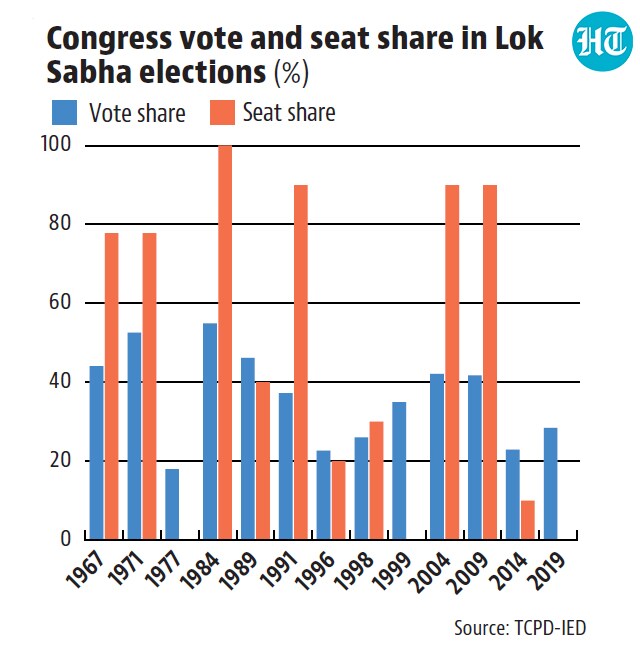
 2019 was not the worst election for the Congress in HaryanaThis is the most important aspect to keep in mind while discussing the Congress’s prospects in the 2024 elections. The Congress could not win even one PC in Haryana in 2019 despite managing a vote share of 28.4% in the state. However, an analysis of past results in the state shows that the 2019 polls were not the worst elections for the party in Haryana in terms of vote share or seat share. The Congress failed to win any Lok Sabha seat in Haryana in the 1977 and 1999 elections as well. Its lowest vote share in the state came in the 1977 Lok Sabha elections -- just 18%. Even in the 1996 and 1998 elections, the Congress’s vote share was lower than what it managed to get in 2019. The Congress recovered from these upsets to win nine of the 10 Lok Sabha seats in the state in the 2004 and 2009 elections. The question is, can the Congress make a similar recovery from its 2014 and 2019 debacle?
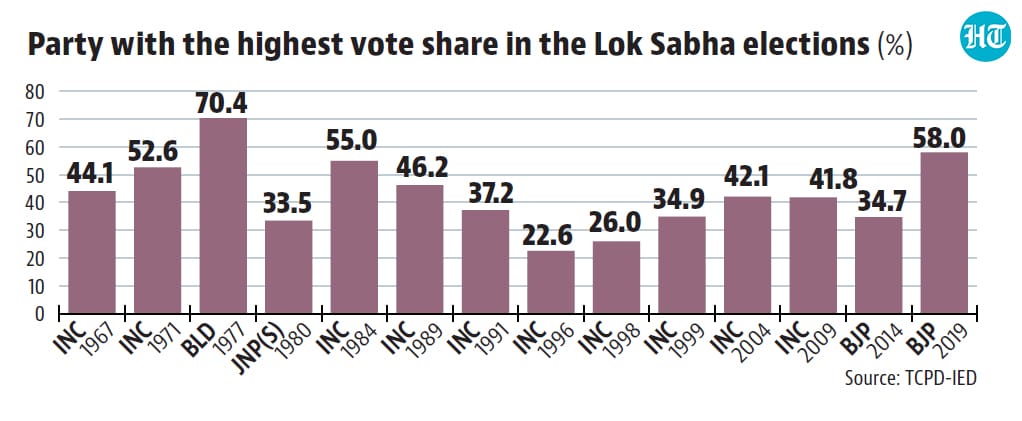
- But the BJP’s scale of victory was massive in 2019The BJP’s vote share in the 2019 Lok Sabha elections in Haryana was a massive 58%. This is the second highest vote share in the history of the state, except the 70.3% vote share of the Janata Party (Officially Bhartiya Lok Dal) in the 1977 elections. Even the Congress’s clean sweep in the aftermath of Indira Gandhi’s assassination came with a vote share of just 55%. What is even more remarkable is the fact that the BJP made a huge gain in its vote share between the 2014 and 2019 Lok Sabha elections. The biggest question facing the BJP is whether its 2019 vote share in Haryana was symptomatic of the Narendra Modi wave across the country or an organic reflection of an expansion in the BJP’s support base.
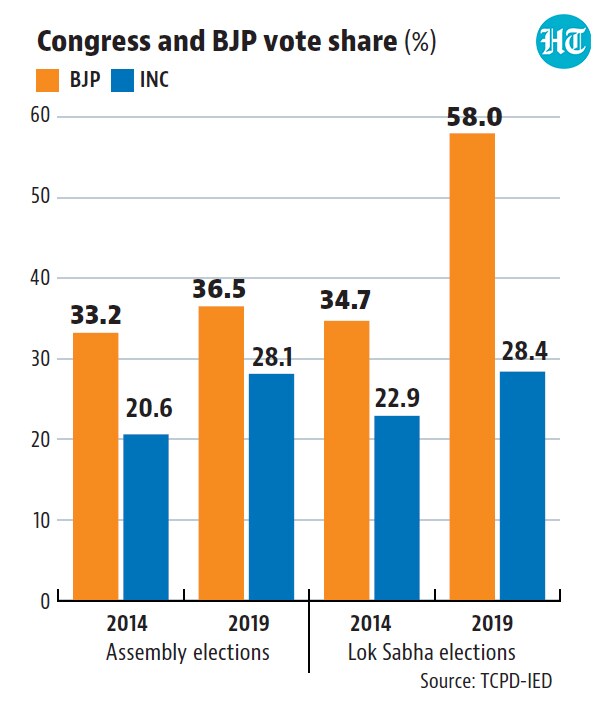
- The 2019 assembly election results underlined the BJP’s vulnerabilitiesThe BJP increased its vote share by 3.3 percentage points between the 2014 and 2019 assembly elections in Haryana. But its assembly tally fell from 47 to 40 in an assembly of 90 MLAs. The Congress increased its tally from 15 to 31 by increasing tis vote share from 20.6% to 28.1% in the state. While the Congress was still eight percentage points behind the BJP in terms of vote share in the 2019 assembly elections, it managed to achieve some sort of a consolidation of anti-BJP votes in the state. Recent developments such as the breakdown of the alliance between the BJP and the Jannayak Janata Party (JJP) and three independent MLAs withdrawing support from the BJP government in the state could generate further tail winds for this process -- unless the BJP sees a jump in its Lok Sabha vote share over and above what it managed in the last assembly elections.
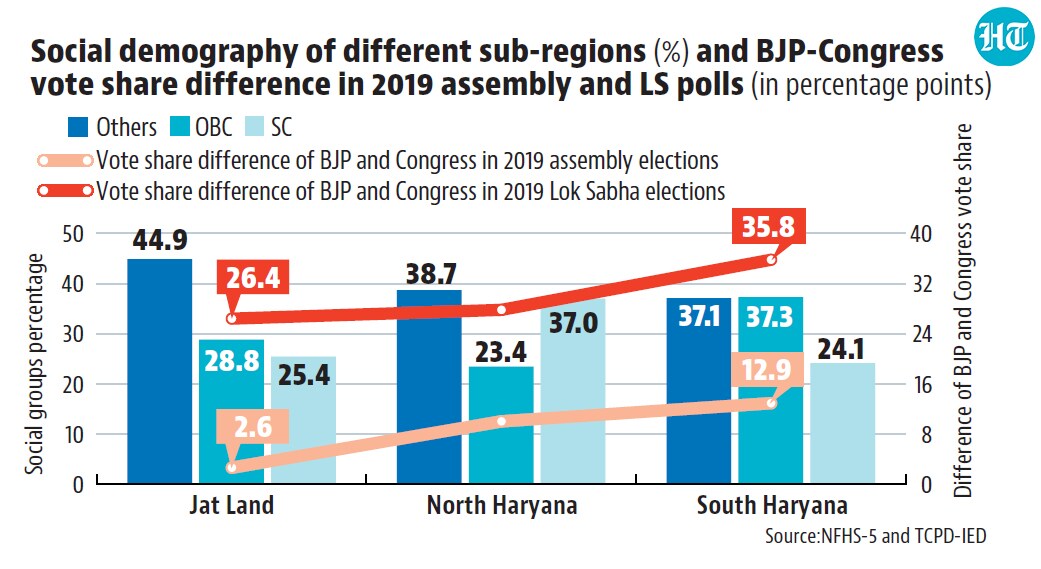
- This is why regional and social dynamics will matter a lot in 2024The Trivedi Centre for Political Data at Ashoka University classifies Haryana into six broad regions: Ahirwal, Jat Land, Jat Sikh Land, Ambala, Mewat, and the National Capital Region (NCR). HT has combined these categories to form three subregions: North Haryana, South Haryana, and Jat Land. The North Haryana subregion has four PCs -- Ambala, Kurukshetra, Hisar and Sirsa. South Haryana and Jat Land have three PCs each with Bhiwani-Mahendragarh, Faridabad and Gurgaon in the former and Karnal, Rohtak and Sonipat in the latter. While the Congress lagged behind the BJP in each of these regions in the 2019 Lok Sabha and assembly elections, the gap was much smaller in the Jat Land subregion than in the other two. When read with the social demography data from the 2019-21 National Family and Health Survey, it suggests that the Congress’s success, or lack of it, in these elections will depend on its ability to bring non-Jat voters to its fold.