E-Paper



Number Theory: Charting monetary policy since formation of MPC
.
Published on: Oct 10, 2024, 22:19:46 IST

 Prefer HTon Google
Share via


Copy link

The 49th meeting of RBI’s Monetary Policy Committee (MPC) ended on November 9. The committee arrived at a unanimous decision to change the policy stance from withdrawal of accommodation to neutral, and decided to keep the policy or repo rate unchanged by a majority of 5-1. Most analysts expect RBI to cut the interest rate when it meets next during December 4-6. Until that happens, it may be useful to recap India’s monetary policy after the adoption of a formal inflation targeting framework which led to the setting up of MPC. Here are four charts which explain this in detail.
RBI monetary policy
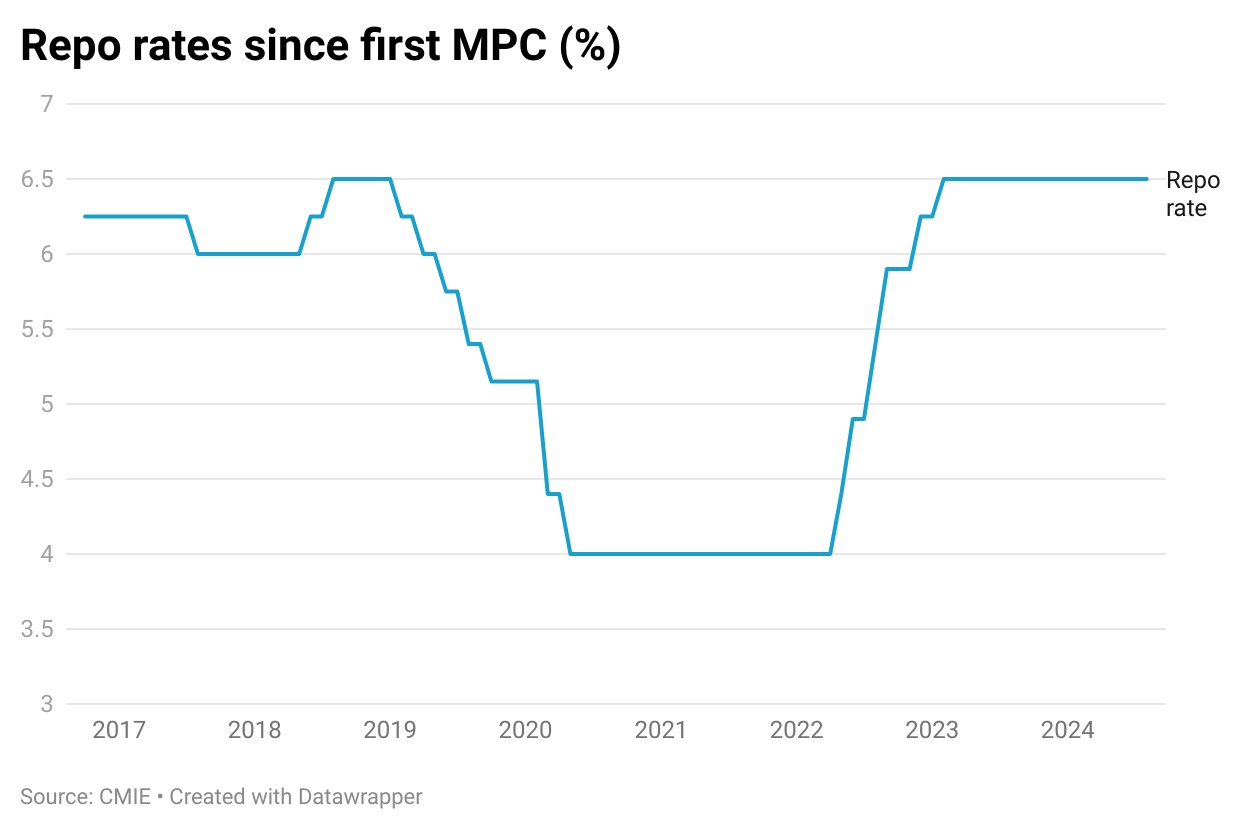
 Policy rates are at their highest since the formation of MPCThe first MPC meeting took place in October 2016. Between then and now, the highest value that the interest rate has taken is 6.5%, which is where it has been since February 2023. In fact, a monetary tightening phase began only after the inflationary spike following the pandemic and the Russia-Ukraine war and MPC had previously been cutting rates to, first, support decelerating growth before the pandemic, and then, manage the massive disruption caused by the pandemic and the lockdown. As is to be expected, this is also the longest phase of the policy stance being focused on the withdrawal of accommodation. To be sure, the policy rate has been higher in the past when there was no MPC or formal inflation-targeting agreement in place. It climbed to 8% in 2014, in the aftermath of a worsening of macroeconomic indicators in India and taper tantrum fears triggered by the US Federal reserve.
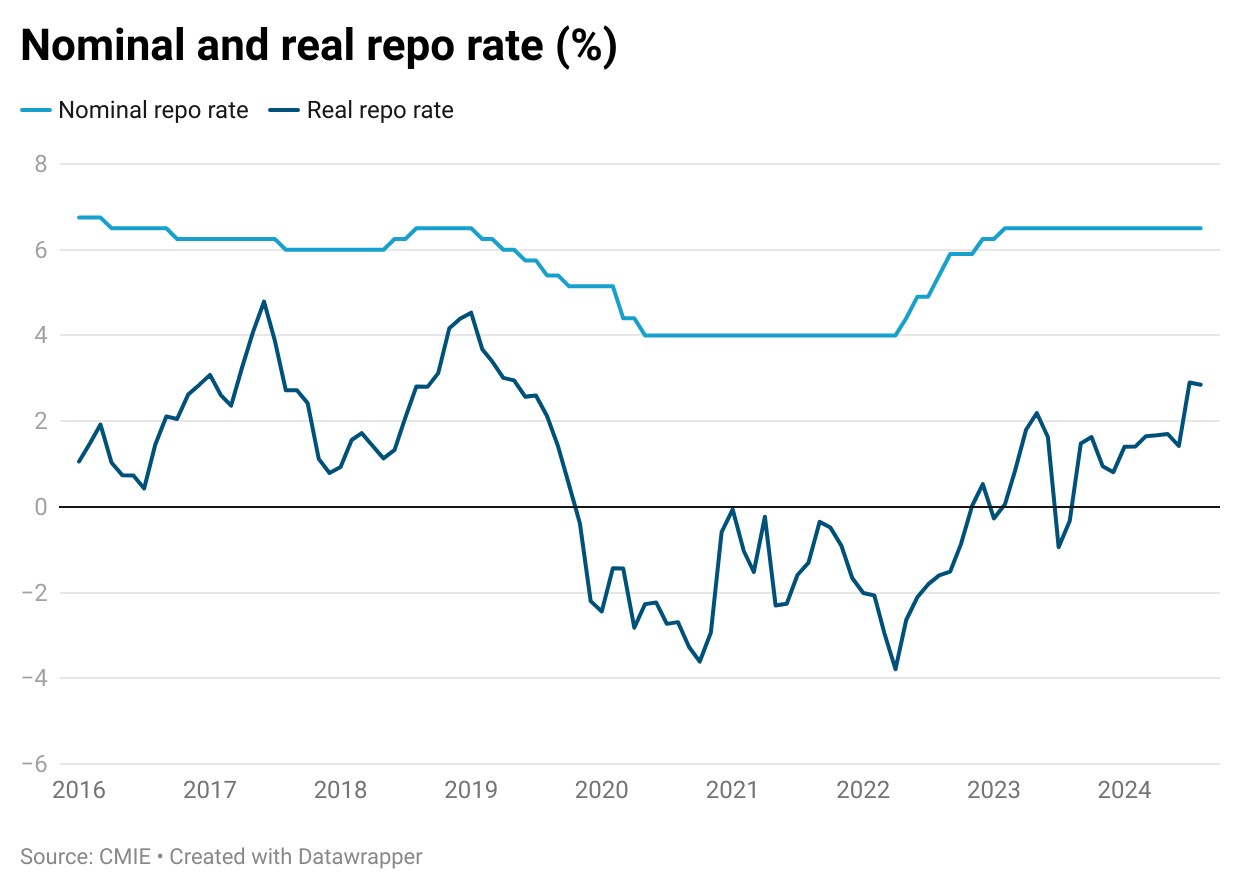
- But the story is slightly different when it comes to real ratesLike all things money, interest rates too are sensitive to inflationary fluctuations. At any given value, higher inflation would mean that the real interest rate would be lower than the nominal rate . In fact, keeping real interest rates, and therefore cost of borrowing and investment stable, is one of the biggest rationales of inflation targeting regimes. If one were to use the benchmark inflation rate, as measured by the Consumer Price Index (CPI) to look at the real policy rate, the picture of the recent period seeing the highest interest rates changes somewhat. The real policy rate, which we arrive at after adjusting the repo rate for inflation, has been much higher in the past. It was the highest in June 2017, at 4.8%, when the repo rate set by MPC was 6.25%. So while the real repo rate in July and August (these are the last two months for which there is inflation data) was the highest it has been since May 2019, when it was 2.95%, this is not the highest in MPC’s history as is the case for the nominal repo rate.
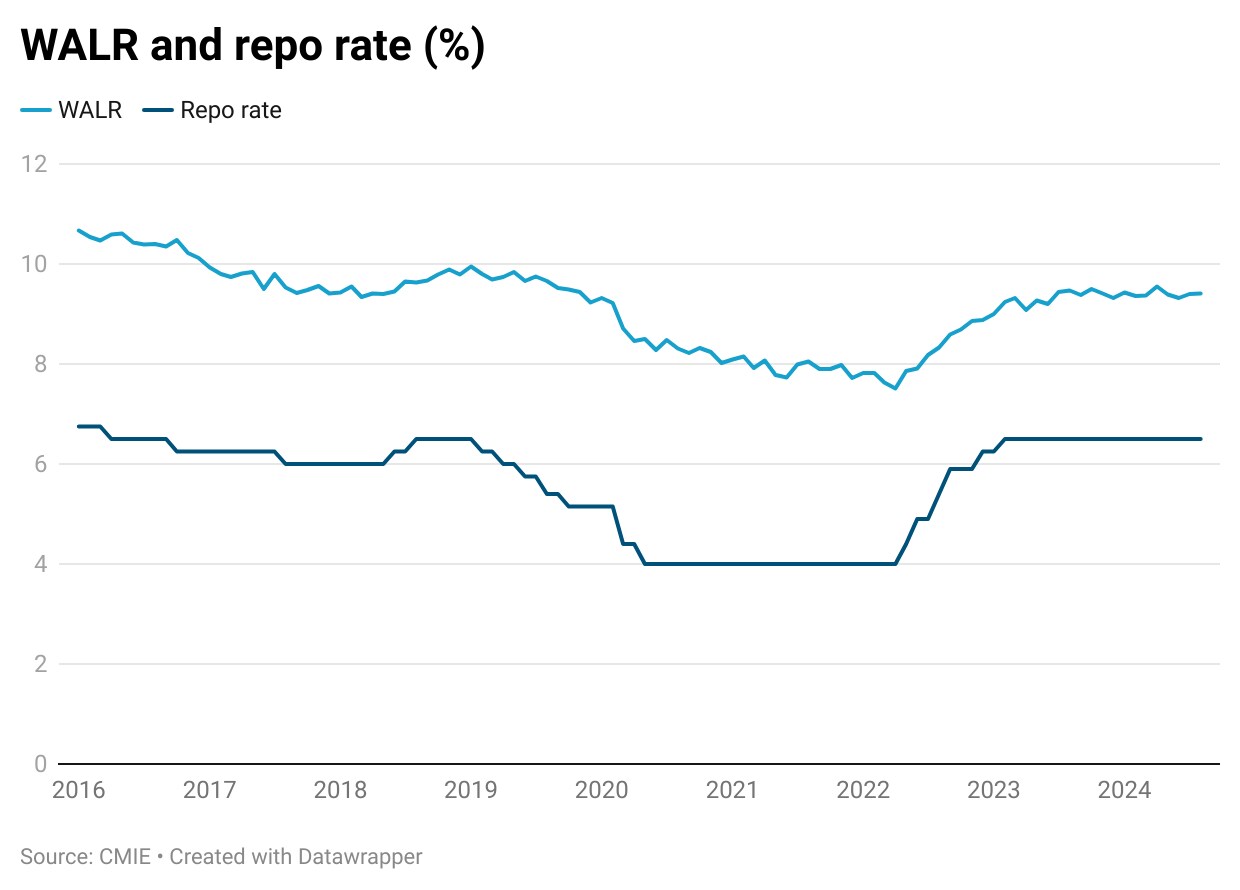
- And then there is the transmission from policy rates to retail interest ratesThis is another important aspect of how monetary policy works. The repo rate is the interest rate at which the central bank gives funds to commercial banks. The latter then decide at what rate they give these funds to the actual borrowers who use this money for consumption or investment purposes. While there is always more than one interest rate in the retail banking sector, a comparison of weighted average lending rates (WALR) of scheduled commercial banks on fresh rupee loans shows that they kept increasing even after RBI stopped raising the repo rate in February 2023. The pace of this transmission effect – how retail interest rates change when the policy rate changes – is among the most important parts of the functioning of inflation targeting via the monetary policy route .Sometimes banks do make a windfall gain when they hold back on transmitting lower policy rates to consumers or do not increase deposit rates while raising borrowing rates. For example, a Financial Times story from September said that US banks made a windfall of a trillion dollars by holding back deposit rates while increasing loan costs during the high interest rate regime of the Federal Reserve. To be sure, borrowing rates are determined by other important things such as risk profile of borrowers and sectors rather than just the policy rate.
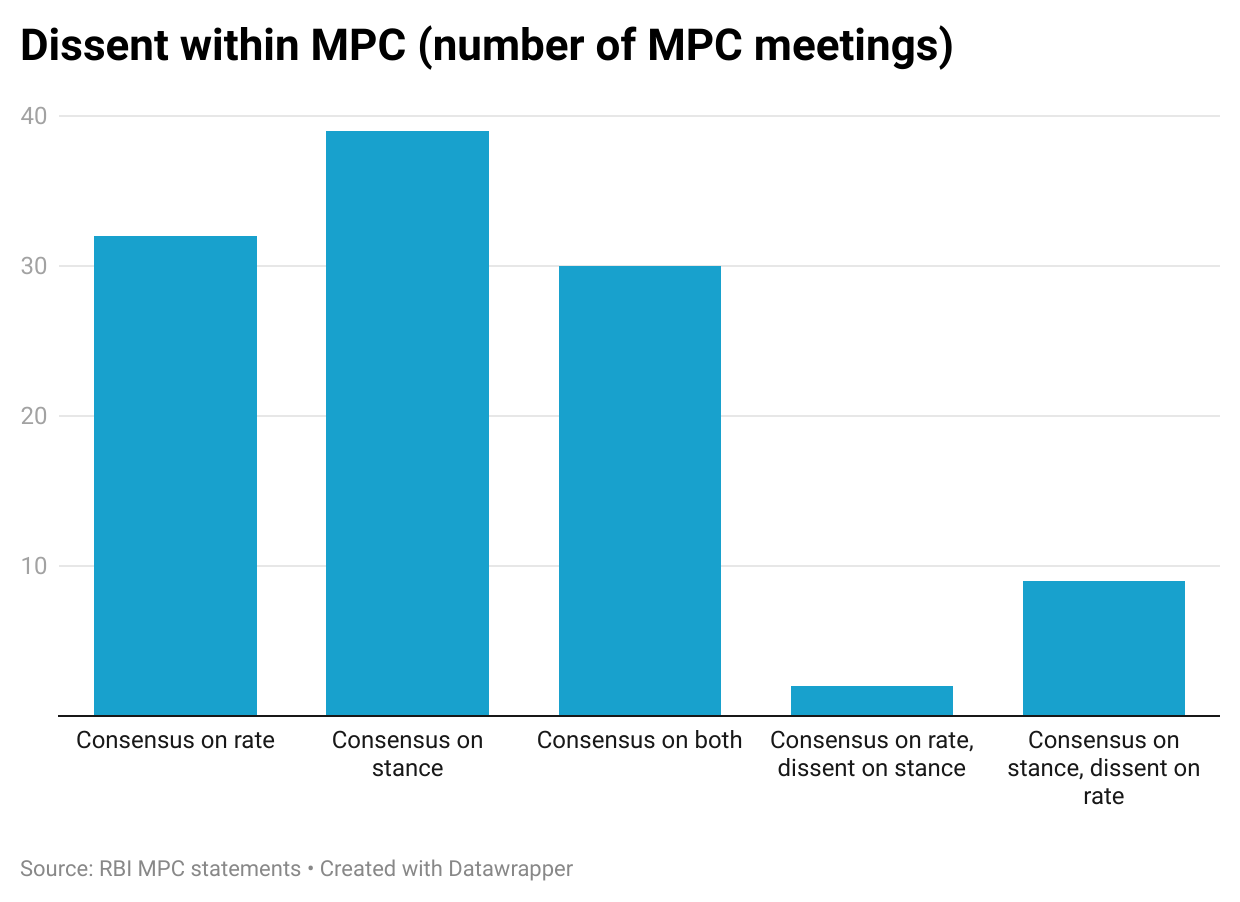
- MPC has mostly been a less divided houseIndia’s inflation targeting framework provides for a MPC of six members where three are from within RBI and another three are independent experts nominated by the ministry of finance. The idea is to promote an institution-agnostic and diverse discussion within the committee. Each MPC sees a decision on two questions: policy rate and policy stance. Of the 49 meetings held so far, 30 have seen a consensus on both the policy stance and policy rate. Individually, there was consensus on stance and rate in 39 and 32 meetings. Two meetings had a consensus on rate but a dissent on stance and nine had unanimity on stance but not rates. The maximum number of members who have dissented is two. To be sure, members sometimes express reservations on stance or ask for a bigger rate change even when voting with the majority. In five meetings with a consensus on rate, members asked for a different magnitude of change. In the August 2017 meeting, only one member dissented, but another member asked for a bigger rate cut. Similarly, while members have dissented on stance in only 10 meetings, they have expressed reservations about it in another 10.