
 E-Paper



Number Theory: Delhi Budget 2025-26 – What to look out for
.
Published on: Mar 25, 2025, 08:33:57 IST

 Prefer HTon Google
Share via


Copy link

The newly elected Bharatiya Janata Party (BJP) government in Delhi will present its first budget today (Tuesday, March 25). Because Delhi was ruled by the Aam Admi Party (AAP) government for the past ten years, the budgetary exercise assumes special significance. Will the BJP make a departure from AAP’s budgetary priorities? What are the political and economic imperatives facing the national capital? How important is the Delhi budget to the city-state’s economy? Here is what the data shows.
Delhi Budget 2025-26 – What to look out for
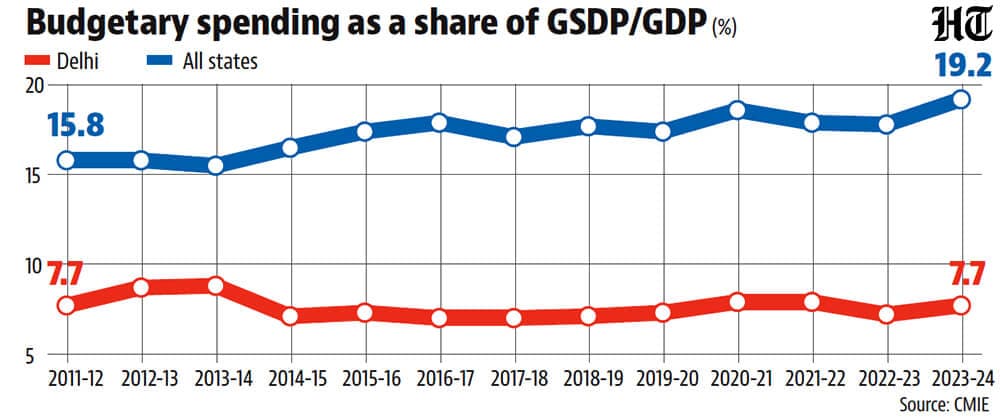
 As a share of GSDP, Delhi’s budgetary spending is much smaller than an average state’sThe importance, or lack of it, of a budget is best determined by looking at the proportion of budgetary spending in the overall economy. Centre for Monitoring Indian Economy (CMIE) database has latest GSDP number for Delhi for 2023-24. Delhi’s budgetary spending in 2023-24 was 7.7% of its nominal GSDP in 2023-24. This number has varied from around 7% to 9% between 2011-12 and 2023-24. The share of budgetary spending in Delhi GSDP is significantly lower than what it is for combined spending by all states. For all states combined, budgetary spending was almost one-fifth of total GDP in 2023-24. To be sure, an important reason for Delhi’s budgetary spending being lower than other states’ as a share of GDP is reflection of the fact that Delhi is a union territory (UT) and the union government takes care of a lot of its spending requirements.
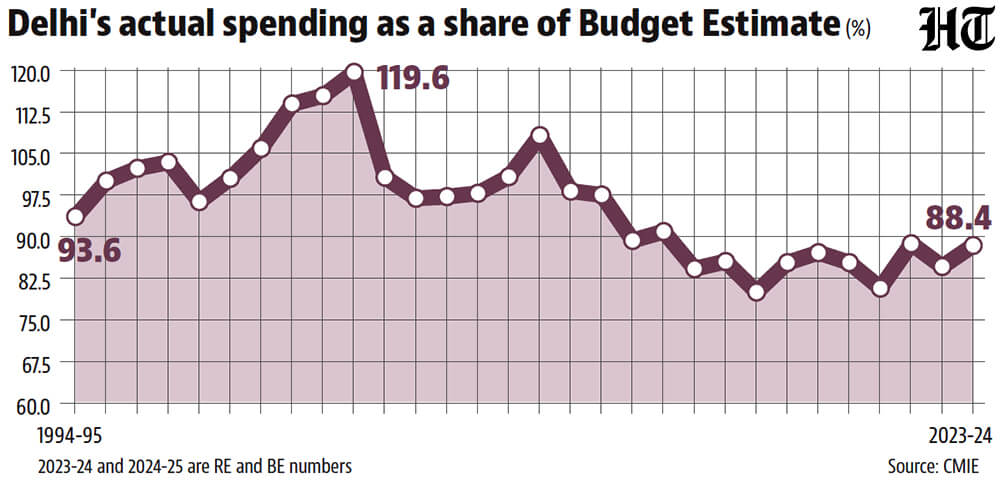
- However, the Delhi government has not even been spending its budgeted amounts for a long time nowA comparison of Delhi government’s actual spending with the budget estimate numbers shows that there has been a large (positive) gap between the latter and the former. While this existed even before AAP came into power in Delhi, it has increased in the AAP era. To be sure, this could be a result of the fact that the AAP government in Delhi and the union government, which had a lot of administrative control over the Delhi government, did not get along and the friction prevented the money from being spent . Hopefully, this will not be the case with the same party running the government in the UT and the Centre.
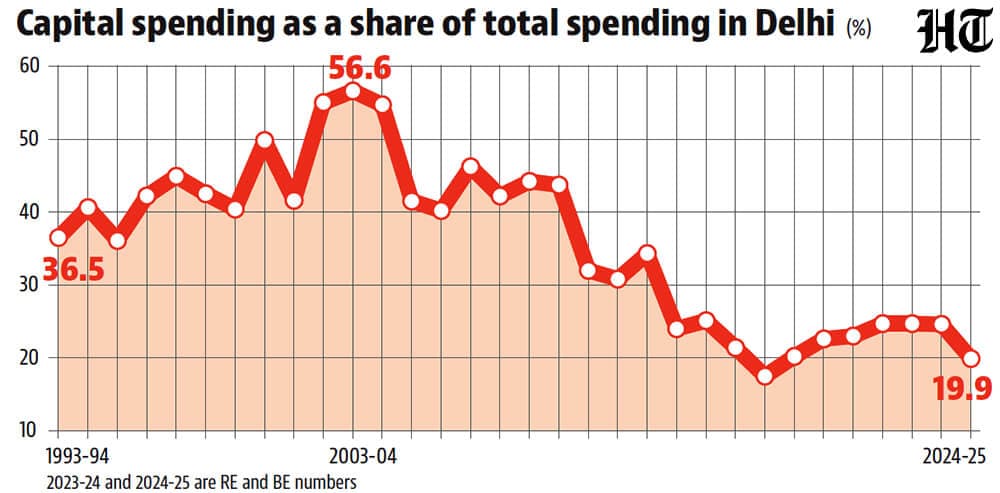
- Delhi’s falling capital spending has to be seen in the context Delhi’s inequalityThat Delhi’s civic infrastructure is inadequate to cater to its more than 20 million people, and in a state of disrepair is obvious to anyone who lives here. Rejuvenation of infrastructure requires a boost to capital spending in the budget. However, it is exactly this head which has seen a large fall in Delhi’s budget, a trend which started earlier but gained momentum under the AAP government.
- What explains this policy decision to underinvest in Delhi’s infrastructure requirements?Political survival seems to be the answer. While Delhi is among the richest states/UTs in India, it is also extremely unequal in nature where a large part of the population is anything but economically secure. It is this cohort -- increasing in number because of migration to the national capital from the poorer states -- which has gained more and more salience in the political calculus of Delhi. Delhi had the highest Gini coefficient in the 2022-23 consumption expenditure survey, the first such survey which was conducted and had results published after the 2011-12. In 2011-12, Delhi had the seventh highest consumption expenditure Gini in the country. Gini coefficient is a measure of inequality which can take values between zero and one where zero represents perfect equality and one perfect inequality. To be sure, Delhi’s Gini coefficient has fallen between 2011-12 and 2022-23 and the rise in its ranking is a result of other states seeing a bigger fall in inequality over this period. Because the CES does not really capture the rich, Delhi’s actual consumption and income inequality is likely to be much higher. It is this inequality which AAP exploited to capture power in Delhi by spending on welfare/populist schemes at the cost of investment.
- Whether or not the BJP will now tread a different path and strike a balance will decide whether the city’s infrastructure gets a much needed rejuvenation.


Unlock a world of Benefits with HT! From insightful newsletters to real-time news alerts and a personalized news feed – it's all here, just a click away! -Login Now!


