
 E-Paper



Number Theory: Four things which will decide Delhi results
.
Updated on: Feb 7, 2025, 18:45:44 IST

 Prefer HTon Google
Share via


Copy link

The counting of votes for Delhi assembly elections will take place tomorrow. Will the Aam Aadmi Party (AAP) come to power for the third consecutive time in the Union territory? Will the Bharatiya Janata Party (BJP) be able to dislodge the AAP in these elections? Here are four questions which will decide the election results.
Four things which will decide Delhi results
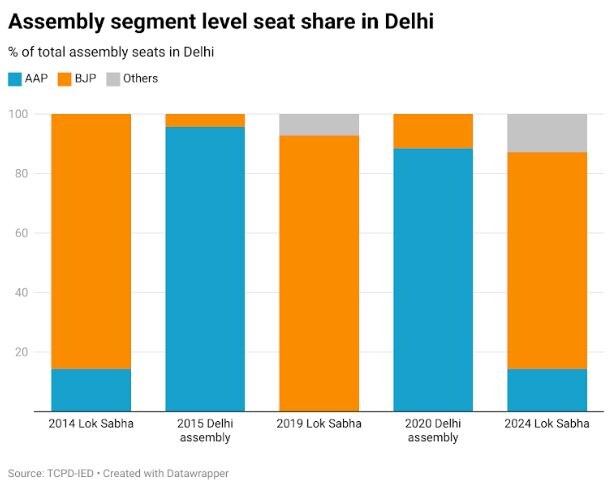
 Will AAP’s advantage in assembly elections continue in 2025?This is the most important factor which will decide the results. Despite overwhelming victories in the 2015 and 2020 elections, the AAP has failed to win even one out of seven parliamentary constituencies (PCs) in all three Lok Sabha elections it has contested in Delhi either on its own or in an alliance. This clearly shows that a large section of the electorate has been voting for the AAP in assembly elections and the BJP in Lok Sabha elections. The AAP’s victory or defeat in today’s results will depend on whether or not this cohort of voters continues with this exceptional behaviour.
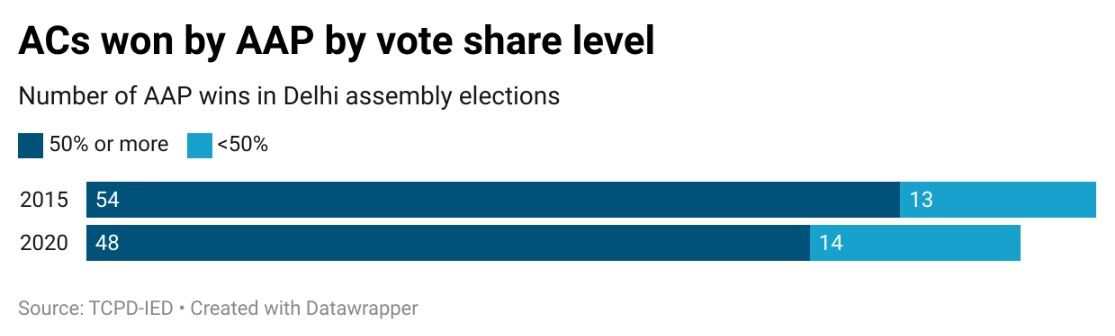
- Will AAP’s staggering 50%-plus vote share erode?The party has had a vote share over 50% in the last two assembly elections. Indeed, the AAP’s average vote share of 50% is not something which is a result of it performing disproportionately well in a handful of ACs. It had a vote share of at least 50% in 54 and 48 assembly constituencies (ACs) in 2015 and 2020. Unless these voters decide to leave the AAP for another party, there is no way the AAP can lose the 2025 elections.
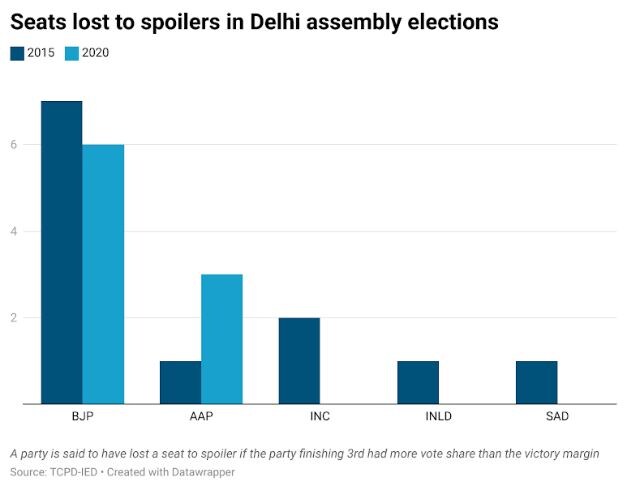
- Will Congress and others hurt the AAP this time?The 2025 contest in Delhi is essentially bipolar with the AAP and the BJP being the major challengers. Can any other party, including the Congress, hurt the AAP in these elections? In 2015 and 2020, there were 12 and 9 ACs in Delhi where spoilers were a factor. A spoiler is defined as a candidate in the third position finishing with a vote share greater than the victory margin. Nine of the 12 spoiler candidates in 2015 were from the Congress and eight of nine in 2020 were from the Congress. The BJP lost seven and six seats to spoilers in 2015 and 2020 compared to the AAP’s one and three seats. Put otherwise, the Congress hurt the BJP in 2015 and 2020. If such BJP candidates who lost to other parties playing spoiler were to receive even a small fraction of the AAP’s earlier vote, or if the AAP were to lose some of its vote to third players, it could suffer significant damage in terms of seats.
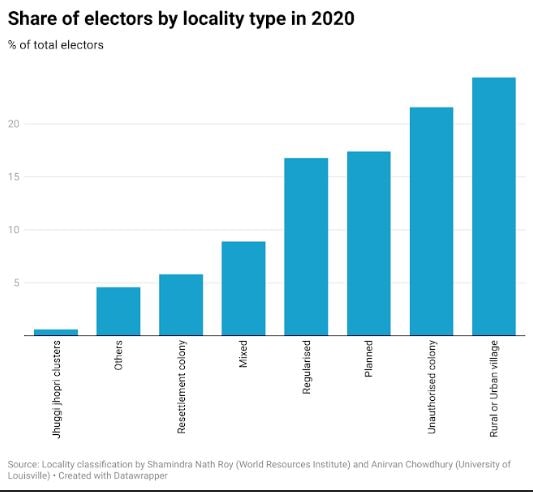
- Will AAP be able to retain its multi-class coalition?This is another important factor in Delhi elections. While a large share -- perhaps a majority of Delhi’s electorate -- can be described as poor, there is also a sizeable middle class vote in Delhi. This can be seen from the share of electors across different categories of polling booths in Delhi. More than a third of Delhi’s voters live in what are planned or regularised colonies, which are believed to be more affluent than other localities. As was shown in these pages previously, the AAP led over the BJP in each category of polling booths in the 2020 elections. Even if it were to lose ground to the BJP in the relatively affluent parts, it could stand to lose significant ground in terms of seats.



Unlock a world of Benefits with HT! From insightful newsletters to real-time news alerts and a personalized news feed – it's all here, just a click away! -Login Now!


