E-Paper



Number Theory: Have oil prices and Israel been dehyphenated?
Does it mean that oil prices and Israel have been dehyphenated today? Here are four charts which try and answer this question

 Prefer HTon Google


When Hamas made its deadliest ever attack on Israel on October 7, 2023, the symbolism of the timing was difficult to miss. It came exactly fifty years after what is known as the Yom Kippur War or the fourth Arab-Israeli war when a group of Arab nations led by Egypt and Syria launched a surprise attack on Israel on October 6, 1973. While Israel managed to win the battle, the costs of the war were paid by the entire world. The Organisation of Arab Petroleum Exporting Countries (OAPEC) decided to put an oil embargo on every country which had helped Israel in its war effort. The list pretty much included the entire advanced capitalist block and led to massive energy shortages, inflation and large-scale economic chaos. The chain of economic events triggered by the Yom Kippur War are known as the First Oil Shock in the history of modern capitalism.

Whether or not the Hamas was hoping for a similar economic fallout of its attack is difficult to say, but the last ten months show that the global energy economy has not been affected by the ongoing conflict at all. Does it mean that oil prices and Israel have been dehyphenated today?
Here are four charts which try and answer this question.
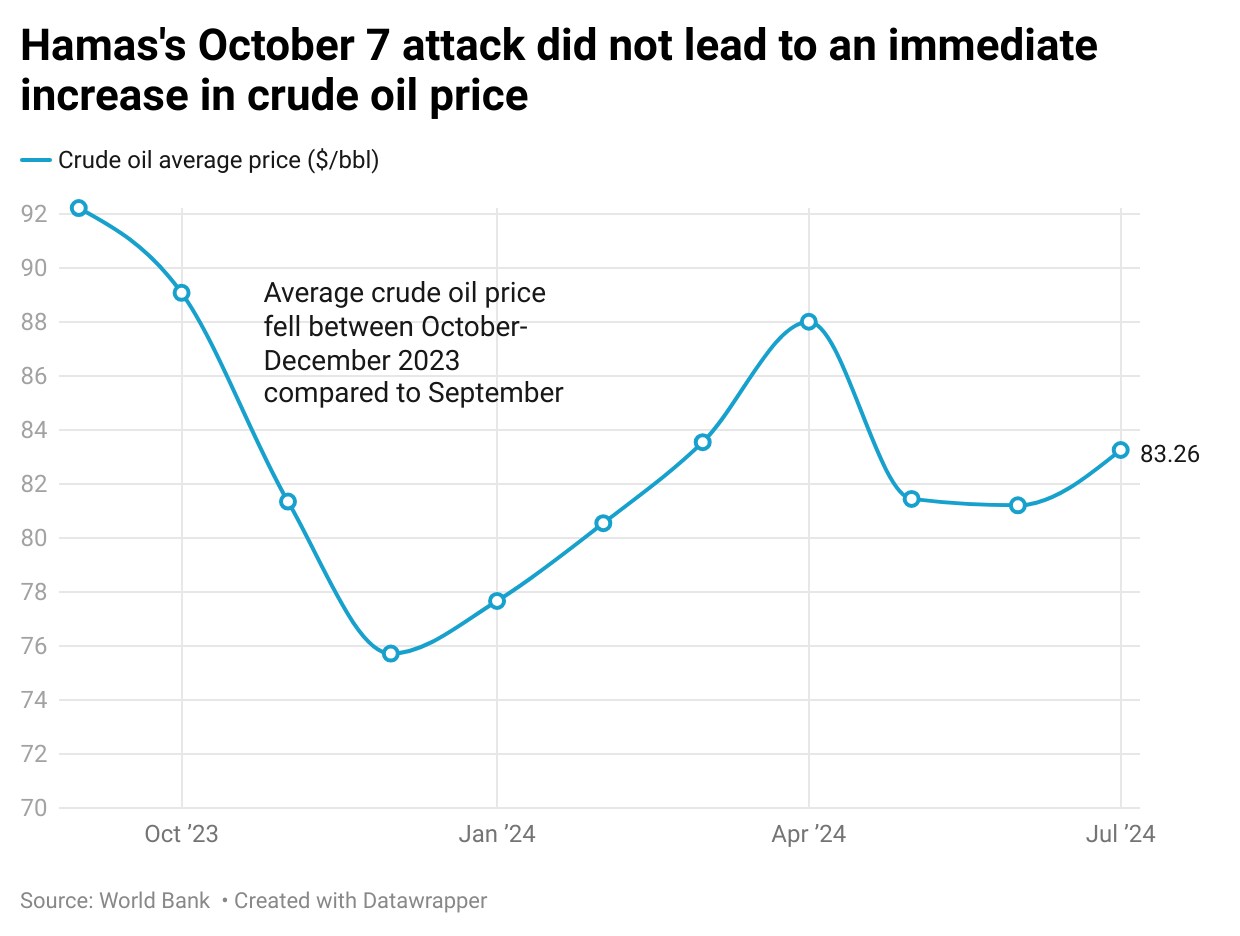
Crude oil prices have not shown an increasing trend in the aftermath of the Hamas attack
World Bank data shows that monthly average crude oil price was $92.2 per barrel in September 2023. This number actually came down to $89.1 in October 2023 and continued to fall in November and December. While oil prices have increased between January and April 2024, they seem to have stabilised at much lower levels subsequently.
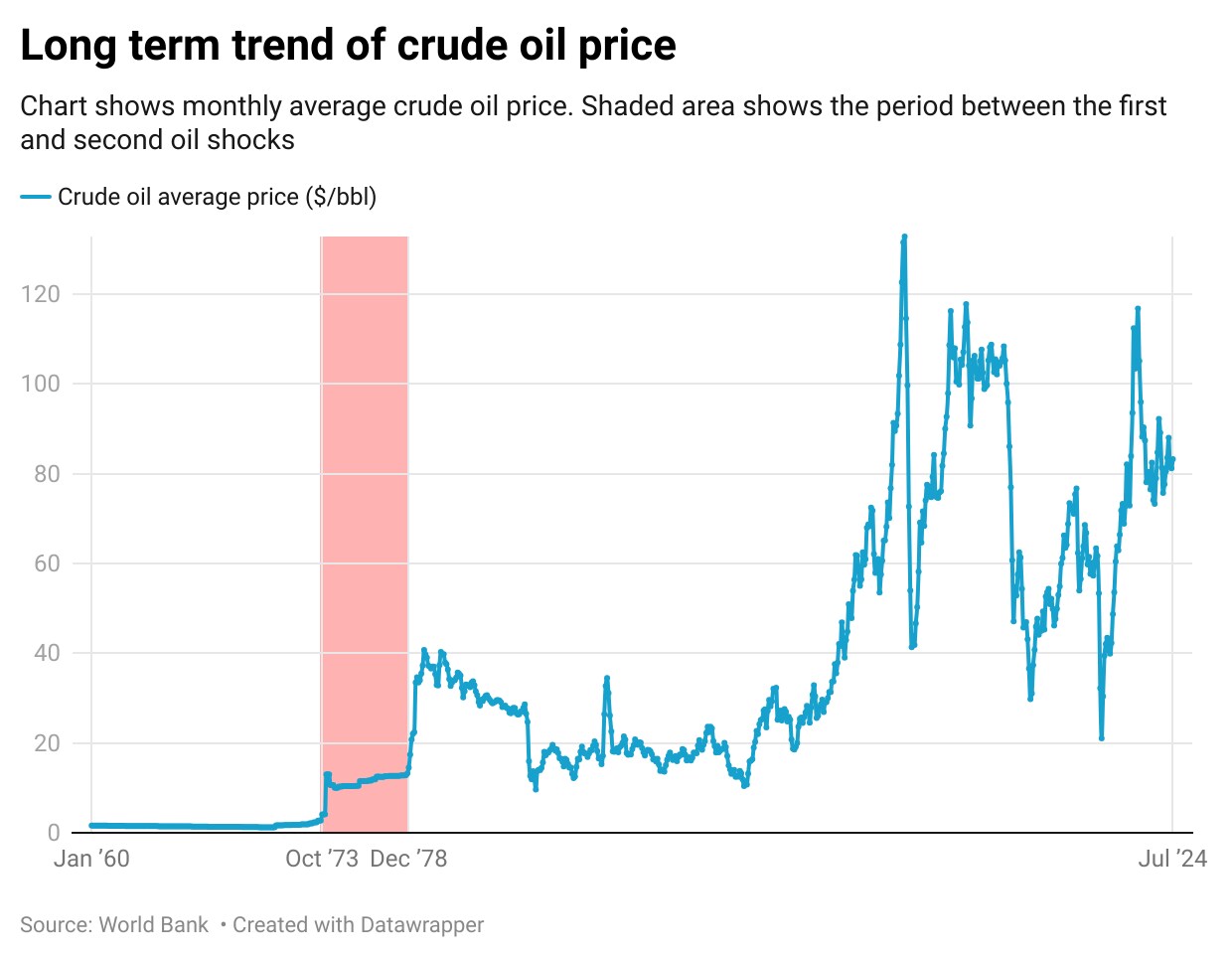
 The impact of the 1973 Yom Kippur War on oil prices was massiveThe OAPEC announced its oil embargo on 19 October, 1973 in response to President Richard Nixon’s request for war funding to Israel. International oil prices rose sharply in the aftermath, World Bank data shows. They went from $2.7 per barrel in September 1973 to $4.1 per barrel in October and reached $13 by January 1974. While they did come down slightly when the embargo was lifted in March 1974, prices never went back to their pre-war levels. To be sure, the 1973 war involving Israel and the Arab nations was not the only military or geopolitical conflict which led to an irreversible increase in crude oil prices. An even bigger increase in oil prices happened in the aftermath of the Iranian revolution in 1978 and 1979 with average prices rising from under $15 per barrel in 1978 to almost $40 per barrel by end of 1979, earning this disruption the nomenclature of the second oil shock. However, unlike the first oil shock, prices did come down significantly from their peak levels. While international oil prices have been affected by other geopolitical conflicts, including the ongoing Russia-Ukraine war, the events of 1973 and 1979 had the biggest, and more importantly, long lasting impacts on energy prices.
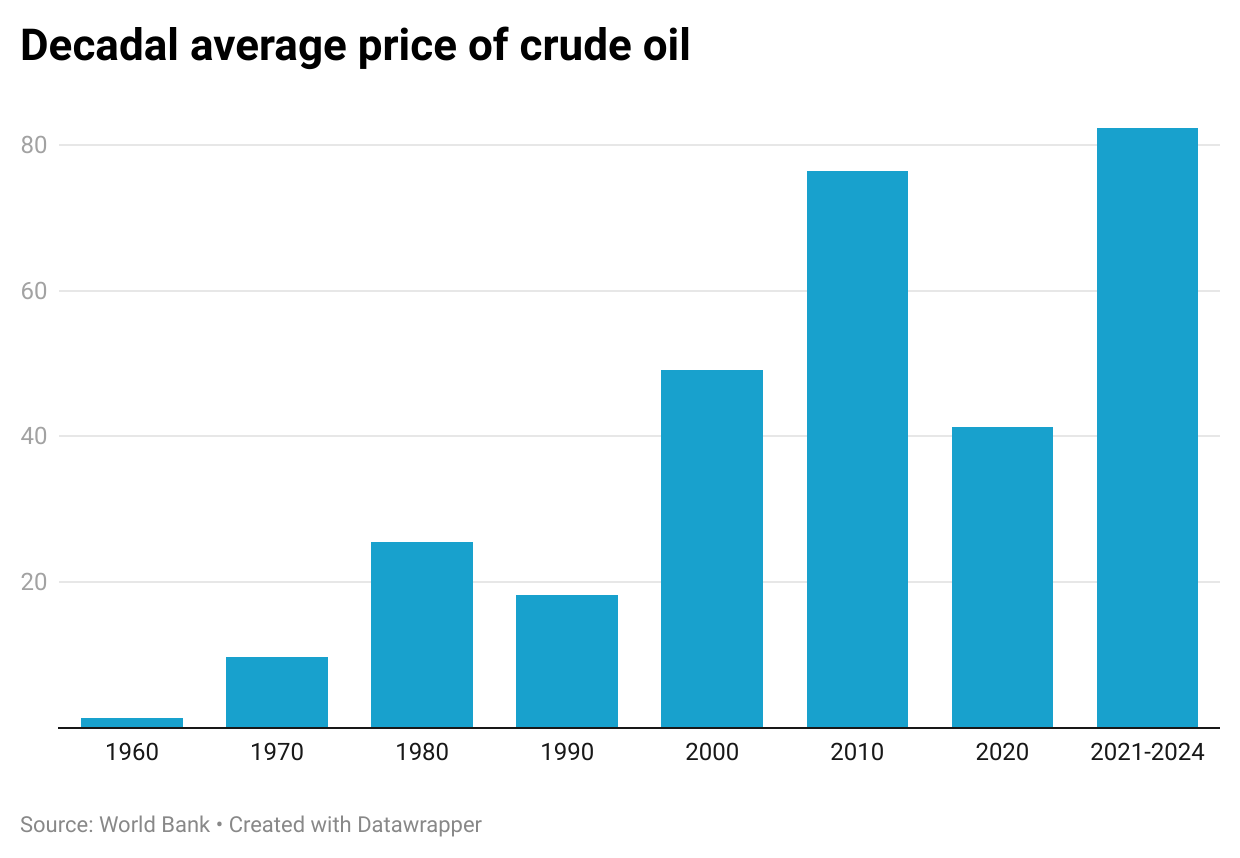
- But average oil price in the 2020s is the highest it has ever beenTo be sure, the fact that oil prices did not see a wild jump in the aftermath of Hamas’s attack on Israel in October 2023 does not mean that the global economy is in a sweet spot as far as energy prices are concerned. An HT analysis of average monthly crude oil prices between January 1961 and July 2024 shows that the ten-year average of prices increased in every decade between 1960 and 2010s except in the 1990s. There was briefly a major fall in 2020 due to the Covid-19 pandemic. This trend was broken again after 2020 and the average monthly price between January 2021 and July 2024 is $82.3 per barrel, the highest it has ever been when compared to previous decadal averages. This pattern does not change drastically if one looks at the inflation adjusted price of oil in the World Bank data. The decadal average of annual real crude oil prices is the highest ever between 2021 to 2023 at $74.6 per barrel. Energy prices continue to worry policy makers, including those in India.
- Decadal average price of oilTo be sure, the ongoing conflict has primarily involved Gaza, Israel, Lebanon, and Iran to some extent. Of these, Gaza and Lebanon produce no oil and Israel and Iran’s share is negligible in the global output. The larger oil-exporting Arab countries have not participated in the fighting like they did in the 1960s and 1970s. Unlike in the past, the larger issue concerning the energy domain now is not conflicts in the Middle East, but the debate on climate change and the need for green energy. With the International Energy Agency calling for a need to shift to renewables, the OPEC is now occupied with preventing a sudden move away from traditional consumption of energy.