
 E-Paper



Number Theory: How Kejriwal’s New Delhi loss puts AAP’s debacle in perspective
In many ways, Kejriwal’s defeat, only puts the AAP’s larger predicament in perspective
Updated on: Feb 10, 2025, 08:58:07 IST

 Prefer HTon Google
Share via


Copy link

What has made Aam Aadmi Party’s (AAP) defeat in Delhi remarkable is the fact that Arvind Kejriwal, the biggest leader of the AAP himself lost from the New Delhi assembly constituency (AC). In many ways, Kejriwal’s defeat, only puts the AAP’s larger predicament in perspective. Here are three charts which explain this in detail.
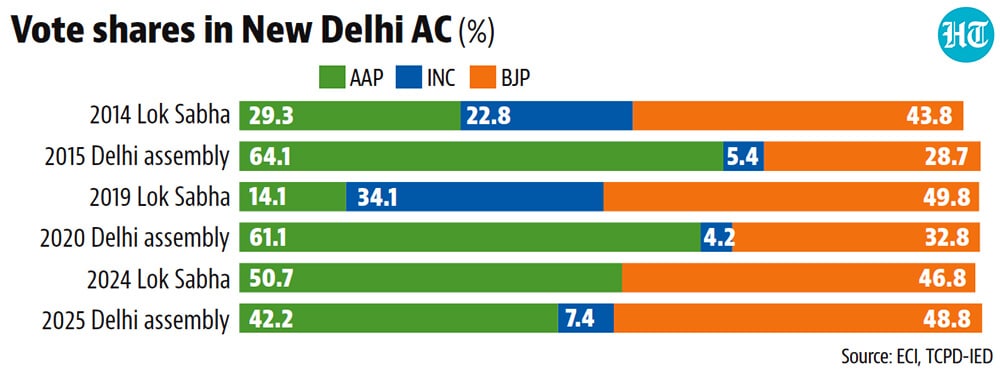
 Kejriwal’s previous New Delhi victories, were powered by a section of BJP, Congress votersA comparison of AAP’s performance in the New Delhi AC in Lok Sabha elections and assembly elections is useful to understand this. Kejriwal won the New Delhi AC continuously in the 2013, 2015 and 2020 assembly elections. However, the AAP finished second in this AC in the 2014 Lok Sabha elections and came third behind the Congress and the BJP in the 2019 elections. It was only in 2024 that the AAP-Congress alliance actually won the New Delhi AC, one of the 18 out of 70 ACs where the alliance actually won. These numbers suggest that there was never an exclusively committed AAP voter base to begin with and its AC victories were more a function of Kejriwal and AAP’s traction in state elections. The vote share AAP gained in this AC in the 2015 and 2020 assembly elections compared to the preceding Lok Sabha is also more than the gain for the party at the state level. This suggests that Brand Kejriwal was even more attractive than Brand AAP for a section of voters who voted BJP in national elections. In 2025, both the Congress and the BJP have received their highest ever vote shares in assembly elections since 2013 and 2015 respectively. To surmise, Kejriwal’s appeal outside traditional AAP voters fell significantly this time. See Chart 1:
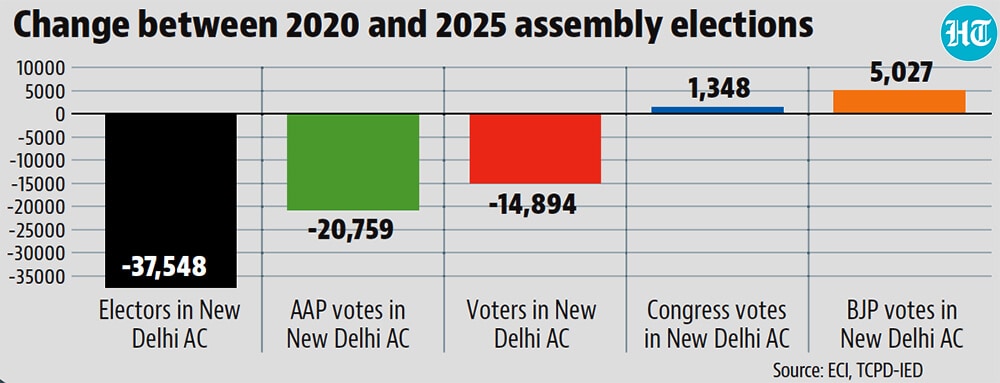
- Did deletion of voters in New Delhi AC play a role in Kejriwal’s loss this time?A lot of claims and counter claims have been made about the composition of the electorate in New Delhi AC in the 2025 elections. New Delhi is one of the 12 ACs where electors have declined since the 2020 assembly election and only one of the two (the other AC being Delhi Cantt) where the fall is more than 20%. AAP won Delhi Cantt but lost New Delhi. The number of electors in this AC have declined to 108,574 in the 2025 assembly election from 146,122 in the 2020 assembly election: a drop of 37,548 electors. The fall in total votes polled was much lower between 2020 and 2025, just 14,499. Did it have an impact on the results? A water-tight argument would have to tally all past and present electors including those who were removed from the rolls in this election. There is no data to do this. But even a more logical approach does not support such a theory. Here is why. Kejriwal polled 25,999 votes in the 2025 election, 20,759 less than what he polled in 2020. The BJP candidate polled 30,088 votes this time, 5027 more than what he polled in 2020. The Congress increased its vote count by 1,348 votes to 4,568 in 2025. For these numbers to hold without a section of Kejriwal’s 2020 voters deciding to shift to either the BJP or the Congress would require a targeted deletion of AAP voters in a very large way. An analysis of booth-level data from the AC supports this theory. See Chart 2:
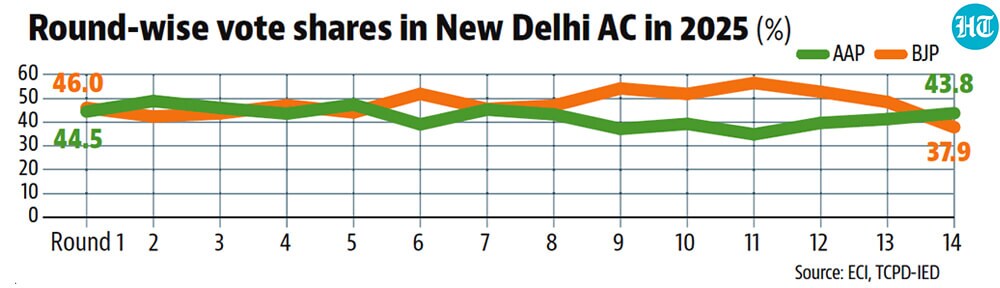
- Kejriwal’s loss, like AAP’s, is driven by middle class attritionNew Delhi is among the most well-off ACs in Delhi as large parts of it are planned settlements of either the really rich or high or low ranked government employees. Kejriwal had broad based support in this AC in 2020. An analysis of booth-wise data using Form 20 shows that he only lost 15 out of the 167 polling booths in New Delhi AC in 2020 with an average victory margin of 8%. Of the 15 he lost, four were located in a urban village locality and the rest in broadly planned localities. While the 2025 Form 20 data will take time to come out, even a round-wise analysis of New Delhi AC result shows that Kejriwal is likely to have lost a lot more booths this time. He only led in four out of the 14 EVM counting rounds and also lost in the postal ballot counting. The 14 rounds had an average of 4,374 votes. This means that each round corresponds to around around 10 polling booths given the average booth size of 453 votes in 2020, which implies that Kejriwal is likely to have won in only around a quarter of the booths in 2025 . 92% of New Delhi’s booths are located in planned localities which suggests that their voters are more middle-upper class and therefore less susceptible to voter suppression or forced deletions. Given the fact that AAP has lost the highest support in relatively richer ACs, New Delhi has only followed the broad trend. See Chart 3:


Unlock a world of Benefits with HT! From insightful newsletters to real-time news alerts and a personalized news feed – it's all here, just a click away! -Login Now!


