
 E-Paper



SpaceX rocket crashes into Moon: What happened and what scientists found
A SpaceX Falcon 9 rocket stage crashed into the Moon, creating a new crater and giving scientists a rare chance to study lunar impacts.

 Prefer HTon Google


A stray SpaceX rocket stage is believed to have crashed into the Moon, creating a new crater near the famous Einstein crater. The object was the empty upper stage of a SpaceX Falcon 9 rocket, which had been left in space after completing its main job during a lunar mission. The rocket stage was expected to hit the Moon at around 5,400 mph (8,700 km/h) on Wednesday, making the impact extremely fast and difficult to observe.
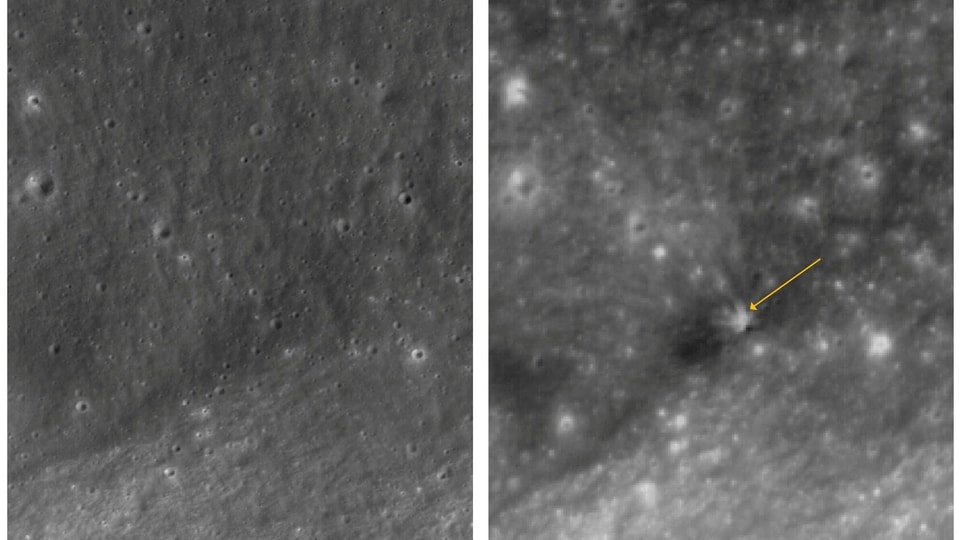
The collision happened at about 07:35 BST (06:35 GMT) on Wednesday. The impact was especially difficult to watch because it happened on a daylit part of the Moon, meaning the area was already brightly lit by the Sun. The actual flash from the crash was expected to last for only a fraction of a second, making it extremely difficult for anyone on Earth to catch it.
Why the Moon crash was hard to see
Even amateur astronomers using high-end telescopes would have had little realistic chance of seeing the impact. The Moon is about 385,000 km (239,000 miles) from Earth, and the impact involved an object only around 14 metres across, making the event very difficult to detect.
A cloud of dust may also have been created by the crash. The dust plume could stretch for as much as 100 km (62 miles) and may have remained visible for several minutes, according to the BBC. Spacecraft already orbiting the Moon also did not have the right position to watch the collision happen live.
Danuri spacecraft may have seen impact
South Korea's Danuri lunar orbiter had one of the best chances of observing the event because it passed close to the expected crash area shortly before the impact. The Danuri team told Korean media that any footage from the spacecraft would only be released after researchers finish studying and analysing the data.
Also read: SpaceX revenue jumps 92%: Where will SpaceX stock be in 1 year?
NASA's Lunar Reconnaissance Orbiter is expected to get into a position where it can photograph the crash site in the coming days. Scientists can then compare before-and-after images of the lunar surface to find the new crater created by the rocket, , according to the BBC. Some of the first useful scientific information could also come from powerful telescopes in the Americas, where the sky was still dark when the impact happened.
Scientists study new Moon crater
Researchers are now waiting for a clear look at the new crater because the crash could provide valuable information about how objects hit the Moon. The event is scientifically unusual because researchers already know important details about the object, including its size, speed and expected impact location. Because these details are known, scientists can treat the crash almost like a controlled experiment, even though the collision itself was accidental.
What the Moon impact can teach
Planetary scientists can use the impact to test their models of what happens when a large object strikes the Moon. One major question is how impacts create craters on the lunar surface and how much material they remove from the ground.
Scientists can also study how much rock and dust is thrown into the air after an impact. This information has a practical use for future Moon missions, , according to the BBC. Knowing how far rocks and dust can fly after an impact could help engineers design safer lunar landers.
Impact could help future Moon bases
The findings could also help with plans for future Moon bases, where astronauts and equipment could be exposed to flying lunar debris. The material thrown out by the crash could also expose fresh material from below the Moon's surface. Studying that material could give scientists more clues about the Moon's geology and its history.
How SpaceX rocket reached the Moon
The Falcon 9 rocket involved in the incident was not originally sent toward the Moon to crash. It was launched from Florida in January last year as part of a mission carrying two lunar landers. The Falcon 9 is a reusable rocket system used by SpaceX on many missions. Some parts of the rocket return to Earth, while other sections are left behind in space after their work is completed.
During this mission, the rocket's upper stage had one important job: it had to provide enough force to send the two lunar landers out of Earth's orbit and toward the Moon. That part of the mission was successful. The upper stage completed its job and the two landers continued on their journey. After that, the spent upper stage was left travelling through space in a long, looping orbit that moved toward the Moon and then back again.
Its movement was slowly affected by the gravity of the Earth, Moon and Sun. Even sunlight can produce a very small force on an object in space. Over a long period, these tiny forces can gradually change an object's path.
Also read: SpaceX rocket thought to have crashed into Moon in unintentional collision: What happened?
Why the rocket started moving toward Moon
Over about 18 months, these small gravitational effects and the pressure from sunlight slowly changed the rocket stage's orbit. Astronomers tracking the rocket eventually realised that these tiny changes had put the object on a path that would take it toward the Moon. The rocket stage also began picking up speed every day as it moved closer to its eventual collision, , according to the BBC.
The crash is therefore being closely studied because it shows how a piece of human-made space hardware can remain in space long after its original mission has ended. This is not the first time a human-made object has hit the Moon. Since 1959, dozens of spacecraft and rocket parts have crashed into the lunar surface. Some of those crashes happened accidentally, while others were carried out deliberately so scientists could study the Moon.
Luna 2 was first to hit the Moon
The Soviet Union's Luna 2 became the first human-made object to reach and strike the Moon in 1959. NASA later sent the Ranger probes toward the Moon during the 1960s, with several missions ending in impacts. Some Apollo-era rocket stages also struck the Moon.
In 2009, NASA deliberately crashed the LCROSS mission into the Moon as part of an experiment to search for evidence of water ice. The most recent confirmed accidental impact before this event happened in 2022, according to the BBC. That 2022 impact was believed to have involved a leftover booster from a Chinese lunar mission launched in 2014.
Why the SpaceX Moon crash matters
In the case of the SpaceX rocket stage, what looked like a piece of leftover space hardware has now potentially become a valuable scientific opportunity.
So, while the SpaceX rocket crash was nearly impossible for people on Earth to witness live, scientists may still get something valuable from it: a rare chance to study a known object hitting the Moon and use the results to prepare for future lunar missions.


