E-Paper



Number Theory: How socially representative is Bihar’s candidature?
The data shows that the NDA has a bigger share of candidates from upper castes (Rajput, Bhumihar, Kayasth and Brahmin) and EBCs than the INDIA block.
Published on: Apr 25, 2024, 14:16:20 IST

 Prefer HTon Google
Share via


Copy link

Bihar, which sends 40 MPs to the Lok Sabha, is set for a bipolar contest between the Bhartiya Janata Party (BJP)-led National Democratic Alliance (NDA) and the Rashtriya Janata Dal (RJD)-led Indian National Developmental Inclusive Alliance (INDIA). How socially representative is the candidature of these two blocks in Bihar? Thanks to the Caste Census results published by the Bihar government in October 2023, one can answer this question with much more clarity than for any other state in India. HT matched candidates and castes for all 80 candidates of the NDA and INDIA to do this analysis. This analysis has not taken into account caste-wise differences among Muslim candidates. Here is what the data shows:
How socially representative is Bihar’s candidature?
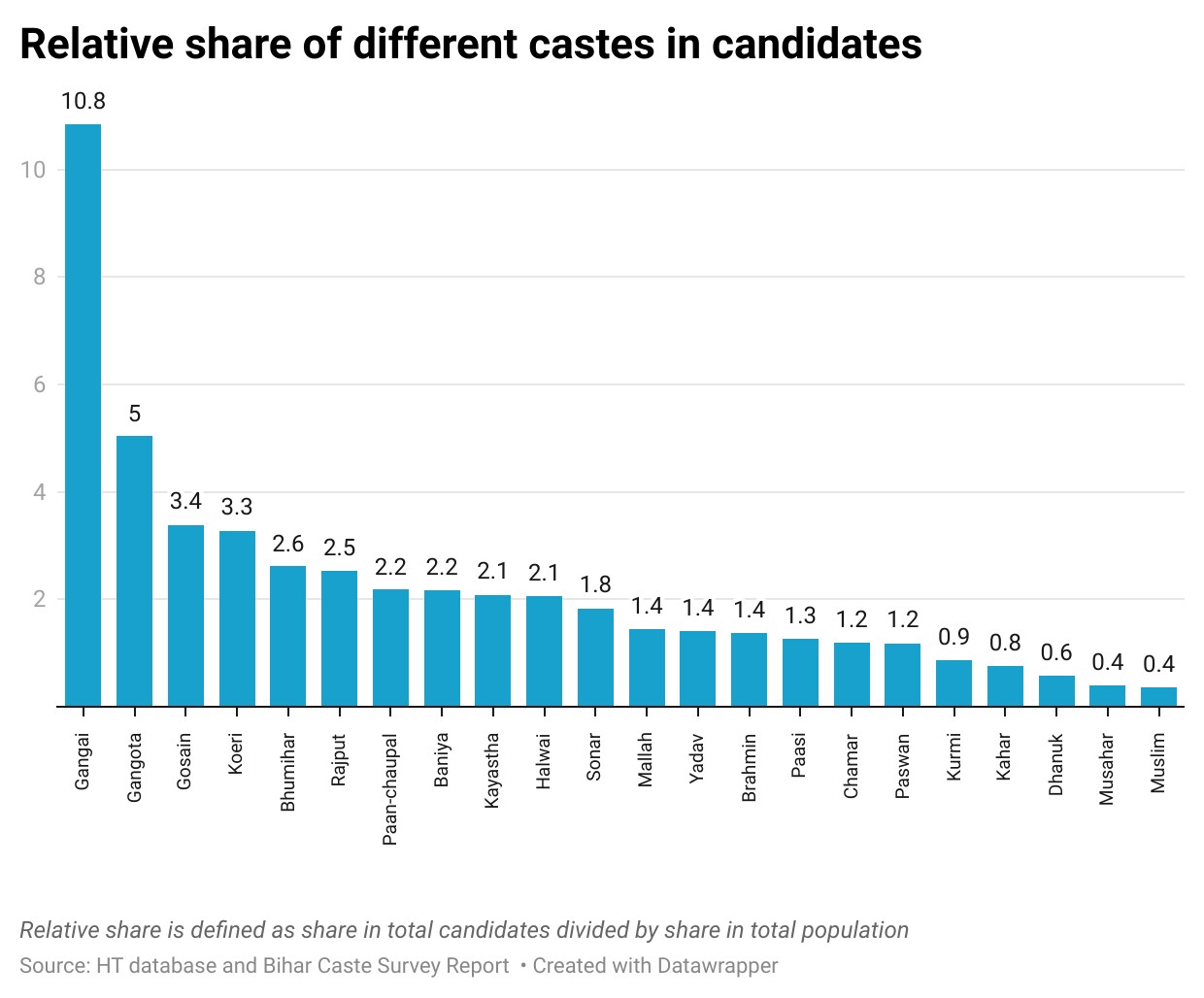
 Yadavs have the largest share in number of candidates from the two blocksAmong the 80 candidates of NDA and INDIA blocs, 16 are Yadav. This makes them the single largest caste in the pool of candidates of the two major blocks. Koeri is the second largest caste with 11 candidates and they are followed by Rajput (7), Bhumihar (6) and Chamar and Dusadh (Paswan) with five candidates each. Does this mean an overwhelming Yadav dominance in Bihar’s politics? A comparison of the relative share of different castes in total candidates – share in candidates divided by share in total population – shows that Yadavs are not as over represented as the data would initially suggest. In terms of the relative share of candidates, they are ranked 13th among 22 castes who have at least one candidate from the two main blocks. In fact, the relative share of Yadav candidates is lower than that of three upper castes (Bhumihar, Rajput and Kayasth) and same as that of Brahmins. Data also shows that caste groups which comprise 25% of Bihar’s population do not have a candidate from either of the two blocks in this election in Bihar.
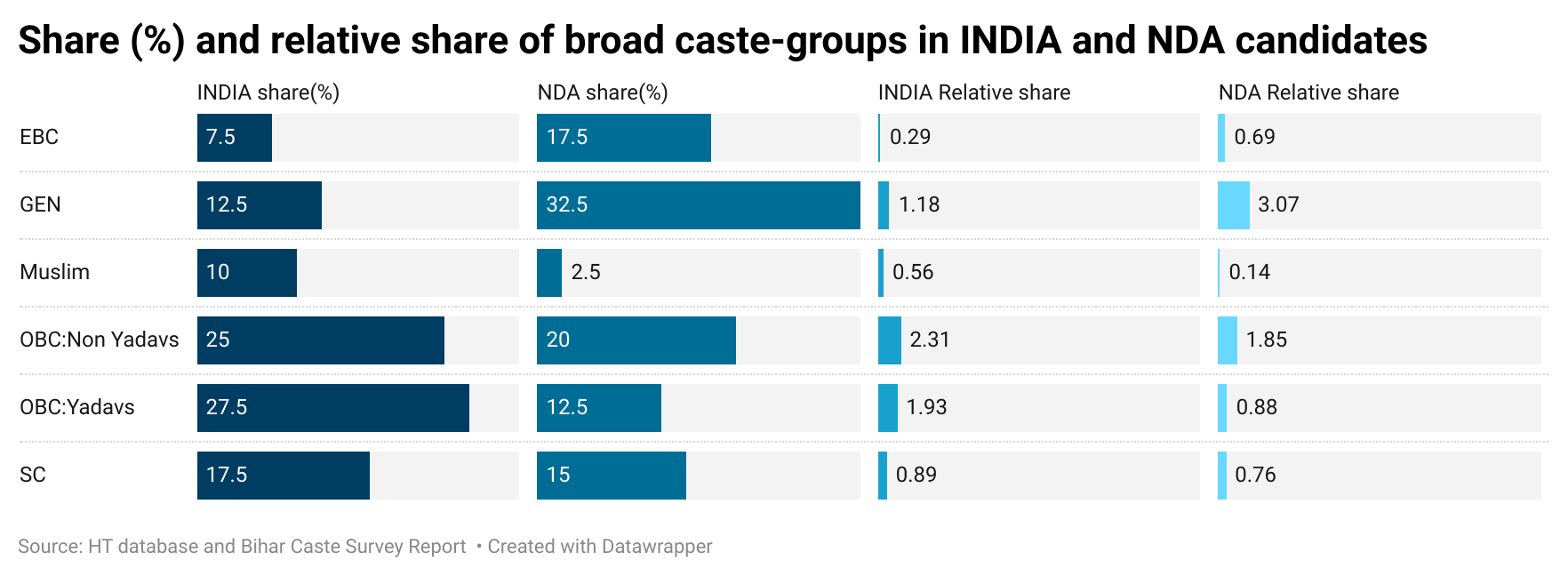
- How do INDIA and NDA compare on the representation of broad caste groups?This is an interesting question to ask because Bihar’s politics has often been focused on this narrative. Bihar was among the first states in India to implement the Other Backward Classes (OBC) quota with a sub-category for extremely backward castes (EBCs). Similarly, RJD’s dominance in Bihar’s politics has also created a Yadav versus non-Yadav divide in OBC politics with Nitish Kumar emerging as the pole of a conglomeration of numerically insignificant non-Yadav OBCs. The RJD, on the other hand, draws its core support from a Muslim-Yadav (MY) consolidation. The data shows that the NDA has a bigger share of candidates from upper castes (Rajput, Bhumihar, Kayasth and Brahmin) and EBCs than the INDIA block. The INDIA block has a higher share of Yadavs, non-Yadav OBCs, Muslims and Scheduled Caste (SC) candidates than the NDA alliance. To be sure, the relative share of upper caste candidates is greater than one even for the INDIA block, which is approaching these elections with an aggressive Mandal politics rhetoric.
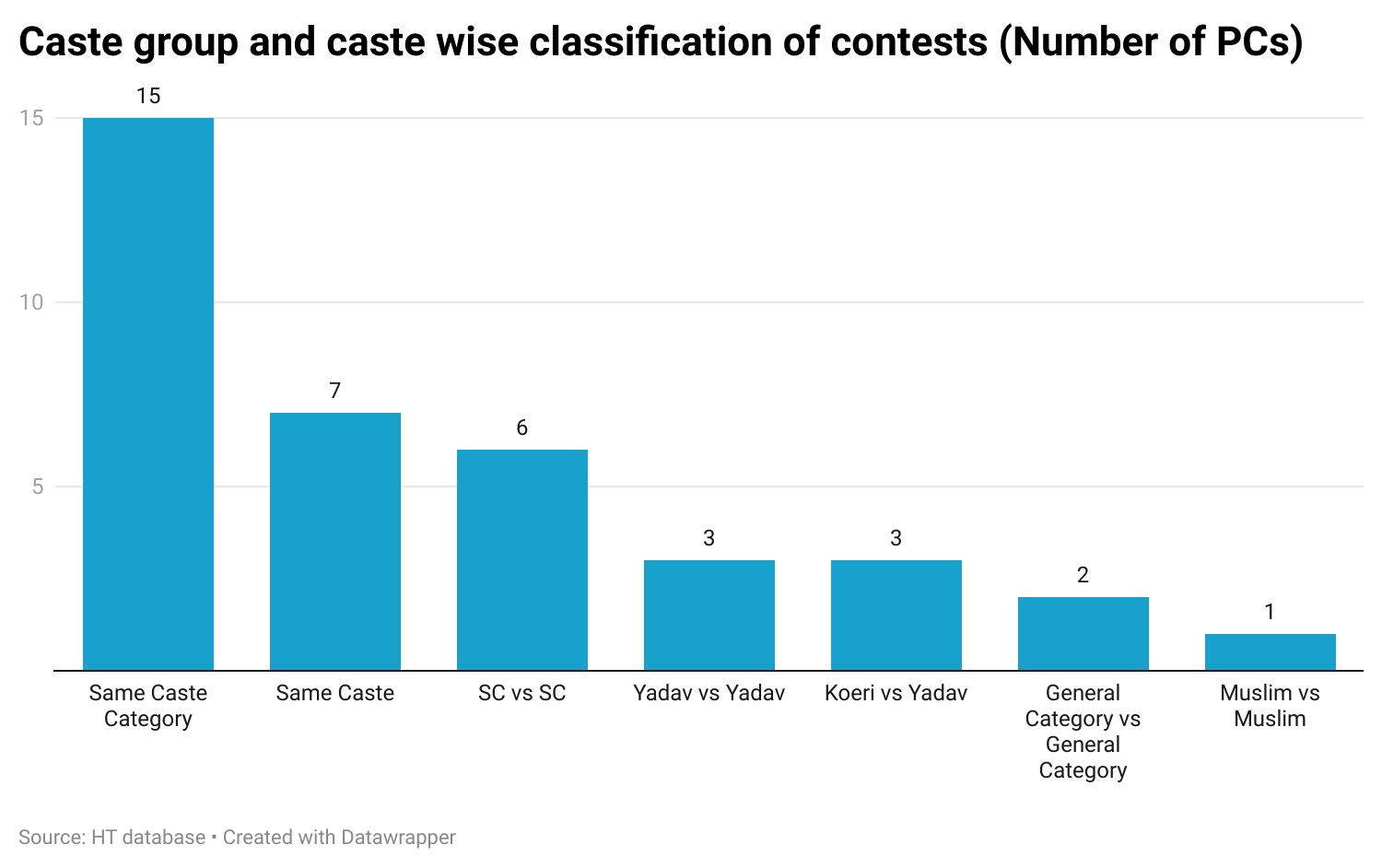
- What is the caste-equation at the level of constituency-wise contests?Have NDA and INDIA fielded candidates from same or different caste/caste-groups in a given constituency? The former would suggest a dominance of a particular caste in a given constituency while the latter might be an indication of efforts to exploit caste-based fault lines. Data shows that only seven out of the 40 PCs in the state will see a contest between candidates of the same caste. If one looks at caste groups, namely, upper castes, SC, EBC, Yadav, Non-Yadav OBCs and Muslims, the number of constituencies with a contest between same caste groups increases to 15. Only one PC in Bihar will see a contest between Muslim candidates of the NDA and INDIA blocks and two will see upper caste candidates against each other. This number is three for 'Yadav vs Yadav' contests.