E-Paper



Number Theory: India's liquor sector aims for growth cocktail
.

 Prefer HTon Google


Beer is the most-consumed alcoholic drink in India. About 3 billion litres of beer was consumed in India in 2023, which was the 13th highest in the world, according to Japanese beer company Kirin Holdings. But on per capita consumption, India was ranked 101, averaging about 2.1 litres of beer per person per year. In those two numbers lies the paradox that liquor multinationals face.
As the world’s most-populous nation, India is a significant market, and growing in width and depth. But its spread of disposable income is thin, which, coupled with social attitudes, end up diluting growth. There’s a third number: 100-150%. That’s the import duty imposed by India on foreign beer (100%) and all other alcoholic beverages (150%), which marks up the price of liquor imports heavily in a price-sensitive market. These numbers are in the news, with both the US and the UK trying to ram down those rates in tariff negotiations with India. If they succeed, it could open the door for more imports and have implications on the domestic market.
This was the second in a two-part series on the Indian liquor landscape. The first part focused on foreign trade. www.howindialives.com is a database and search engine for public data.
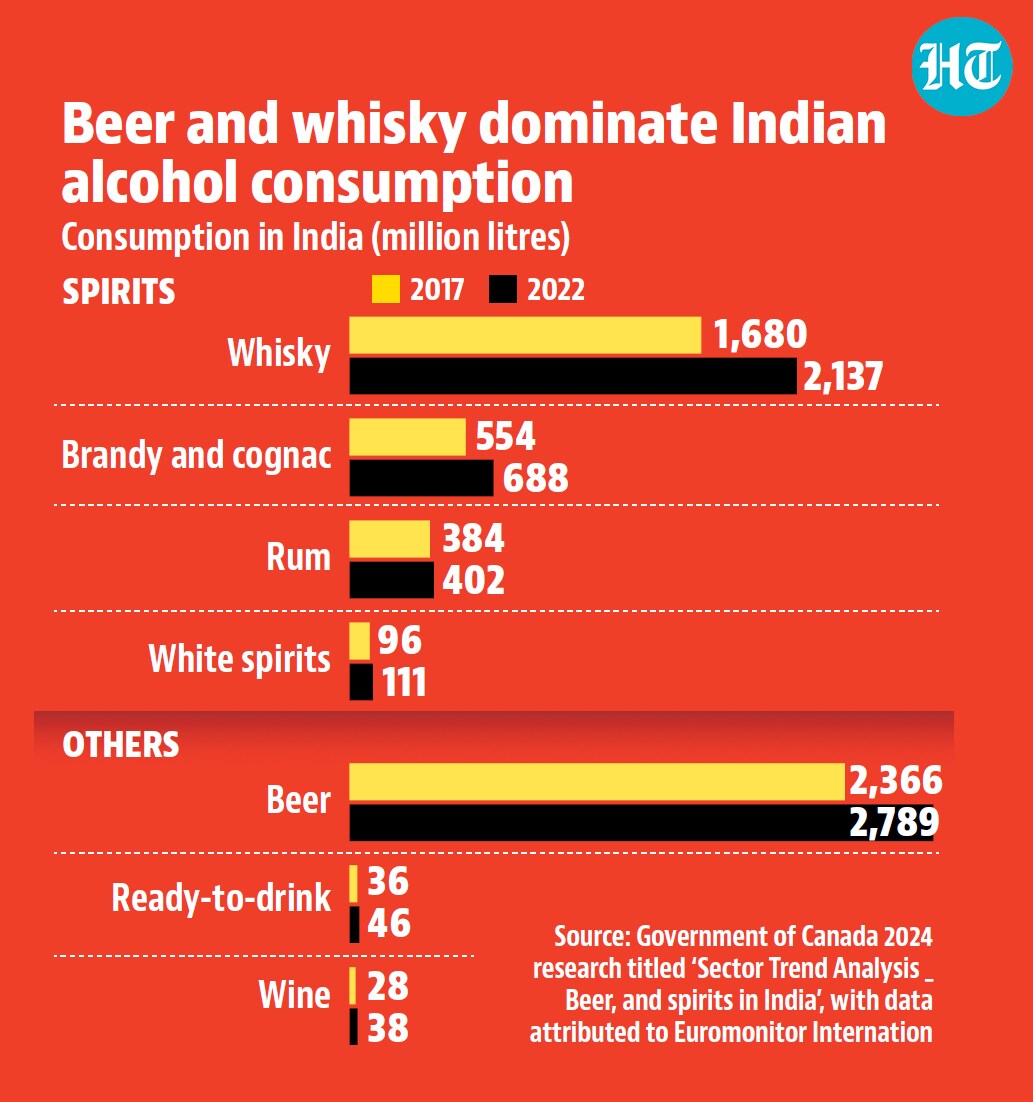
 India, an IMFL marketA 2024 report by retail consultancy Technopak Advisors valued the Indian market for alcohol beverages in 2022-23 at ₹3,15,000 crore. Of this, Indian made Indian liquor (IMIL)—country liquor like toddy, mahua and arrack—accounted for about 33% in volume terms but 11% in value terms. IMIL is cheaper and less regulated. At present, Maharashtra, Uttar Pradesh and West Bengal are the main markets for IMIL, but it’s also the segment that state governments are targeting with bans. Then comes, what is called, Indian made foreign liquor (IMFL), which is basically all spirits excluding beer and wine made in India according to specifications of international brands. In volume terms, as per Technopak, IMFL accounted for 36% of sales by volume and 70% by value. At a more granular level, of the seven alcohol segments, beer led in domestic consumption, with a volume share of 45% in 2022, followed by whisky (34.4%), brandy and cognac (11.1%) and rum (6.5%), according to a 2024 analysis of the Indian liquor sector by the government of Canada.
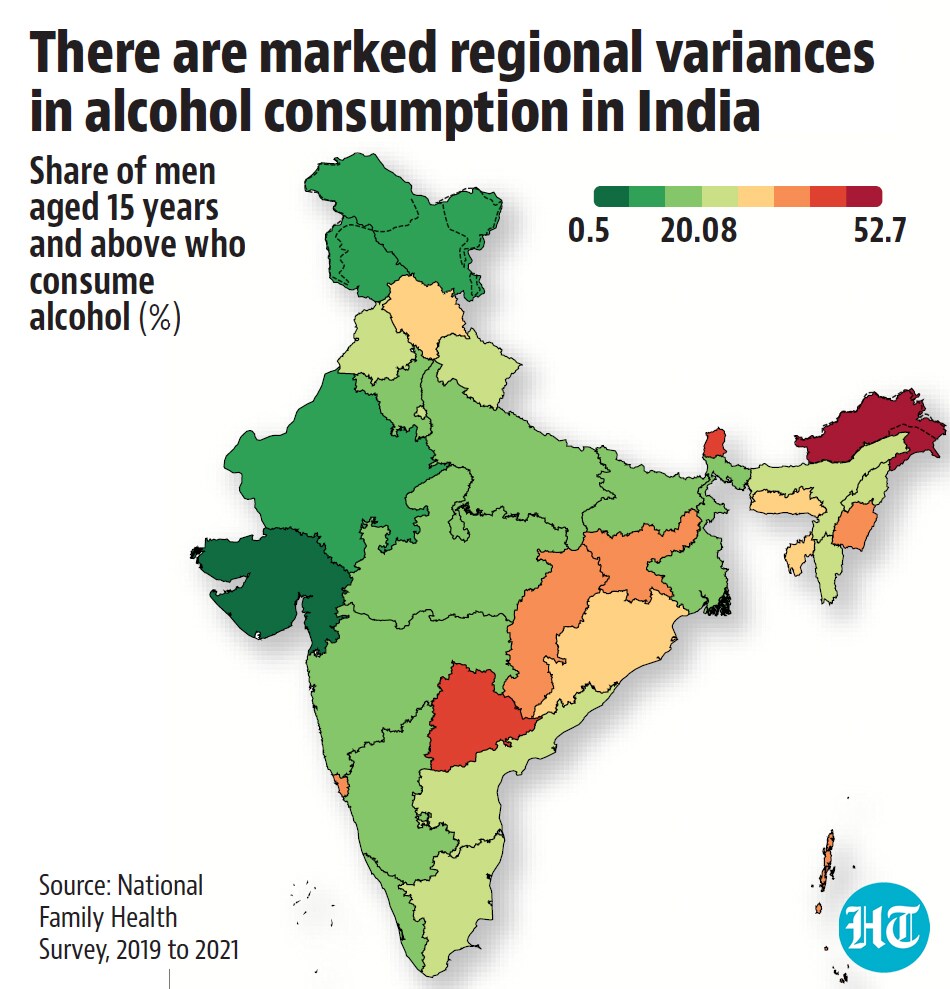
- Regional variancesThe latest government National Family Health Survey (NFHS), for 2019 to 2021, captured data on alcohol consumption. It showed that 18.8% of Indian men aged 15 years and above consumed alcohol. For women of the same age group, that figure was markedly lower, at 1.3%. Applying this on population estimates from the National Commission on Population for 2021 would mean about 103 million people in India drank alcohol. However, India’s alcohol consumption is far lower than other countries—for social, cultural and financial reasons. Illustratively, Mexico, with about one-tenth of India’s population, consumed 3.4 times the beer that India did in 2023, as per the Kirin report. India also shows marked regional variances. Among men, for instance, the proportion varied from 5.8% in Gujarat (which has banned the sale of alcohol) to Arunachal Pradesh (52.7%). In general, north-eastern states and southern states showed a greater share of their population drinking alcohol. Similarly, the share of alcohol drinkers was higher in rural areas than in urban areas.
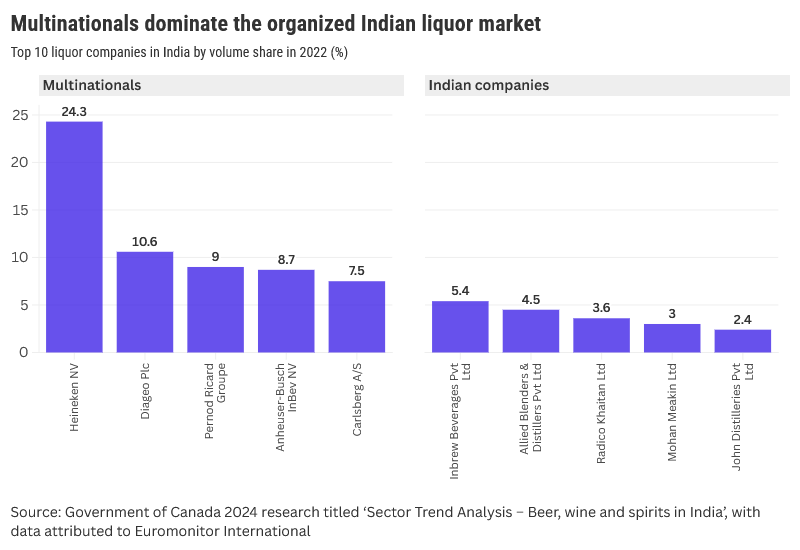
- Multinational leadersAlong with fuel, alcohol is the other main good whose taxation is still in the hands of states, and not passed on the centre as part of the nationwide goods and services tax (GST). Being a discretionary item of consumption, that too with health consequences, it’s also taxed heavily, and is a major revenue generator for states. According to the Technopak report, about 60% of the gross revenue of leading alcoholic beverage companies in India constitutes of excise paid directly to state governments. As the Indian liquor market gets more organized, multinationals are cementing their share. The top five companies are all multinationals in beer and IMFL, with about 60% volume share, as per the government of Canada research report. They are followed by a clutch of Indian companies. That leaves about one-fifth of the organized market, which is fragmented across producers; this is also the segment that has, in recent years, seen the entry of niche Indian producers.
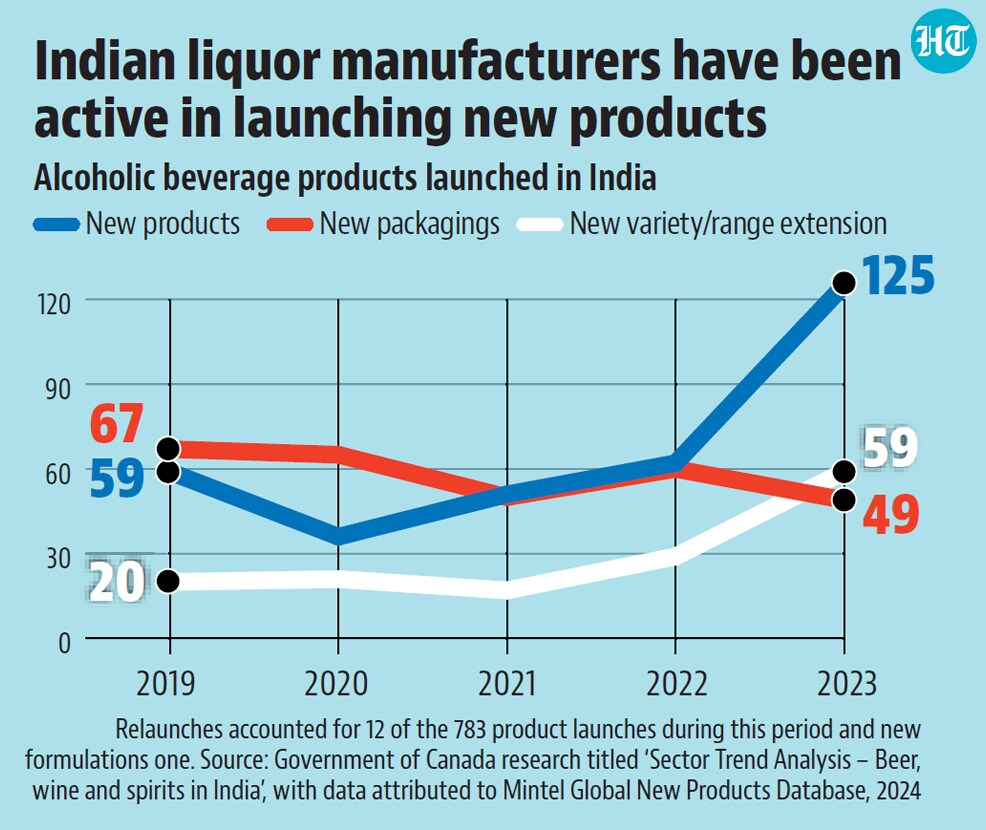
- Premium behaviourIndia’s liquor market is also in the throes of change, with the Covid-19 pandemic marking a separation point of sorts. Other segments beyond the established segments of whisky and beer are growing faster, though on a smaller base. More premiumisation is being seen, with people willing to pay more, even for homegrown brands. Indian producers are showing a greater spirit of innovation and experimentation. As per the government of Canada report, 783 products were launched in India between 2019 and 2023, about 42% of which were new products and about a quarter had premium pricing. Examples include Samsara gin, Camikara rum and Enso Whiskey. About 34% of these 783 products were whiskys and about 24% were beers. Lower import duties—as the US has got for bourbon whisky and the UK is demanding for its whiskys—will make foreign liquor cheaper, and could affect the homegrown activity.