E-Paper



Number Theory: Monsoon's 1st week has decreased heat only in parts of India
Except Gujarat and southern half of Rajasthan, almost the entire country received some rain during the week.
Updated on: Jun 11, 2024, 10:11:41 IST

 Prefer HTon Google
Share via


Copy link

The first week of the official monsoon season – it runs from June 1 to September 30 -- is now over. While this is early days to judge the performance of the monsoon season, has the onset of India’s rainy season at least brought down temperatures? An HT analysis of India Meteorological Department’s (IMD) gridded data shows that the impact of the monsoon on temperatures so far is mixed. Here are four charts that show this.
Monsoon's 1st week has decreased heat only in parts of India
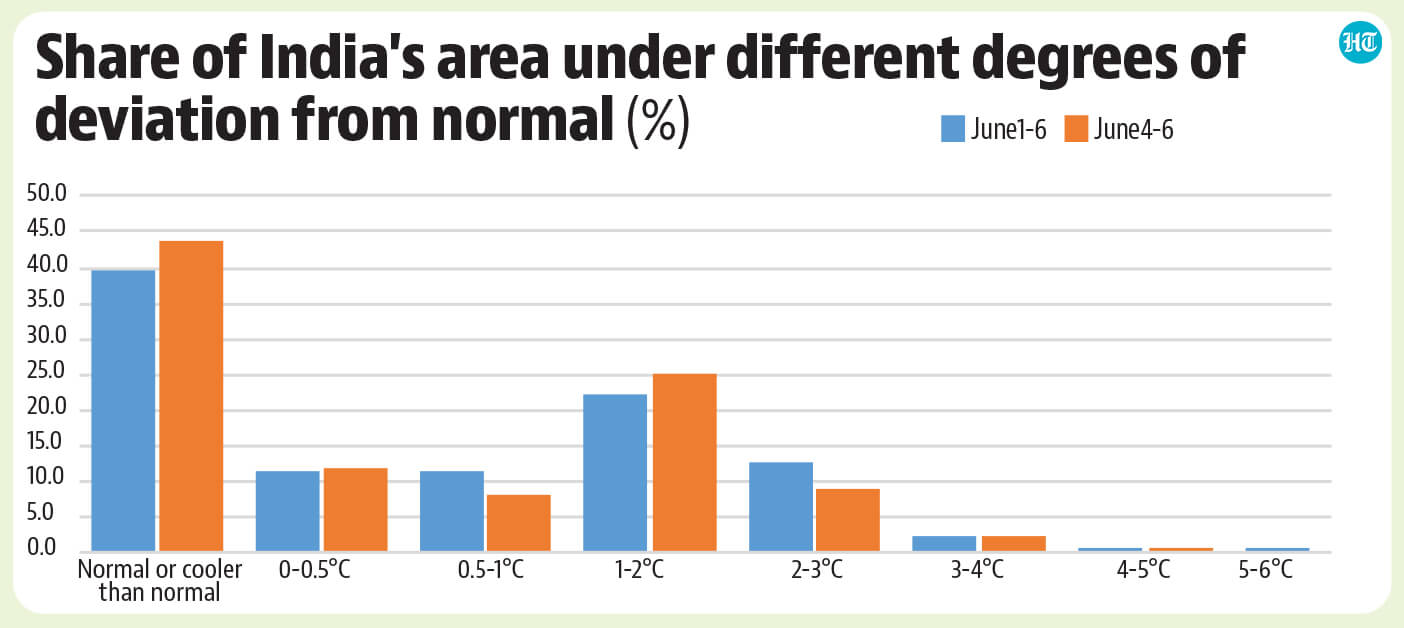
 Only 40% of India experienced normal or cooler than normal maximum temperatures in the past weekThis statistic highlights that any cooling from the beginning of the monsoon season is currently limited to less than half of the country. To be sure, while 60% of the country was warmer than normal (the average during the 1981-2010 period) last week, just 38% of it was warmer by more than 1°C and just 15% was warmer by more than 2°C. Moreover, there was some relief in the second half of the week. 44% of the country experienced an average maximum that was normal or cooler than normal in the second half of the week. Similarly, compared to the week taken as whole, a smaller proportion of the country’s area (12%) experienced an average maximum warmer than normal by more than 2°C.
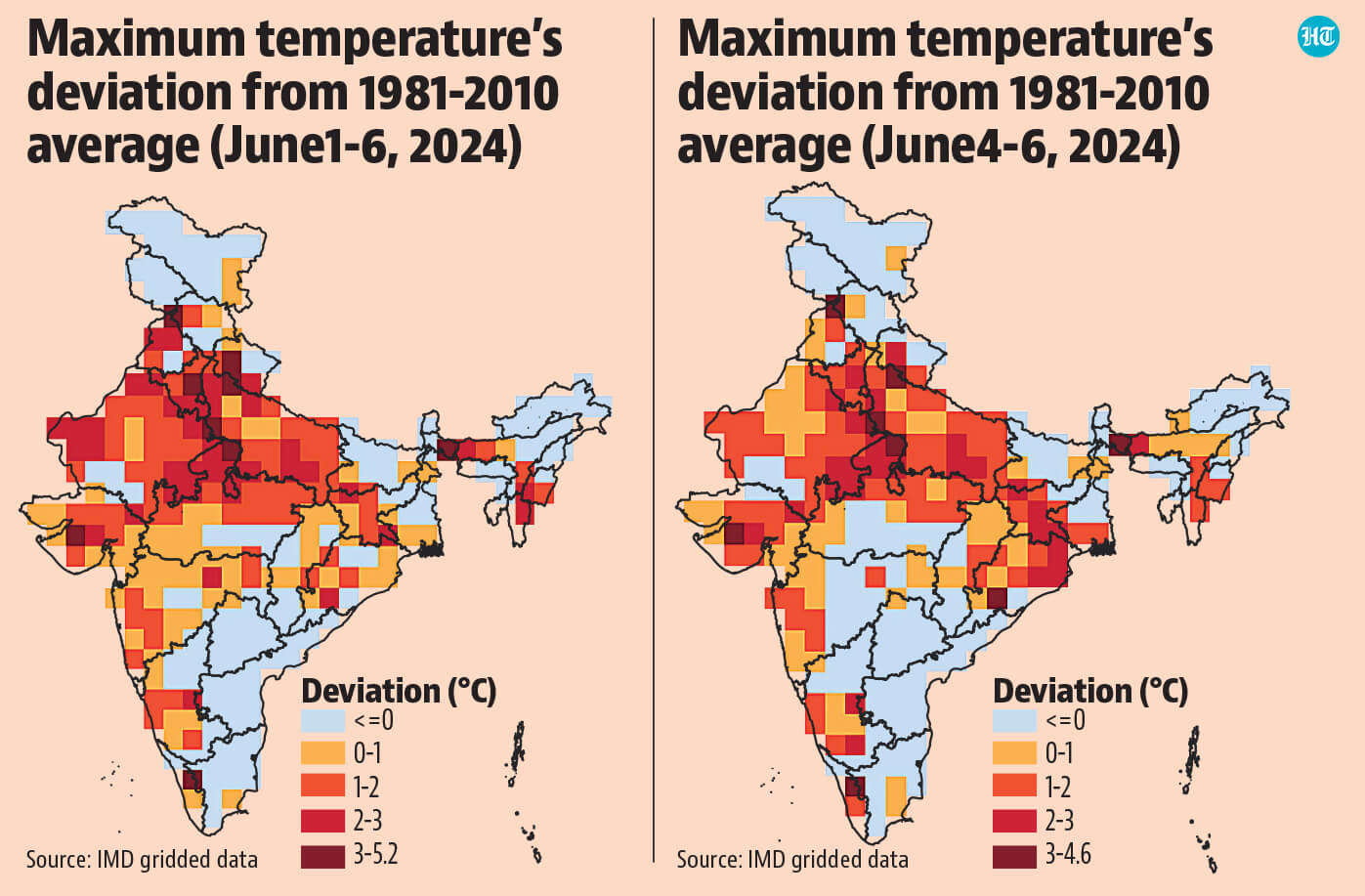
- The upward deviation in maximum did not decrease everywhere in the past weekThis is expected when the growth in the area covered by normal or cooler than normal maximums was limited. Where did the shift happen the most? Madhya Pradesh and Maharashtra. In these two states, the area covered by normal or cooler than normal maximum temperatures was 16.8% and 18.5% in the week overall. However, in the second half of the week, this area increased to over 40% of the area in both these states. To be sure, there was also some relief in other states. For example, between 37% and 50% of the area of Uttarakhand, Punjab, Haryana, Rajasthan, and Uttar Pradesh experienced an average maximum warmer than normal by more than 2°C in the week. However, in the second half the week, there was no such area in Punjab. In the other four states, such areas were limited to half to two-thirds of the total area if the week is taken as a whole. While such calculation is not possible for Delhi because of its small size, the deviation in Delhi also decreased from 2.5°C in the week overall to 2.1°C in the second half. To be sure, the eastern half of peninsular India experienced maximum temperatures that were normal or cooler than normal in both halves of the week.
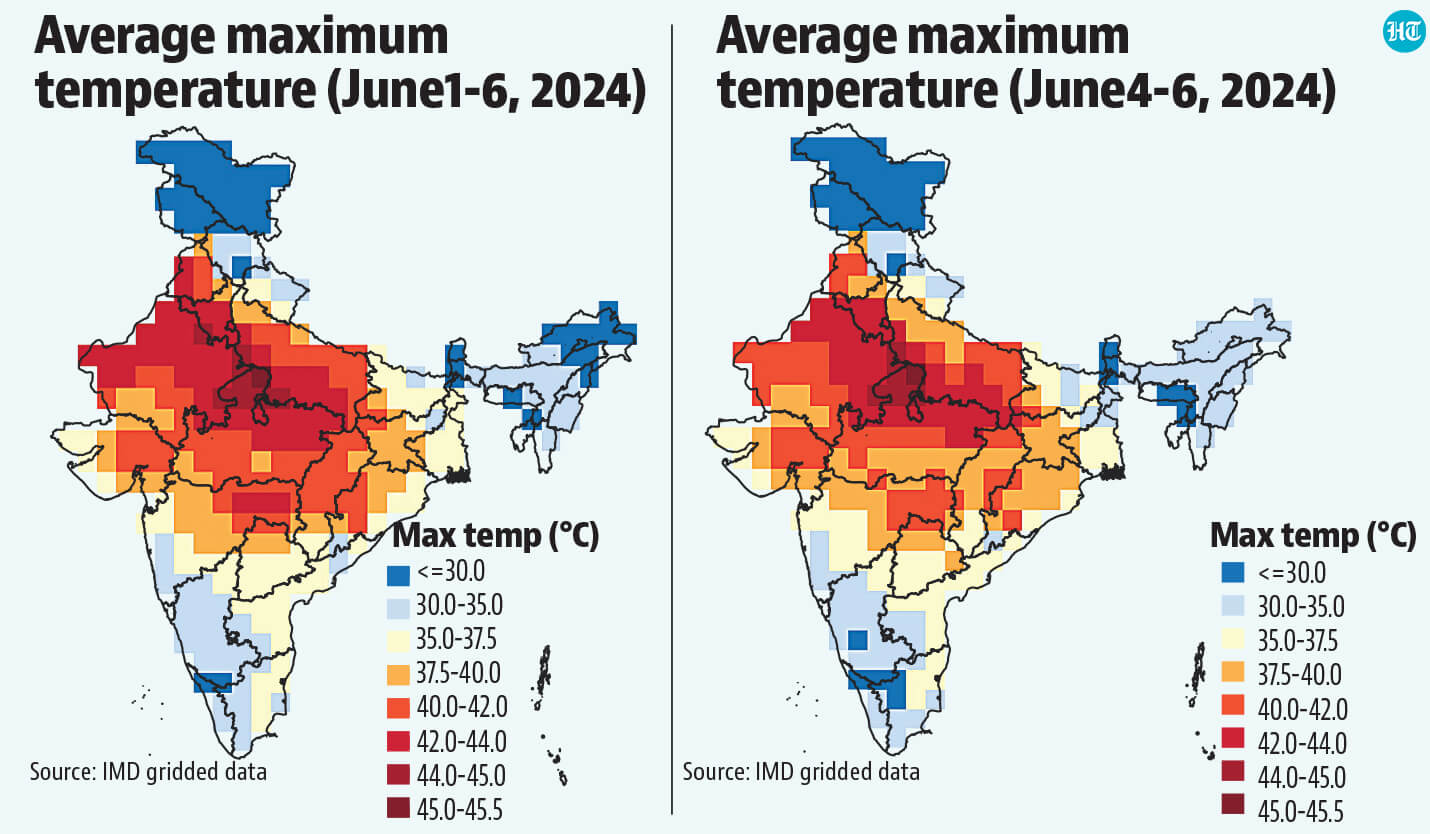
- Large parts of central, north-western India experienced average maximum of more than 40°C even in the second half of last weekOne should keep this in mind while reading the trend in maximum temperature’s deviation shown above. For example, Delhi’s average maximum was 43.6°C for the week overall compared to 43.2°C in the second half of the week. Similarly, while the maximum inched towards normal in large parts of central and north-western India during the course of last week, it did not become pleasant. Of the six states listed in the previous section, only Maharashtra had a majority of its area with a maximum averaging under 40°C in the second half of the week. In the other five – all of them central and north-western states – 66% to 87% of the area averaged a maximum of more than 40°C even in the second half of the week. To be sure, the area that experienced such high maximums did decrease in Punjab, Madhya Pradesh, and Uttar Pradesh.
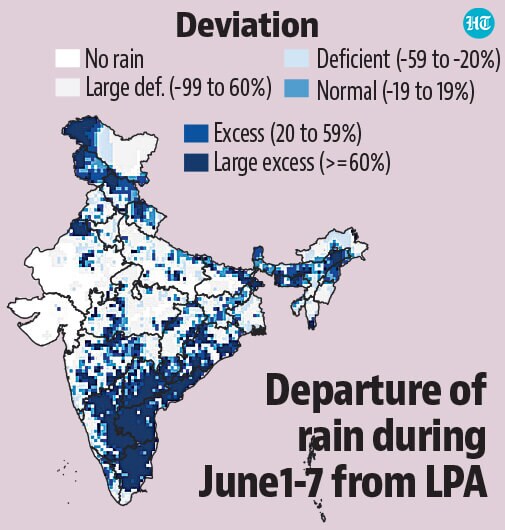
- And deficient rains are likely to have made the heat worse because of humidityThis is another thing to keep in mind while reading temperature trends during the monsoon season. Except Gujarat and southern half of Rajasthan, almost the entire country received some rain during the week. However, in central and north-western India, as well as parts of west coast, rains were deficient compared to the long period average (LPA), which is considered as the 1971-2020 average by the IMD currently. This means that there was moisture in these regions, but not enough for normal rain (departure of under 20% from LPA). This is why maximum temperatures decreased in these areas during the course of the week, but did not become normal except on the west coast. This is because the monsoon has arrived on the west coast; just not rained enough relative to LPA. In fact, the scant rains, especially in central and north-western India, made these places humid. Humidity decreases the ability of the human body to lose heat. This is the reason a small drop in maximum may not feel pleasant.