E-Paper



Number Theory: SAD and its importance in Punjab's poll contest
The SAD fought the 2022 assembly elections on its own after walking out of the National Democratic Alliance on the issues of three contentious farm laws.

 Prefer HTon Google


It would not be an exaggeration to say that Punjab has seen the biggest political churn among large Indian states in the last decade. In 2014, a traditionally bipolar Punjab polity made way for a three-cornered outcome with the Aam Aadmi Party (AAP) winning four parliamentary constituencies (PCs) from the state. Between 2014 and 2019, the AAP saw its footprint shrinking and the Congress became dominant in the state. However, things changed drastically in 2022 when the AAP won a landslide victory in the state elections with the Congress finishing a distant second. An even bigger outcome of the 2022 contest was the almost-complete decimation of the Shiromani Akali Dal (SAD). But with 2024 being a four-cornered contest between the AAP, Congress, the SAD and the Bharatiya Janata Party (BJP), the Akali Dal support base could very well be the 'X factor in the contest. Here are three charts which explain this in detail.

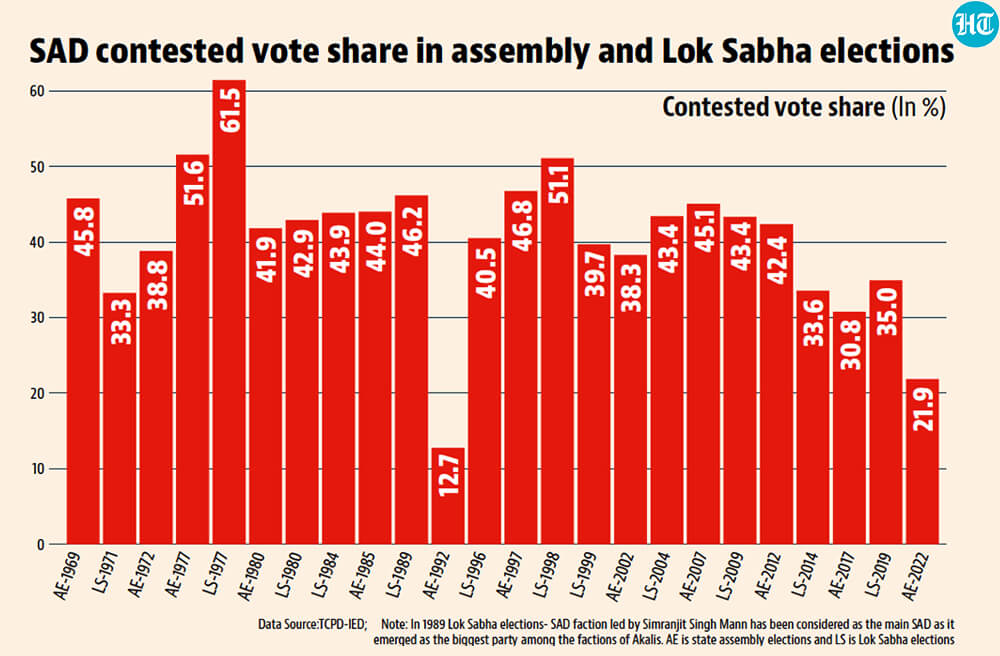
 SAD’s 2022 performance was the worst in its historyThe SAD fought the 2022 assembly elections on its own after walking out of the National Democratic Alliance (NDA) on the issues of the three farm laws which were introduced in 2020 and repealed in late 2021. The SAD and the BJP had been in an alliance in every elections in the state since 1998. The SAD managed to win just three assembly constituencies (ACs) in 2022 and saw its vote share falling to just 18.4%. Its contested vote share fell to 21.9%. On both these metrics, the SAD’s performance in the state was the worst in Punjab in every Lok Sabha and assembly election since 1969, except in 1992. The Akalis had contested only part of the assembly elections in 1992 and boycotted the polls in large parts of the state.
- Both the BJP and the SAD suffered losses across the state in 2022The end of a 23-year-old alliance between the BJP and the SAD did not help either party. A simple comparison of 2017 and 2022 election results shows this clearly. Out of the 117 ACs in the state, the SAD and the BJP fought 84 and 23 ACs in both the 2017 and 2022 assembly elections. The SAD saw its vote share coming down in 2022 in 78 out of the 84 ACs that it contested in both these elections. For the BJP the number was 19 out of the 23 ACs that it contested in both 2017 and 2022.
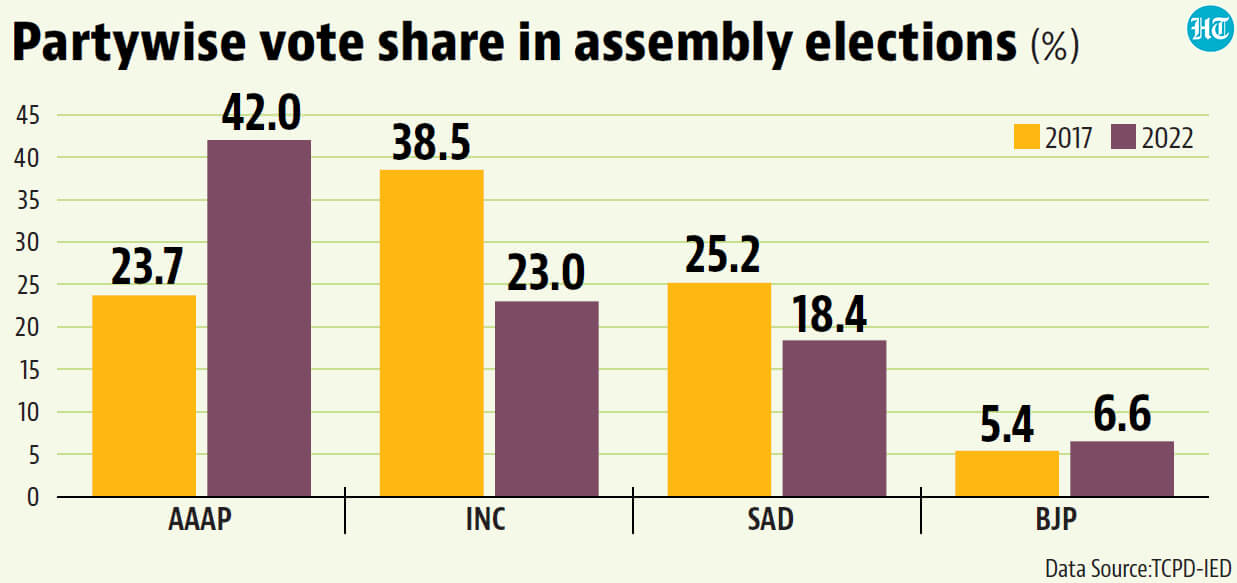
- To be sure, the AAP made a bigger dent in the Congress vote bank in the 2022 electionsA simple comparison of 2017 and 2022 party-wise vote shares make this clear. The AAP’s vote share increased from 23.7% to 42% between the 2017 and 2022 assembly elections. While the combined vote share of SAD-BJP went down from 30.6% to about 27% – to be sure, the BJP contested alone and SAD had an alliance with Bahujan Samaj Party – the Congress saw its vote share falling from 38.5% to 23%. This shows that the AAP’s victory was a result of a bipartisan political shift from the ranks of both the Congress and BJP-SAD in the state.
- Will 2024 be about national or local anti-incumbency in Punjab?The AAP and the Congress are fighting elections as adversaries in Punjab but are contesting against the BJP as allies in Delhi and Haryana. The BJP is trying to exploit this fact and hoping to establish itself as a credible political force in the state. It is entirely possible that the Congress and the AAP are contesting against each other to make the most of what seemed like an overwhelming anti-BJP sentiment in the 2022 Punjab elections. Between an anti-BJP friendly contest and the BJP trying to break new ground in the state, the SAD will face a tough battle to preserve its vote share and political salience in the 2024 elections. In these circumstances, even a fraction of the SAD’s support base gravitating towards the three parties, especially the AAP and Congress, could have a big impact on the electoral outcome in Punjab.