E-Paper



Number Theory: Social representation in council of ministers
This four-part data journalism series evaluated the social representativeness or lack of it in all councils of ministers in India.
Updated on: Aug 26, 2024, 08:52:29 IST

 Prefer HTon Google
Share via


Copy link

The third part of this series looked at state-wise inequality in the council of ministers dataset. The concluding part will look at party-wise representation and its role in social inequality in the council of ministers.
Social representation in council of ministers
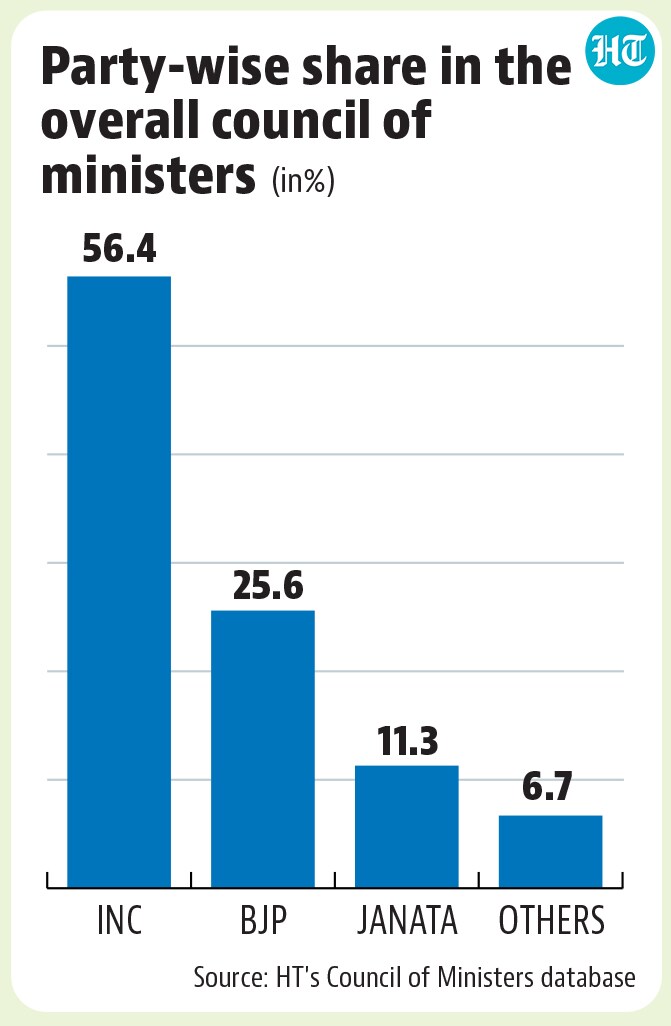
 Over half the people who have been in the Council of Ministers are from CongressOut of the 3,278 persons in the council of ministers dataset, 56.4% are from Congress, which is only to be expected because the party formed 10 of the 18 governments that have administered India . The Bhartiya Janata Party (BJP) is the party with the second-highest share in the council of ministers, but its overall share is less than half of what it is for the Congress. The party formed six governments but one lasted only 13 days and another 13 months (reducing opportunities for reshuffles). This analysis has treated parties which had a temporary split with the Congress as part of the Congress. This includes parties such as the Congress Requisitionists, Congress Organisation, Devraj Urs Congress etc. However, parties such as the Nationalist Congress Party or the Trinamool Congress which split but never went back to the Congress have been kept separate. The dataset has clubbed parties which emerged out of the socialist or Janata Party eco-system in the wider Janata group. This includes parties such as the Janata Dal-United, Rashtriya Janata Dal and Samajwadi Party.
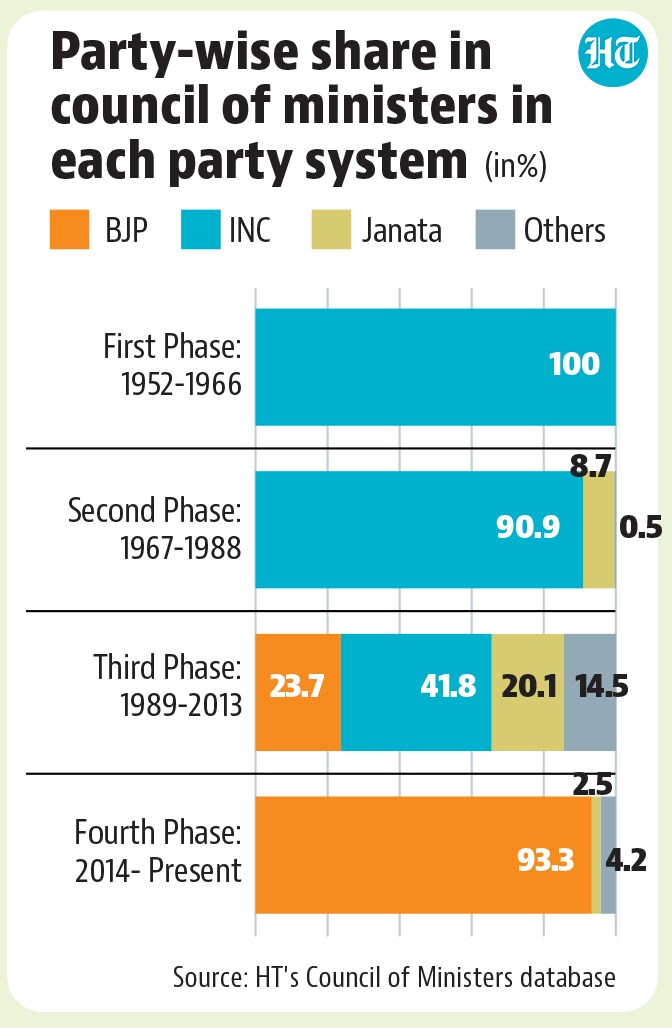
- ...As is to be expected, the Congress’s share in the Council of Ministers has fallen significantly in each successive ‘party system’ in India. Political scientists generally ascribe India’s post-independence political trajectory to four party systems. They include the periods from 1952-1967 to describe the first phase under absolute Congress dominance phase two is from 1967 to 1988. The third phase starts with the 1989 Lok Sabha elections till 2013 and the last and most recent phase ushered in with the triumph of BJP in 2014. Data shows that the first and second phases were marked by complete Congress dominance-- Congress share was above 90% in these two phases. BJP dominates phase four of the party system. In the third phase-- BJP, Congress, Janata, and others have a share of 23.7%, 41.8%, 20.1%, and 14.5% respectively.
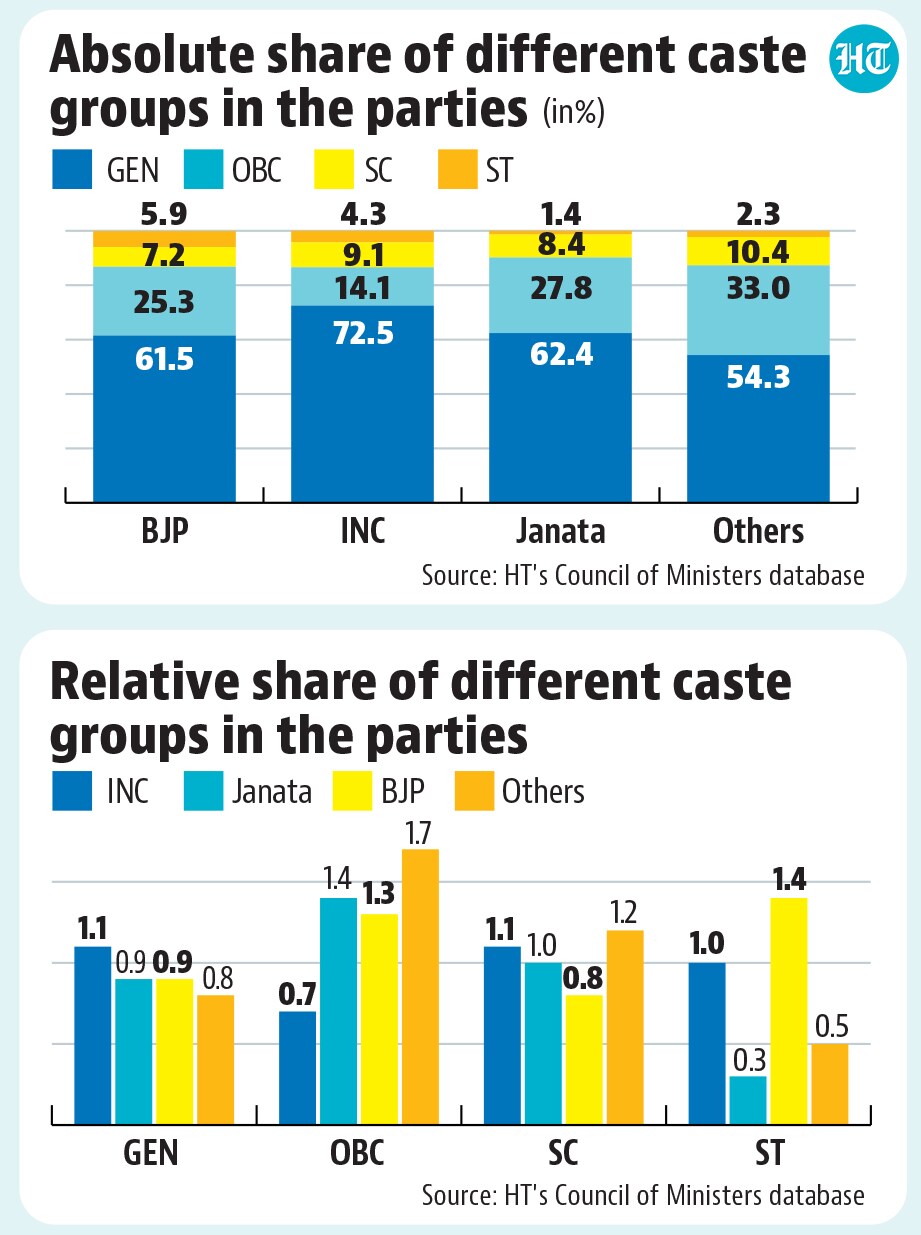
- Congress also has the largest share of upper castes in the council of ministersA simple social break-up of party-wise members in the entire council of Ministers dataset shows that the Congress has the highest absolute and relative share of non-SC-ST-OBC members. It is important to look at relative shares as well because the overall share of parties is different in the total council of ministers. Relative share gives us an idea about the intra-party variation in the share of different caste groups. It is calculated as the ratio of a party’s share in a particular caste group and the party’s overall share in the portfolios. Congress has the highest relative share among the upper castes at 1.1. BJP has a relative share of 1.3 for the OBC groups. OBCs have the highest relative share in the other categories followed by Janata at 1.7 and 1.4 respectively. BJP also has the highest relative share for ST groups at 1.4 while Janata has the lowest relative share at 0.3. Among the SC groups, Congress has the highest relative share at 1.1 while it is lowest for BJP at 0.8.
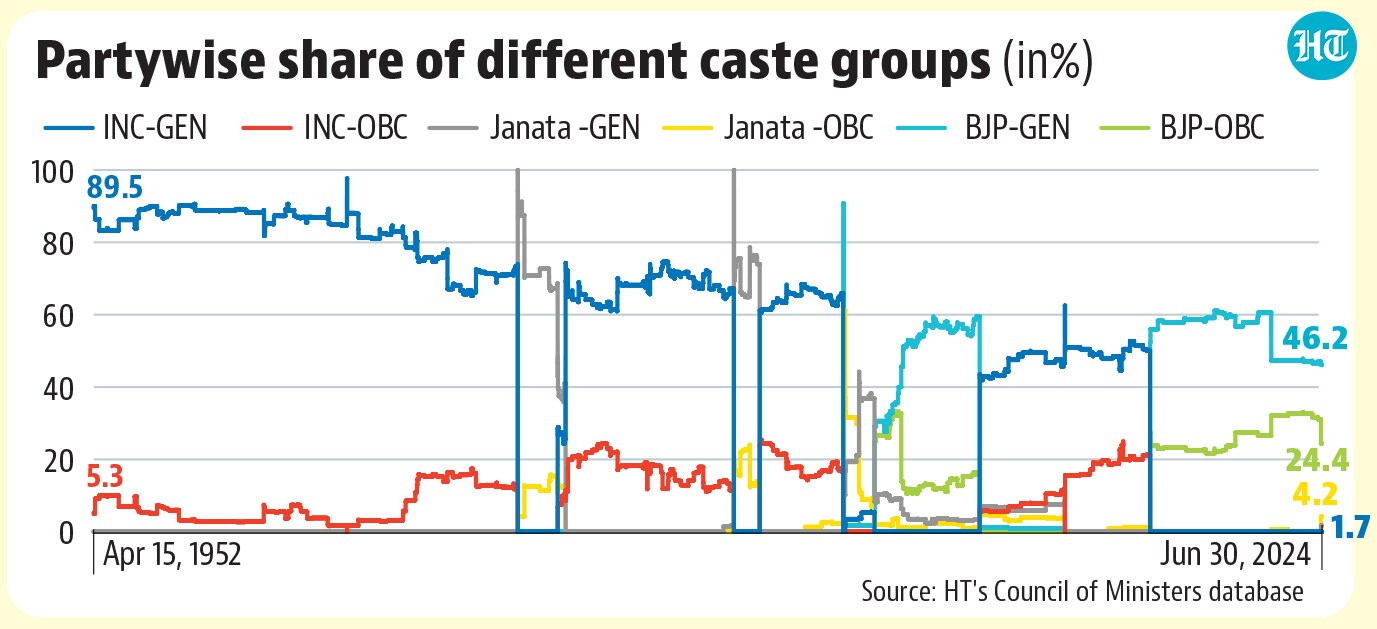
- Is there parity in the caste composition of the council across parties in similar periods?This is an interesting question to ask because one can make an argument that the overrepresentation of non-SC-ST-OBC ministers in Congress is a result of its political dominance in a period when upper caste dominance was much larger in politics. One way to check this claim is to look at the party-wise caste composition of the council of ministers in the different party-system periods. A phase-wise analysis shows that the share of non-SC-ST-OBC groups in Congress has decreased by sixteen percentage points between the first and second phases. It further decreased by 4.5 percentage points between the second and third phases for the Congress. BJP was non-existent during the first two phases of Indian politics. Non-SC-ST-OBC group’s share in BJP portfolios has decreased by fourteen percentage points between the third and fourth phases. OBCs’ share in the BJP’s portfolios has increased by 8.3 percentage points between the third and fourth phases. These numbers suggest that all parties have become more socially inclusive in sharing executive power among castes, even though none of them are observing perfect equality.