E-Paper



Number Theory: The JD(U) risk to the NDA in Bihar
How much will the JD(U) matter for the NDA’s performance in Bihar in these elections? Here are three charts which answer this question

 Prefer HTon Google


With 16 candidates in the state of Bihar, the Janata Dal (United) is the second largest alliance partner of the Bhartiya Janata Party (BJP) in these elections. While the BJP and the JD(U) have had a long and very successful alliance history in Bihar, both the JD (U) and its leader Nitish Kumar are expected to have lost some of their political capital because of the latter’s repeated somersaults since 2014. This makes the JD(U) a big risk to the NDA’s and possibly even the BJP’s 2024 performance in Bihar which sends 40 MPs to the Lok Sabha. Some of these issues were discussed in these pages in an earlier story. But how much will the JD(U) matter for the NDA’s performance in Bihar in these elections? Here are three charts which answer this question.
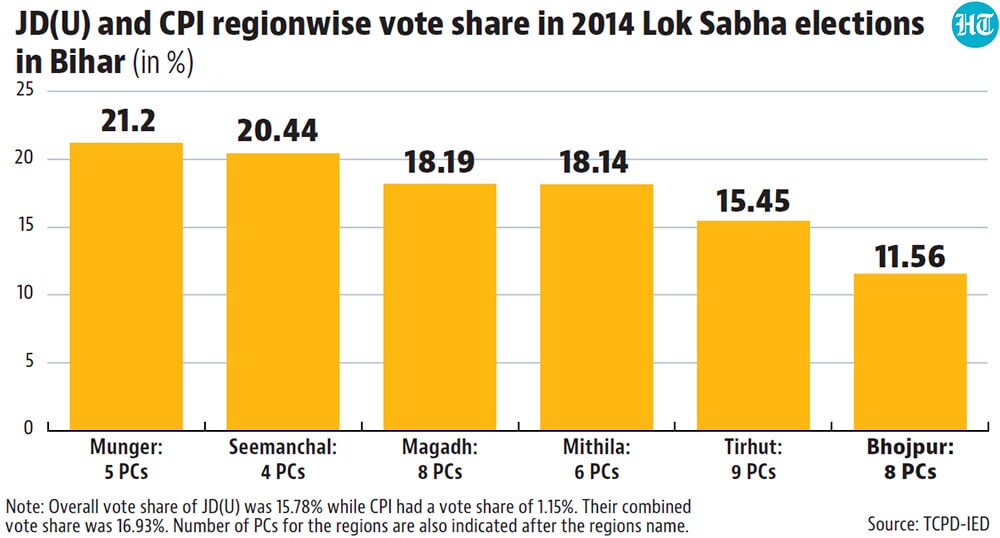
 How big is the JD(U)’s support base in Bihar?Because it has never contested an election on its own, this is not an easy question to answer. The closest one can get to answering this question is by looking at the JD(U)’s performance in the 2014 Lok Sabha elections. Nitish Kumar walked out of the NDA in 2013 after opposing Narendra Modi’s candidature for the prime minister’s post and contested 38 out of the 40 PCs in Bihar while he gave two to the Communist Party of India (CPI) in the 2014 Lok Sabha elections. The combined vote share of the JD(U) and the CPI in the 2014 elections was almost 17% and the JD(U) managed to win two PCs. To be sure, a sub-region wise analysis of the vote share of JD(U) and CPI in these elections shows that its support was not uniform across the state.
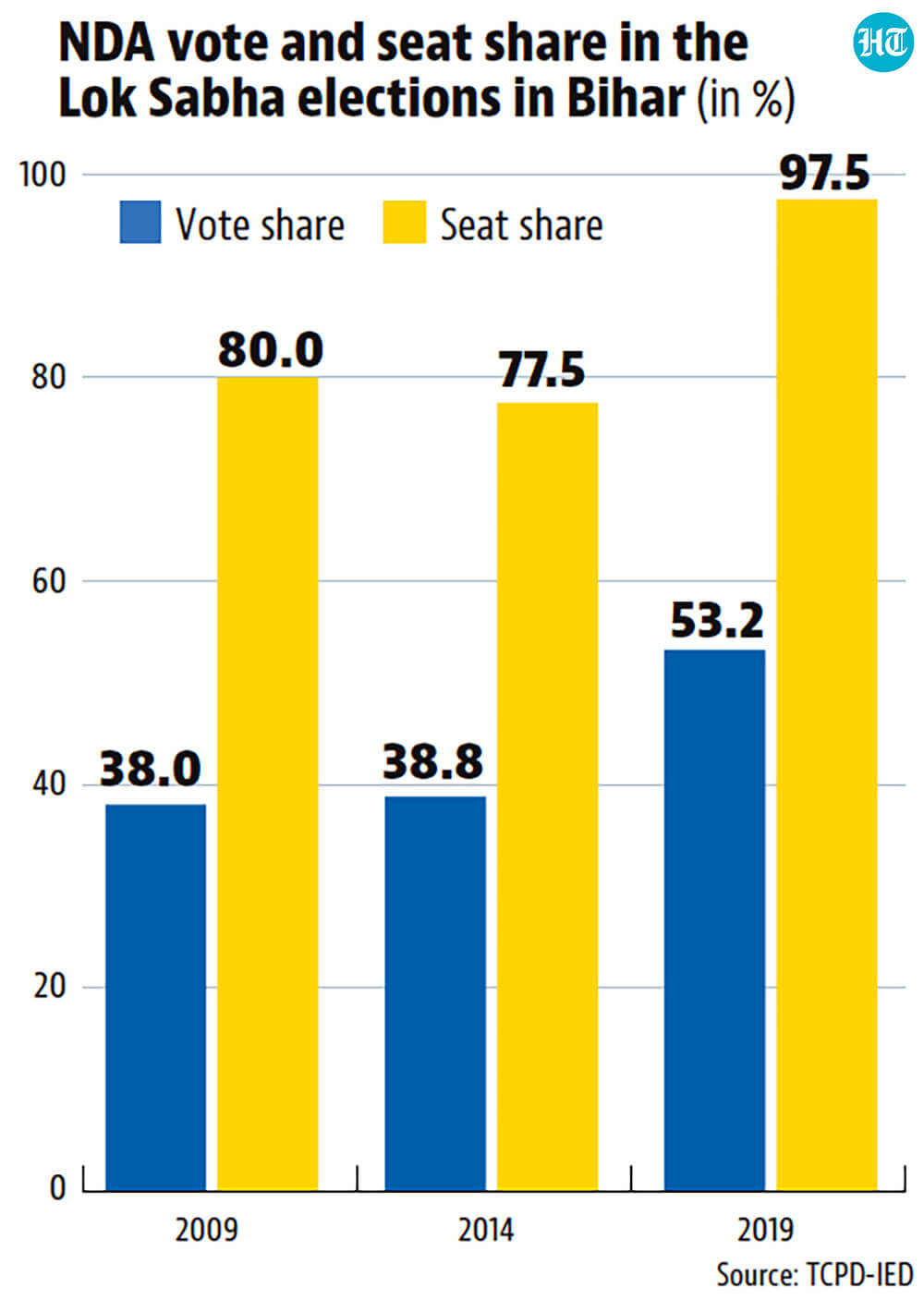
- What does JD(U) bring to the NDA in Bihar?This is also an interesting question because the answer seems to have changed after 2014. The JD(U) and BJP won 32 out of the 40 PCs in Bihar in the 2009 Lok Sabha elections with a combined vote share of 38%. When the BJP contested the 2014 Lok Sabha elections without the JD(U) but along with other smaller allies, NDA vote share and seat share largely remained unchanged at 38.8% and 77.5%. However, when the JD(U) rejoined the NDA in 2019, its vote share increased by 14.5 percentage points to reach a formidable 53.25% and it won 39 out of 40 PCs in the state. The fact that the JD(U) contesting separately in 2014 did not bring down the NDA’s vote share but its rejoining the NDA in 2019 led to a big jump in the NDA’s vote share makes the importance of JD(U) a tricky question for the BJP. To be sure, the BJP’s main worry about not aligning with the JD(U) could have been the prospect of the latter joining the Rashtriya Janata Dal (RJD) and its allies instead of fighting alone. The grand alliance of RJD, JD(U) and the Congress decimated the NDA in the 2015 assembly elections in Bihar with a vote share and seat share of 41.8% and 73.3%.
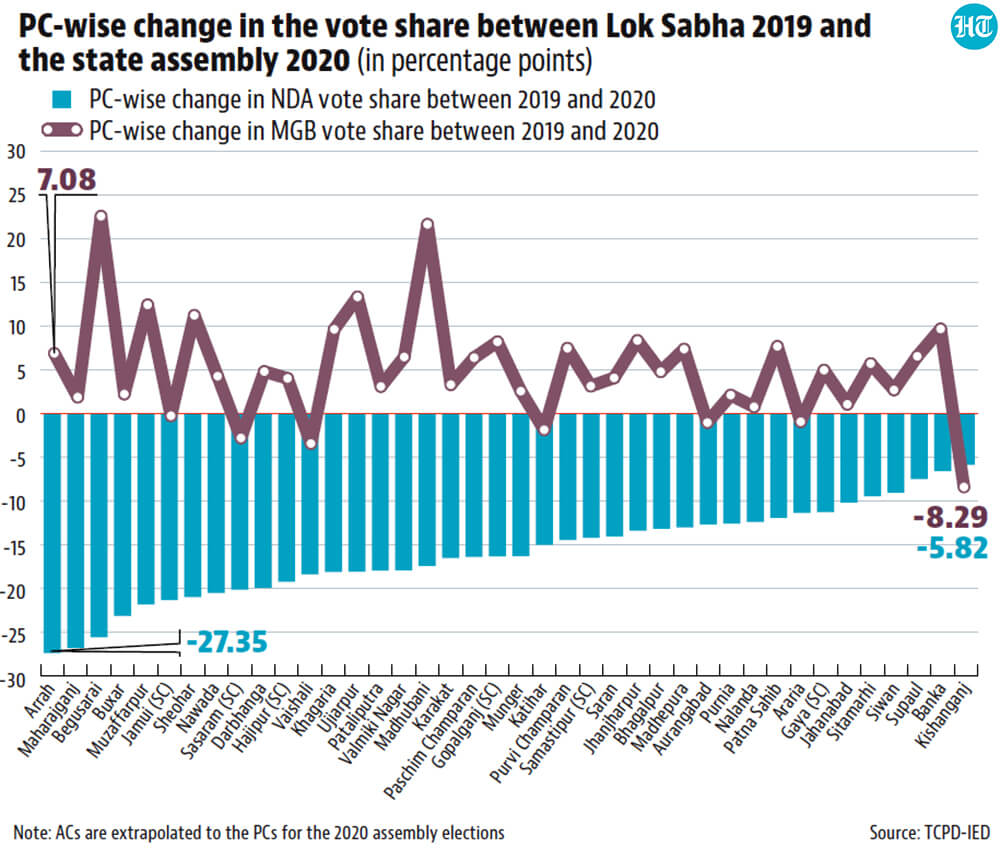
- The 2020 elections raised questions on the strength of the NDA even with JD(U)The 2020 assembly elections in Bihar were held just over a year after the 2019 Lok Sabha elections. The NDA’s seat share fell from 97.5% in 2019 to just 51.45% in the assembly elections and its vote share dropped by a massive 16 percentage points to just 37.26%. While the BJP doing better in a national election has become a stylised fact of sorts in the post-214 period, what should worry the NDA is the disproportionate fall in the JD(U)’s performance within the alliance in the 2020 elections, which had a strike rate of just 37.4% compared to the BJP’s 67.3% figure. To be sure, what saved the NDA from an outright defeat was the fact that the erosion in NDA’s vote share between 2019 and 2020 did not translate into a one-to-one gain for the RJD led alliance. Greater fragmentation because of state elections and the role of the Lok Janshakti Party (LJP) which contested 135 ACs in the state; 115 of them were also being contested by the JD(U), might have played a role in this. While the JD(U) lost 28 ACs where the LJP acted as a spoiler, it also won 26 ACs where the LJP played spoiler.
- With no LJP like shock absorber in the fray in 2024 elections, and the JD(U)’s and Nitish Kumar’s own popularity under bigger doubt than ever, does the NDA run the risk of anti JD(U) votes consolidating behind the RJD led alliance in a bigger way than they did in 2020? We will know the answer on June 4 when votes are counted.