E-Paper



Number Theory: The relationship between migration and religion
Globally, Christians, Muslims, Jews are more likely to move out of the country they were born in as they make a higher share of migrants than overall population

 Prefer HTon Google


Migration, especially its religious and cultural aspects, are becoming more and more politically important and contentious today. What do we know about the relation between religion and migration in the world? Are people from some nationalities or religious groups more likely to migrate than others? What has been happening to the relationship between religion and migration over time? A report by the Pew Research Centre – a global nonprofit – released on Monday gives an insight into some of these questions.

The report focuses on “existing stocks of international migrants – all people who now live outside their birth country, no matter when they left”. This does not include short-term visitors such as tourists or naturalised citizens whose parents were migrants. It uses census and survey-based estimates to arrive at its findings, some of which might involve a fair bit for approximation. Here is a summary of some of the major findings in the report.
 Although the number of migrants has increased, their religious composition hasn’t changed muchIn the last three decades (1990-2020), the global migrant population has grown significantly by 83%, outpacing the global population growth of 47%. Migrants now represent 3.6% of the world’s population numbering over 280 million people living outside their country of birth. In absolute terms, migrants from all religious groups have seen a rise in their numbers between 1990 and 2020. However, the religious composition of global haven’t seen much change.
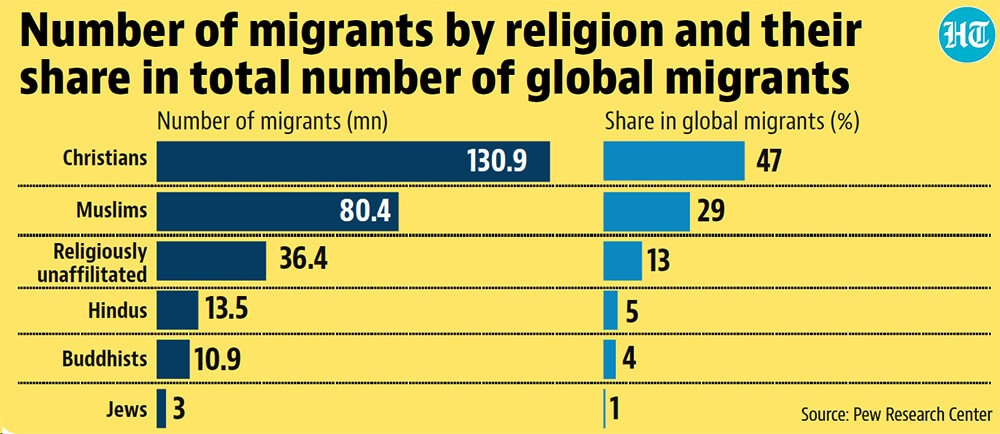
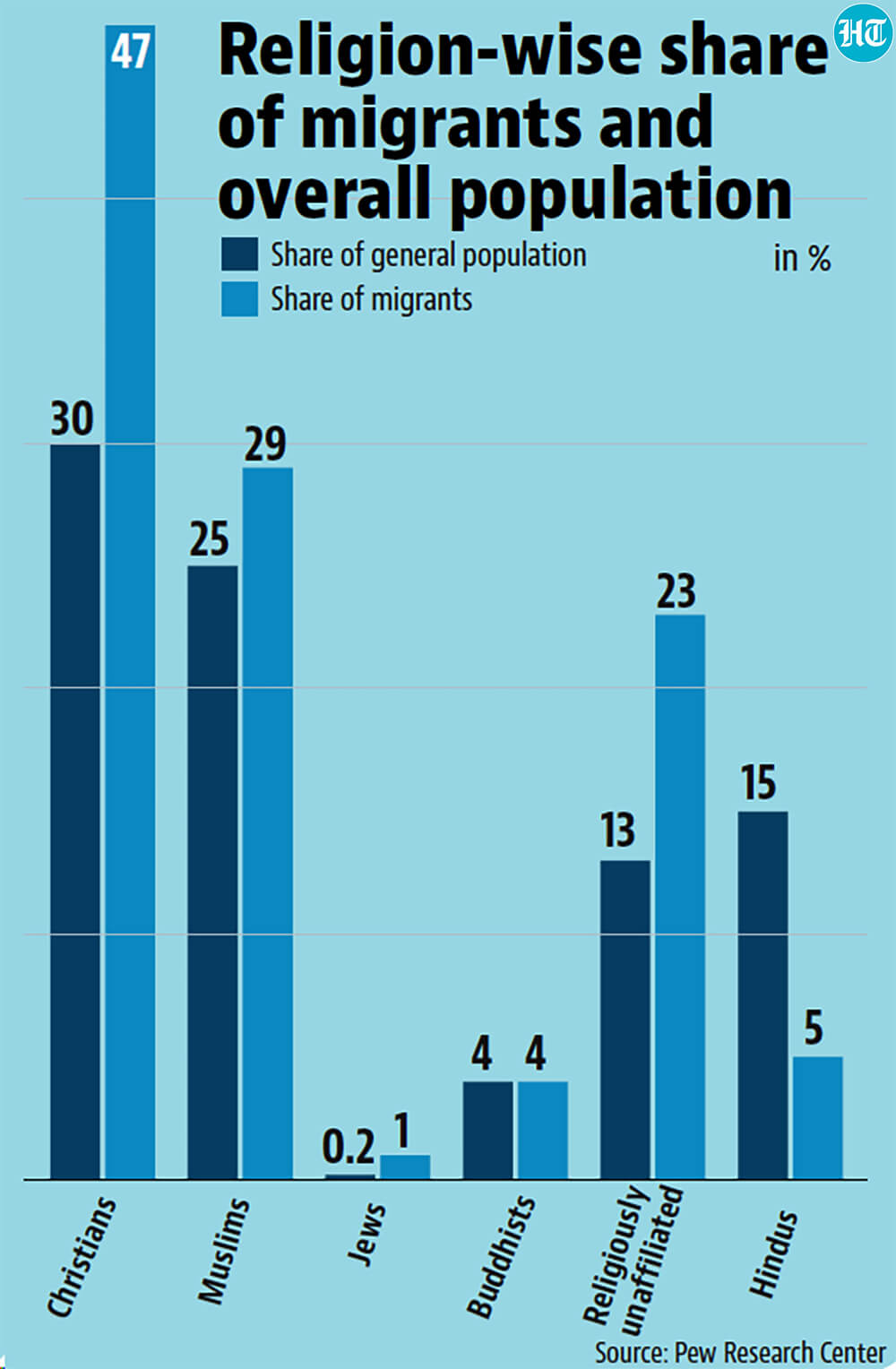
- Some religious groups are more likely to migrate than othersGlobally, Christians, Muslims, and Jews are more likely to move out of the country they were born in as they make a higher share of migrants than of the overall population. Christians account for 47% of all migrants globally, but their share in world population is only 30%. Meanwhile, Muslims, whose share in the world population is 25%, account for 29% of the migrants globally. And Jews, whose population is just 0.2% of the world population, account for 1% of global migrants. To be sure, out of the 2.5 million Jewish migrants in the world, 1.5 million live in Israel. On the other hand, Hindus are starkly underrepresented among international migrants, accounting for only 5%, compared with their 15% share of the global population. However, Hindu migrants, when they do migrate, are likely to cover the largest distance. The average distance between the birth country and country of residence of a Hindu migrant is 4,989km. Christian and Muslim migrants on average travel 3,862km and 2,735.88km respectively from their country of residence . This is not surprising as 44.2% of Hindus who have migrated (most of them lived in India) have moved to the United States, United Arab Emirates and Saudi Arabia.
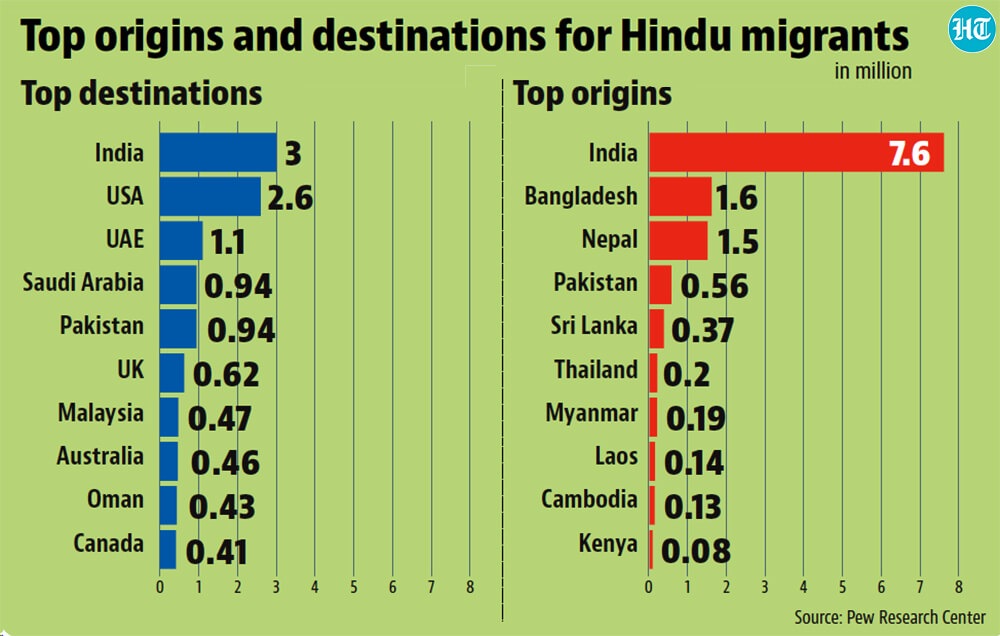
- India is both the top destination and origin for Hindu migrantsIndia has become a bigger source of out-migrants than a destination for in-migrants according to the report. While the number of Indian migrants living outside (or emigrants) has increased almost three times between 1990 to 2020 to 18.6 million, the number of migrants who were living in India (or immigrants) fell from 7.6 million to 5 million during this period. To be sure, most of the migrants living in India were labelled as such because they came to the country after Partition in 1947, and the fall in the number of in-migrants is a largely a result of death due to ageing. Globally, 22% of Hindu in-migrants (3 million) have moved to India, making it the top destination for Hindu migrants. India is also the biggest source for Hindu out-migrants, with 7.6 million Hindus born in India now living elsewhere.
- But India is also the second-largest country of origin for Muslim migrantsThe report also shows that India is the second-largest country of origin for Muslims migrants after Syria, which has seen an exodus after a bloody conflict since the last decade. This is largely a result of two factors: high Muslim population of India in absolute terms and a higher propensity of Muslims to migrate out of India than Hindus. According to Pew, as of 2020, India had 229.62 million Muslims, just 16.28 million short of the number of Muslims in Indonesia, which has the highest population of those following the religion. “The religious mix of migrants who have left India is very different from the religious composition of the country at large, as of 2020. Those who have left India are about half as likely to be Hindu as those who remain (41% vs. 79%). They are more than twice as likely as those who remain to be Muslim (33% vs. 15%), and about eight times as likely to be Christian (16% vs. 2%),” the report said.