E-Paper



Number Theory: Three crucial factors that will decide the Haryana elections
.
Updated on: Oct 4, 2024, 18:43:39 IST

 Prefer HTon Google
Share via


Copy link

All the 90 assembly constituencies (ACs) in Haryana are voting tomorrow. While the Bharatiya Janata Party (BJP) is hoping to form a government for the third consecutive time in the state, the Congress is looking to stage a comeback in Haryana after being out of power for 10 years. What are the key factors that are likely to affect the result of the Haryana elections? Here are three things that will matter.
Three factors which will decide the Haryana elections
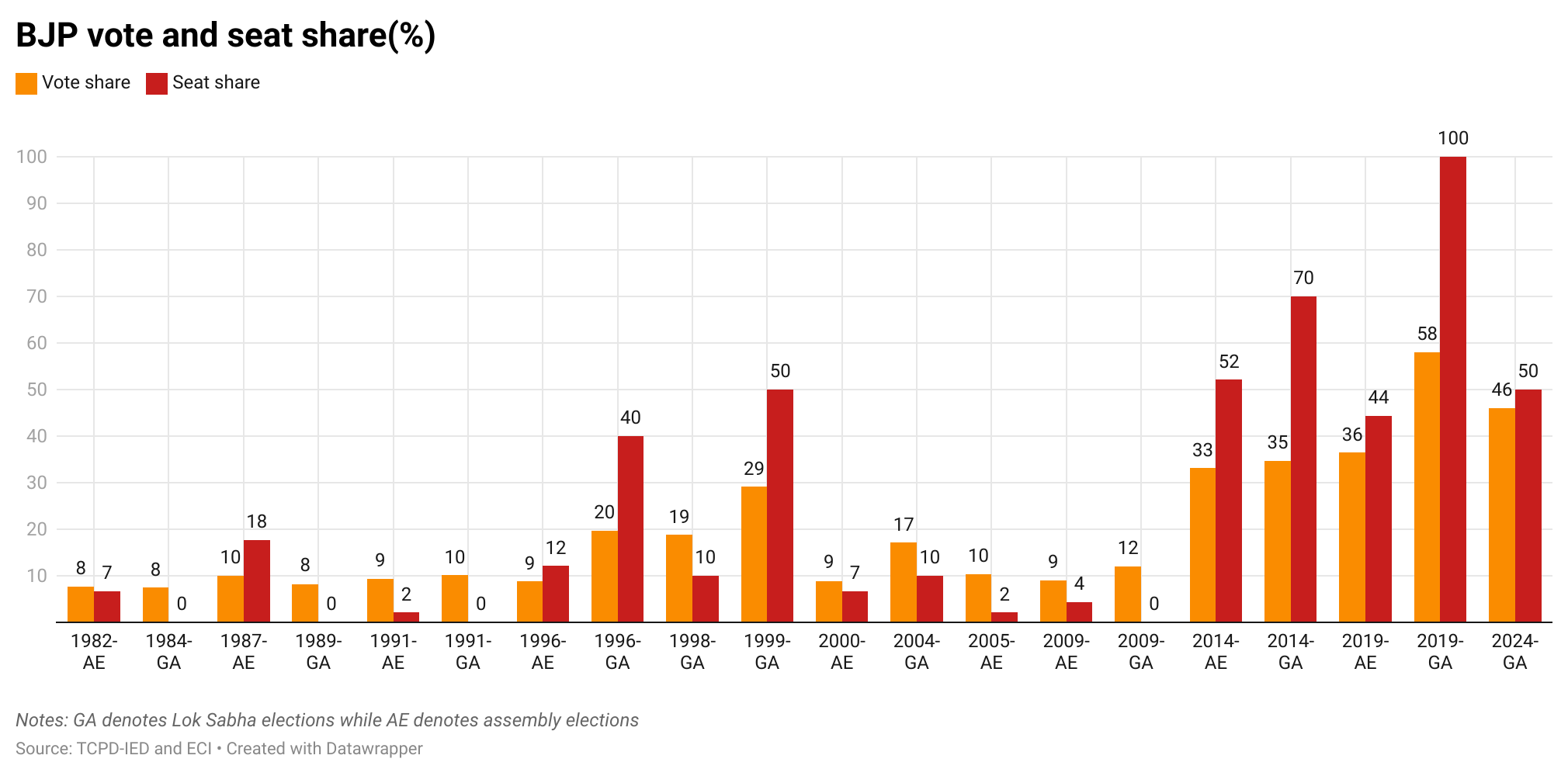
 What is the BJP’s core voter base in Haryana?The BJP never crossed the 30% vote share mark in any assembly or Lok Sabha elections in Haryana before the 2014 Lok Sabha elections when it won seven out of the ten parliamentary constituencies (PCs) in the state with a vote share of 34.7%. Its vote share reduced marginally in the 2014 assembly elections but improved significantly in the 2019 Lok Sabha elections, the numbers being 33.2% and 58.02% respectively. What made the 2019 assembly elections remarkable in Haryana was the fact that the BJP’s seat share went down despite an increase in its vote share compared to the 2014 assembly elections. This process continued in the 2024 Lok Sabha elections. BJP ended up with a lower seat share than its 2014 performance despite a higher vote share than 2024. Will the BJP retain its post-2014 threshold of at least one-third of the vote share this time? With its aura of invincibility significantly diluted after falling short of the majority mark in the 2024 Lok Sabha elections, this is not something which the BJP can take for granted anymore. To be sure, the fact that it managed to increase its vote share by 9.6 percentage points between the 2019 assembly and 2024 Lok Sabha elections underlines the fact that the BJP should not be written off.
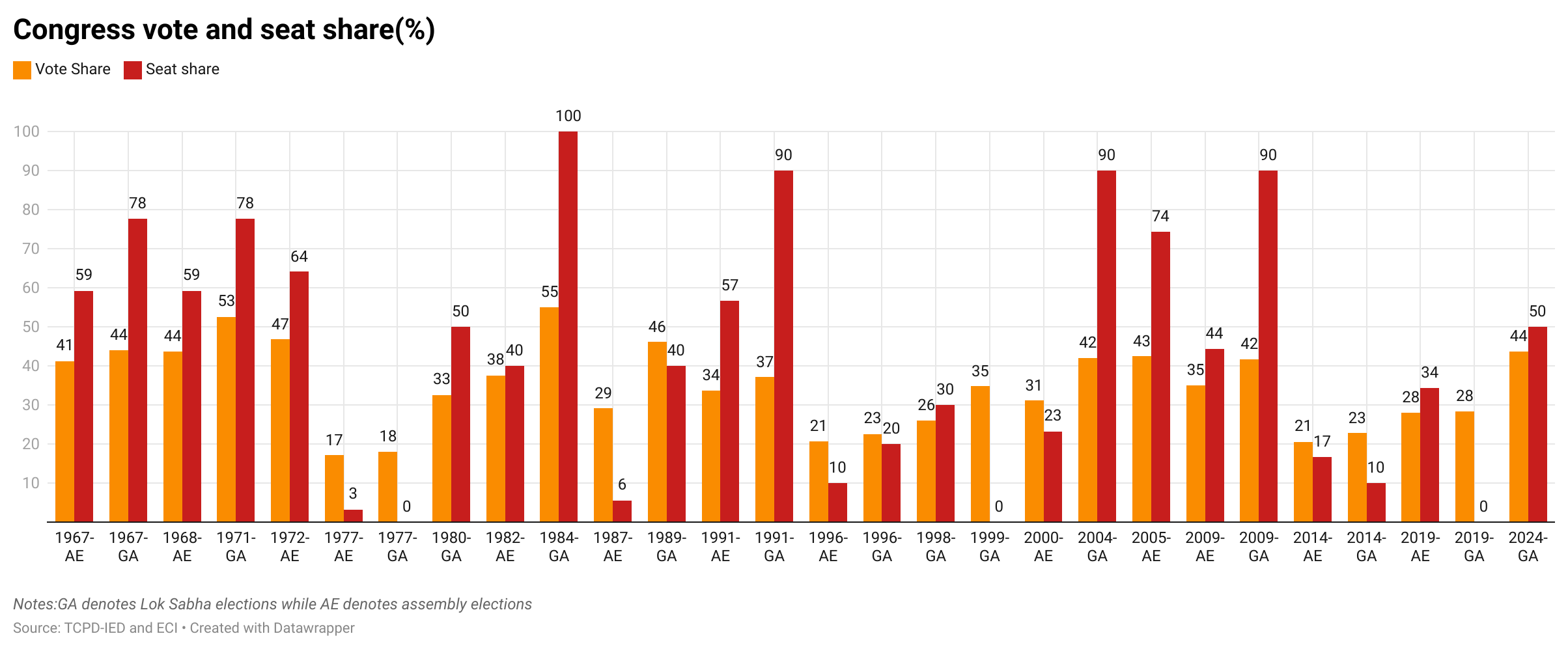
- How wide a social coalition has the Congress put together?Jat versus non-Jat is one of the most important political fault lines in Haryana’s politics. While there is no official data on the share of Jats in Haryana’s population, anecdotal estimates put their share between one-fifth and one-fourth. The Congress, especially under the leadership of the Hoodas, has been known to have its core support among the Jats, which is also reflected in its candidature with 29.2% of its candidates being from the community. But the numerical and social dominance of the Jats has also led to an anti-Jat counter-polarisation in Haryana, something the BJP has consciously tried to exploit by appointing non-Jat chief ministers since 2014. This means that Congress has to ensure it has a broad-based social coalition in place rather than just Jats. A long-term comparison of Congress vote share in assembly and Lok Sabha elections in Haryana shows that it managed to build such a coalition in the 2024 Lok Sabha elections after 15 years. The 2024 vote share of the Congress is the highest for the party in any Lok Sabha and assembly election in the state since 1989. If one were to add the vote share of the Aam Admi Party as well which contested one parliamentary constituency as the Congress’s alliance partner, this number would increase further. Will this broad social coalition hold for the Congress? If it does, a landslide victory could be on the cards.
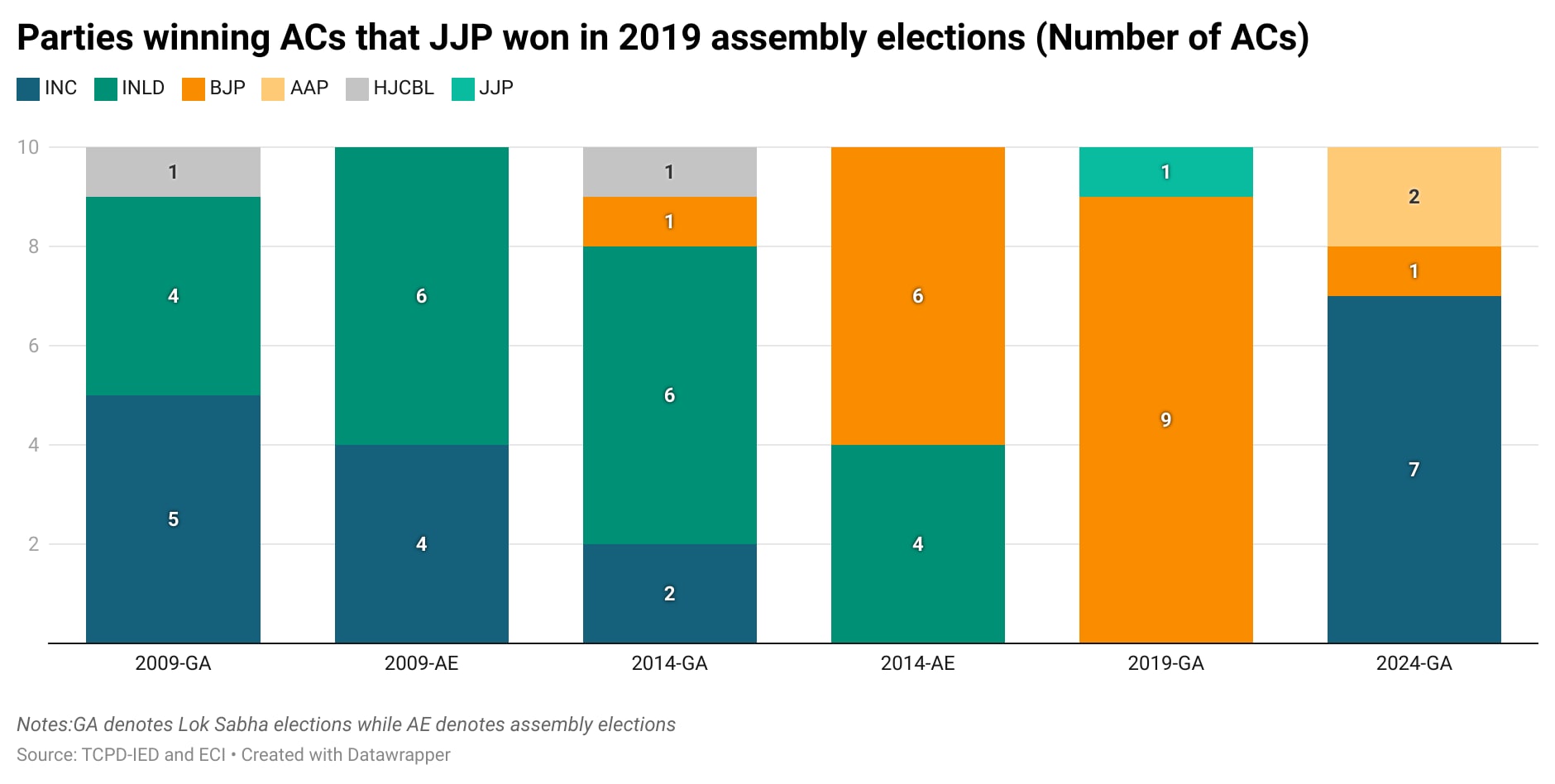
- Who gains if the election becomes more bipolar?This is among the most interesting questions about the Haryana contest. The BJP formed its government in Haryana with support from 10 MLAs of the JJP (Jannayak Janata Party) in 2019. The JJP is a splinter of the Indian National Lok Dal (INLD) and is known to have maximum appeal within Jats. The BJP refused to have a seat-sharing with the JJP in the 2024 Lok Sabha and assembly elections. What will happen if the 2024 assembly elections become a straight contest between the Congress and the BJP? Reading the median ENOP of previous assembly elections in Haryana with the results shows that there is no obvious party that gains when the ENOP rises or falls. For example, Congress’s seat share fell by a massive 27.8 percentage points between the 2009 and 2014 elections despite very little change in the median ENOP. ENOP is defined as the reciprocal of the sum of squares of the vote share of all candidates in a constituency, and a higher value indicates greater political fragmentation in the elections. For example, if there are four candidates in a constituency and they receive 26%, 25%, 25%, and 24% of the votes, the ENOP value will be 3.99. If these vote share numbers change to 50%, 45%, 3%, and 2%, ENOP will fall to 2.2. Another piece of statistic suggests that Congress could make some gains if the JJP were to atrophy in these elections. The JJP, which made its electoral debut in the 2019 Lok Sabha elections in Haryana, won 10 ACs in the 2019 assembly elections. The Congress-AAP alliance won 9 out of these 10 ACs in the 2024 Lok Sabha elections, something it had not managed to do since the 2009 Lok Sabha elections. A comparison of pre-2009 results is not possible because AC boundaries changed in the 2008 delimitation.