E-Paper



Number Theory: What explains the JMM’s massive victory in Jharkhand?
After all, the JMM alliance won the elections even in 2019 and the BJP alliance has largely maintained its seat tally between 2019 (25) and 2024 (24)
Updated on: Nov 29, 2024, 10:41:45 IST

 Prefer HTon Google
Share via


Copy link

The Jharkhand Mukti Morcha (JMM) led alliance has won 56 out of the 81 assembly constituencies (ACs) in Jharkhand, making it the largest ever mandate in the history of the state. What explains this historic result in the state? After all, the JMM alliance won the elections even in 2019 and the Bharatiya Janata Party (BJP) alliance has largely maintained its seat tally between 2019 (25) and 2024 (24). Here are four charts which explain what happened.
 The simplest explanation of these results is an ST versus non-ST consolidationThis becomes clear if one were to compare strike rates of the JMM and BJP led alliances with share of Scheduled Tribe (ST) population in Jharkhand’s 24 districts. The JMM alliance’s seat share and strike rate show a strong positive correlation with share of ST population and BJP’s shows an almost equal negative correlation. Simply put, this means that JMM and its allies did better in places with high ST population.
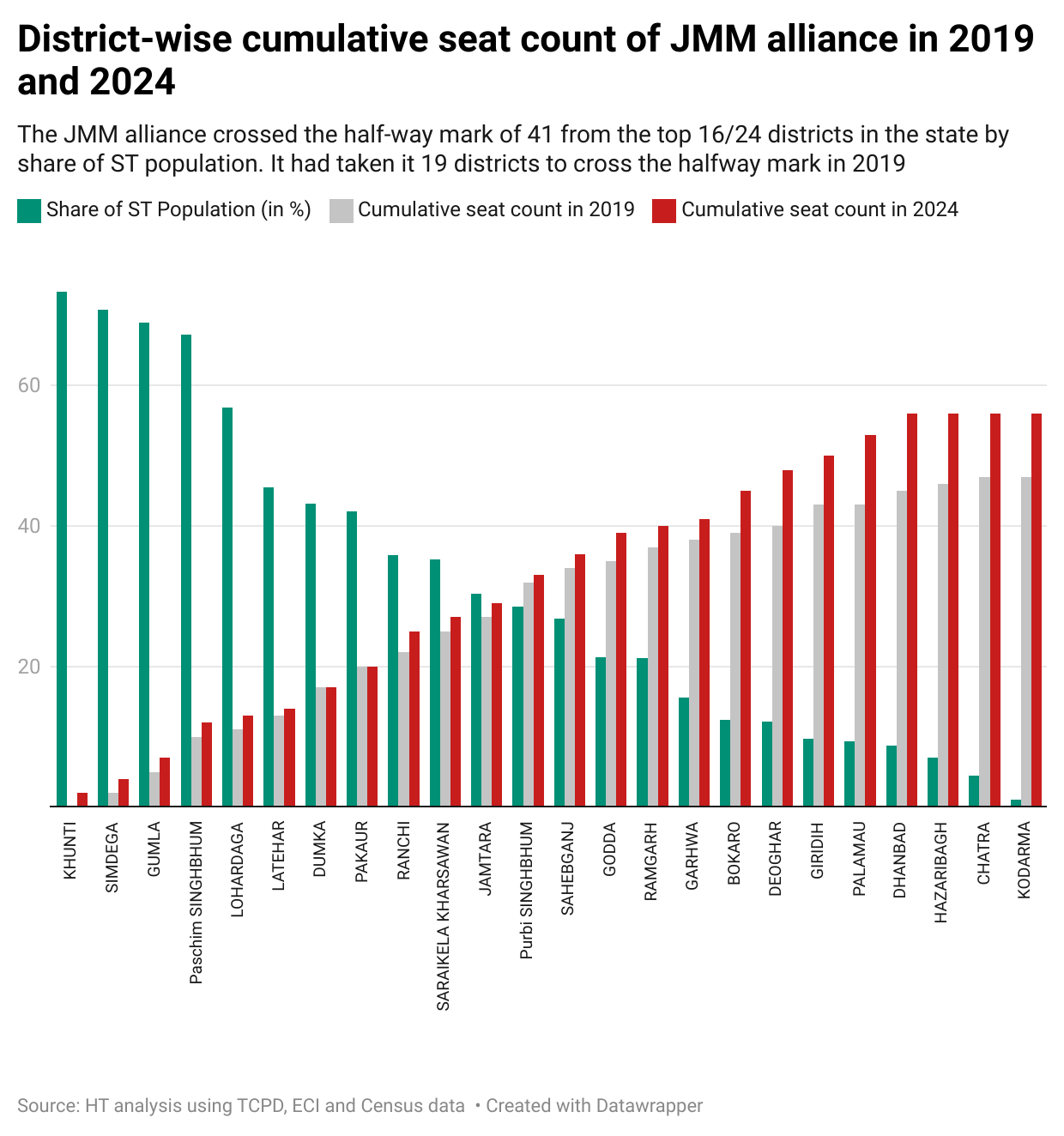
- But the JMM alliance improved its performance in districts with lower ST population as wellThe best way to look at this is to track JMM alliance’s cumulative seat count in districts arranged by the share of ST population. The share of STs falls from 73% in Simdega district of Jharkhand to just 1% in Kodarma. If all the districts were arranged in descending order of ST population, the JMM alliance would have crossed the half-way mark of 41 in Giridih district (ranked 19th among 24 districts by ST population share) in the 2019 elections. In 2024 it crossed this threshold in Garwah district (ranked 16th) itself. What is even more interesting is the fact that the JMM alliance added 15 ACs to its tally in districts with lower ST population than Garwah in 2024. This number was just nine in the 2019 elections. This what makes its win historic.
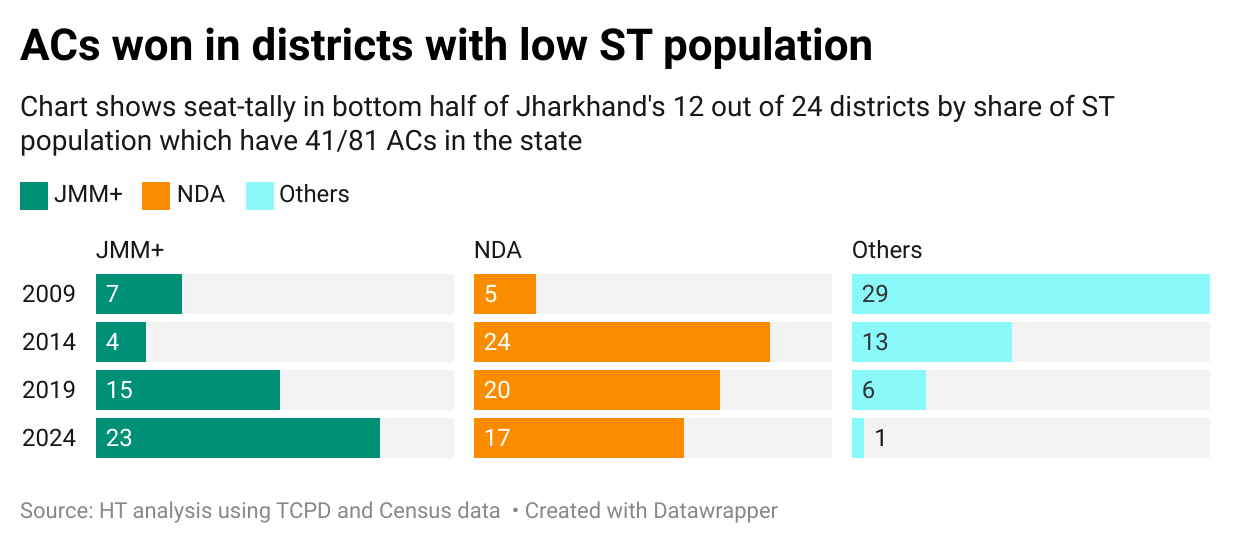
- In both high and low ST population parts of the state, the real story is a decimation of non-aligned political partiesThis is among the most interesting aspects of the Jharkhand results. If one were to divide Jharkhand’s 24 districts into 12 each with lowest and highest share of ST population, the former would have 41 out of the 81 ACs and the latter the remaining 40. Both the JMM and BJP alliances have increased their seat count in the districts in the top half of ST population share between 2019 and 2024. This has come at the cost of non-aligned political parties whose seat count has fallen from three to zero. In the bottom half of districts by ST population share, the story is slightly different. Not only has the seat count of non-aligned parties fallen from six to just one, even the BJP alliance has seen a fall in its tally from 20 to 17, leading to a massive gain of eight ACs (in Jharkhand it is 10% of the total ACs) for the JMM alliance. It needs to be kept in mind that the JMM expanded its alliance by bringing in the Communist Party of India Marxist-Leninist Liberation (CPI ML) which won one AC and finished second in another two in 2019. While the CPI ML won Bagodar AC in 2019 and did not finish second in any AC, it had already merged with the Marxist Coordination which finished second in Nirsa and Sindri ACs in 2019; CPI ML has won both these constituencies this time.
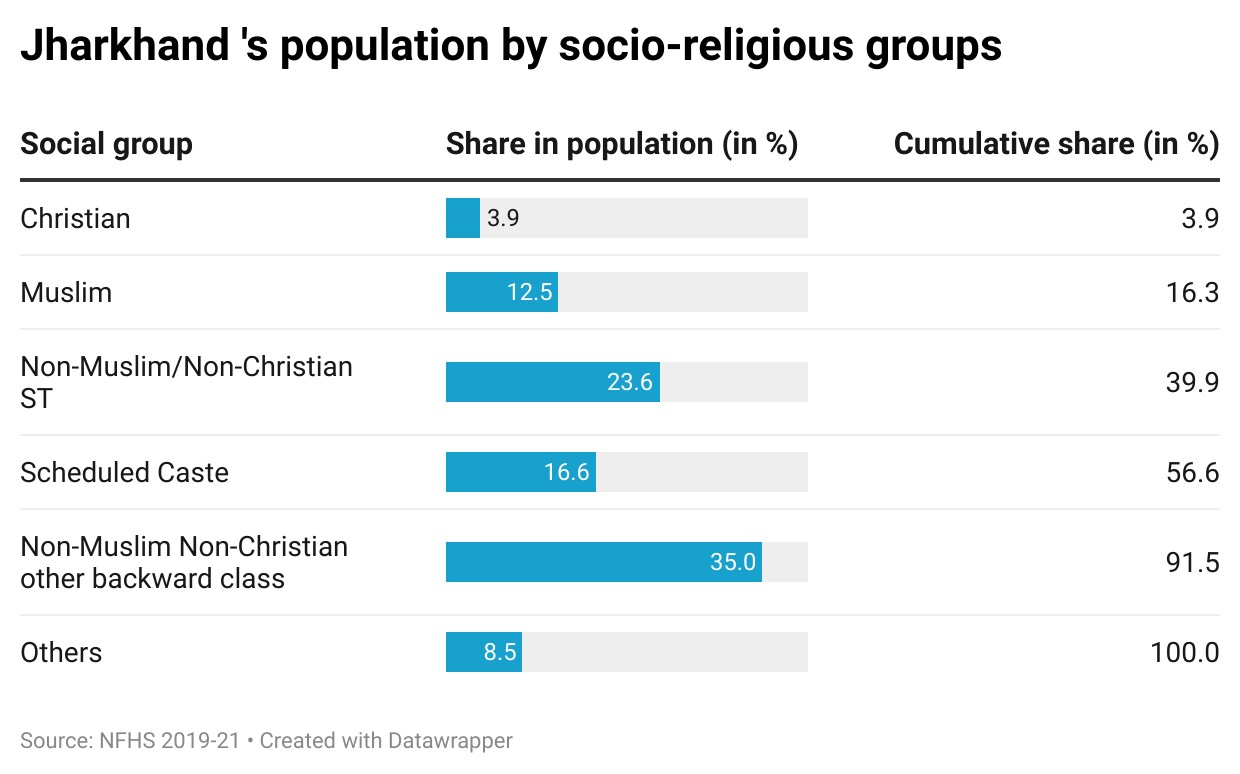
- At the root of the JMM’s success is a formidable social baseWhy have the anti-BJP parties been rallying around the JMM in Jharkhand? As can be seen in Chart 3B, the JMM established itself as the clear challenger to the BJP in the high-ST population districts even in 2014. The coming together of the Congress and JMM in 2019 took the JMM alliance way past the BJP in districts with high ST population although it was behind the BJP in the low-ST population districts. This time, the JMM used this new found dominance in the ST belt to build a broader collation getting parties such as the CPI ML. The CPI ML has won both its ACs in Dhanbad district which has an ST population of just 8.7%, the fourth lowest in the state. Also, part of the JMM’s success is on account of the BJP’s core politics. According to 2019-21 National Family Health Survey data, the combined population share of Christians (3.9%), Muslims (12.5%) and non-Muslim non-Christian STs (23.6%) is a formidable 40%. The BJP anyway discounts the first two in its politics and it alienated the STs in Jharkhand by not appointing/nominating an ST chief minister/chief ministerial face in 2014 and 2024. Having already achieved a formidable social consolidation of these three communities, what the JMM had was the electoral equivalent of a juicy full toss waiting to be hit out of the ground. Hemant Soren has done precisely that with the cash-transfer scheme to women which likely made a huge dent in the poor voters of other communities too.

alliance won the elections even in 2019 and the Bhartiya Janta Party (BJP) alliance has largely maintained its seat tally between 2019 (25) and 2024 (24). Here are four charts which explain what happened.