E-Paper



Number Theory: Congress's Haryana loss was less simple than it seems
.

 Prefer HTon Google


Why did the Congress fail to win Haryana despite having momentum on its side? With the benefit of hindsight, several explanations are being offered which include but are not limited to bad election management; monopolisation of the party organisation and candidature by the Hoodas, and, by extension, the Jat community; and, last but not the least, complacency . What makes these questions difficult to answer is that there is no credible data on voting patterns apart from the headline numbers on voting. Having said this, a constituency-wise analysis of results from 2009 to 2024 – pre-2009 constituency boundaries are different because of 2008 delimitation – shows that one should be careful in ascribing simple theories for the Congress’s Haryana loss. Here is why.
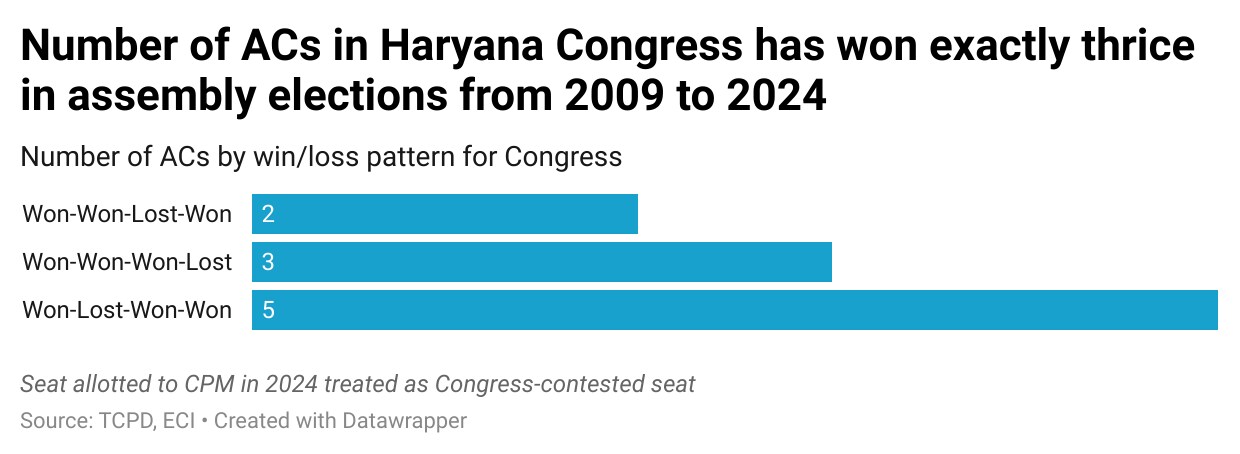
 Did the Congress lose too many of its bastions this time?This is what would seal the case for overconfidence or bad candidature on the part of the leadership of any political party. HT has done a simple statistical exercise to test this for the Congress in Haryana: looked at the number of assembly constituencies (ACs) which the Congress won in 2009, 2014 and 2019, but lost in 2024. The number of such ACs is just three – Kharkhauda, Gohana, and Tosham – for the Congress in 2024 Haryana elections. This is not very different from the seven ACs that the Congress won in 2009 and these elections, but lost in either 2014 or 2019. Of the 10 ACs that the Congress has won exactly three times in the four elections from 2009 to 2024, two are SC-reserved ACs. There are a total 17 ACs reserved for SCs in Haryana. So the complacency argument does not track statistically.
- The Congress’s problem is it does not have many stronghold seats in HaryanaThere are only five ACs – Baroda, Garhi Sampla-Kiloi, Kalanaur, Jhajjar, Beri – which the Congress has won in all four assembly elections between 2009 and 2024. Two out of these are reserved for SCs. In an assembly of 90, this amounts to very little insurance. As shown above, this number would not change much even if one were to take out 2024 from the equation. To be sure, this is to be expected, as 2024 is still the Congress’s best showing in terms of number of seats since it lost Haryana to the BJP in 2014.
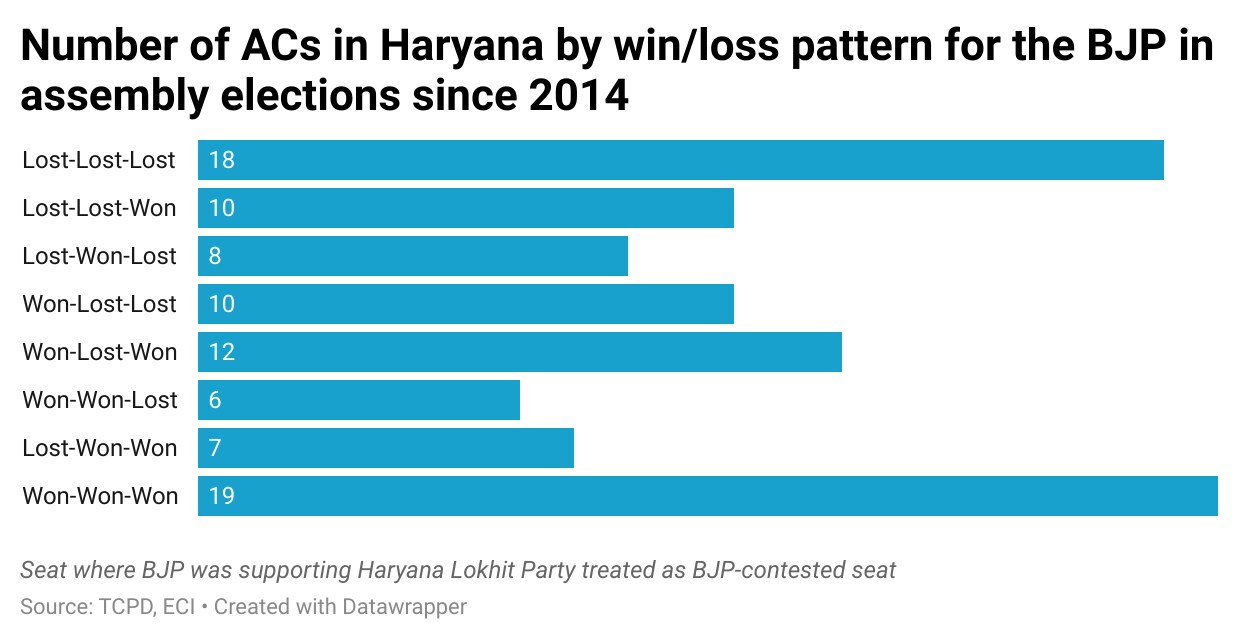
- And the BJP has created a much larger number of strongholds than the Congress in the last three electionsThis is the most important and underappreciated fact about today’s Haryana polity. There are 19 ACs in Haryana which the BJP has won in all three assembly elections, 2014, 2019 and 2024. To be sure, the BJP did lose significant ground in Haryana in the 2019 elections, which is evident in the fact it failed to win 22 ACs that it won in 2014. Of these 22 ACs, it was wrested back 12 ACs in the 2024 elections. What is important to note here is that of the BJP lost only eight out of these 12 ACs to the Congress in 2019. The other four were lost to the Jannayak Janta Party, the Indian National Lok Dal, or independents.
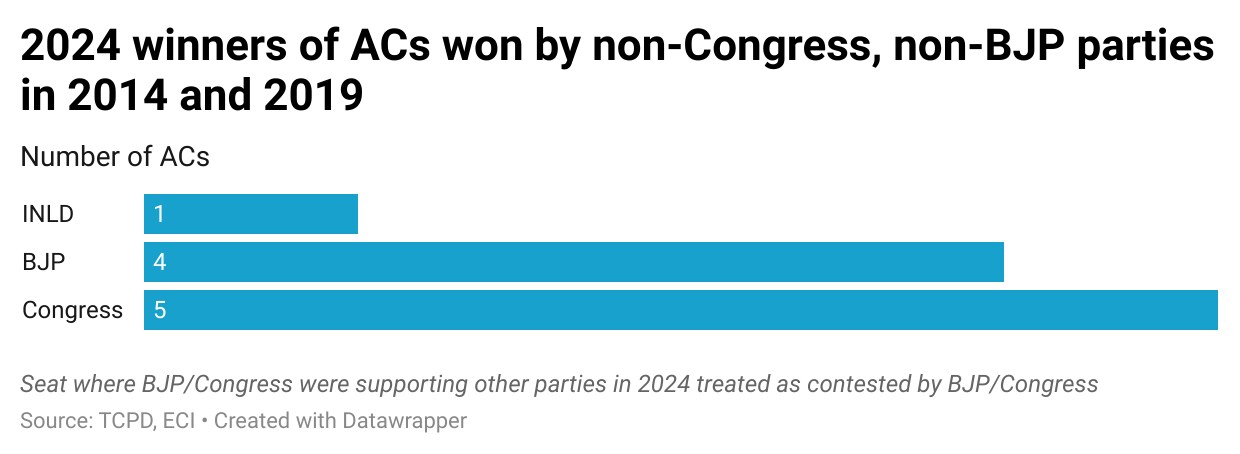
- The Congress did not even do badly in winning strongholds of non-Congress non-BJP partiesBecause the vote share and seat share of non-Congress non-BJP parties has fallen to its lowest level in 2024 in assembly elections held since 2014, this is an interesting data point to investigate. There is only one AC (Rania in Sirsa district) which has been won by non-Congress non-BJP parties in every election since the BJP made its impact in 2014. There were 10 ACs which were won by non-Congress non-BJP parties in the 2014 and 2019 elections, but have gone to either the Congress or the BJP. Both parties have won an almost equal number of these ACs.
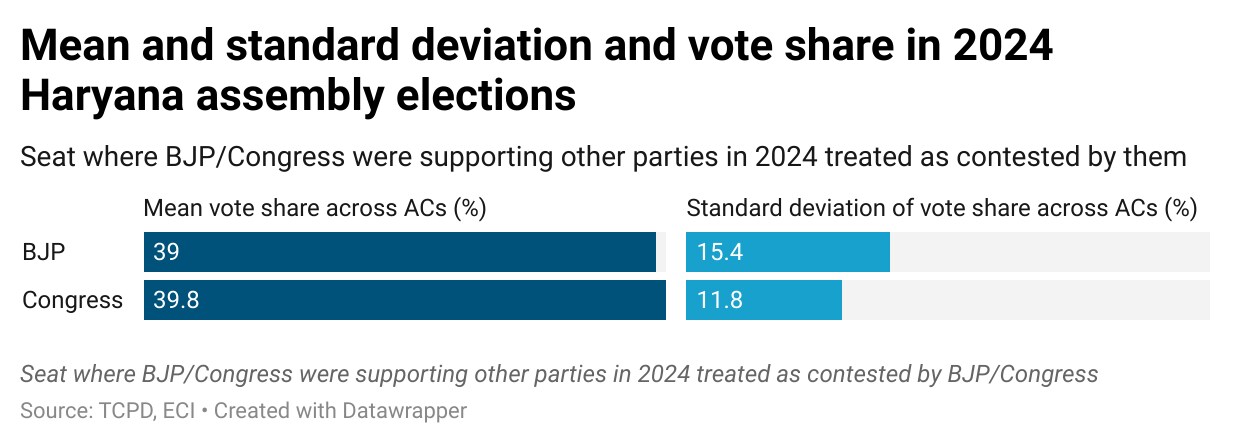
- The Congress’s biggest handicap is its limited appeal to floating votersStatistics is useful to explain the argument here. Both the Congress and the BJP have an almost identical vote share if one were to look at the mean of AC-wise vote shares across 90 constituencies in Haryana. However, the BJP has a much higher standard deviation for this number than the Congress. This means that there is a greater chance that its vote share in individual ACs would be much larger than that of the Congress, thereby making the BJP more successful in attracting the floating voter to its cause than the Congress. This explains BJP’s ability to win a larger number of seats. To be sure, the Congress did a good job in expanding its core support base compared to not just 2014 and 2019 but also the 2009 elections it won. But with the BJP gobbling pretty much everything else, this was not enough to get it past the majority mark in the assembly. This is exactly what the Congress needs to work on: Convince the unconvinced voter to choose it rather than the BJP in head-to-head contests.