
 E-Paper



October took us closer to the 1.5° goal being breached | Number Theory
Latest monthly data for the planet’s October temperatures is yet another proof that the 1.5°C could be breached sooner rather than later
Updated on: Nov 8, 2025, 10:16:27 IST

 Prefer HTon Google
Share via


Copy link

Limiting global warming to under 1.5°C above the pre-industrial average was once a sacrosanct climate goal which now looks almost certainly redundant with a Donald Trump led US reneging on the 2015 Paris Agreement. Latest monthly data for the planet’s October temperatures is yet another proof that the 1.5°C could be breached sooner rather than later. Here is the data which proves this.

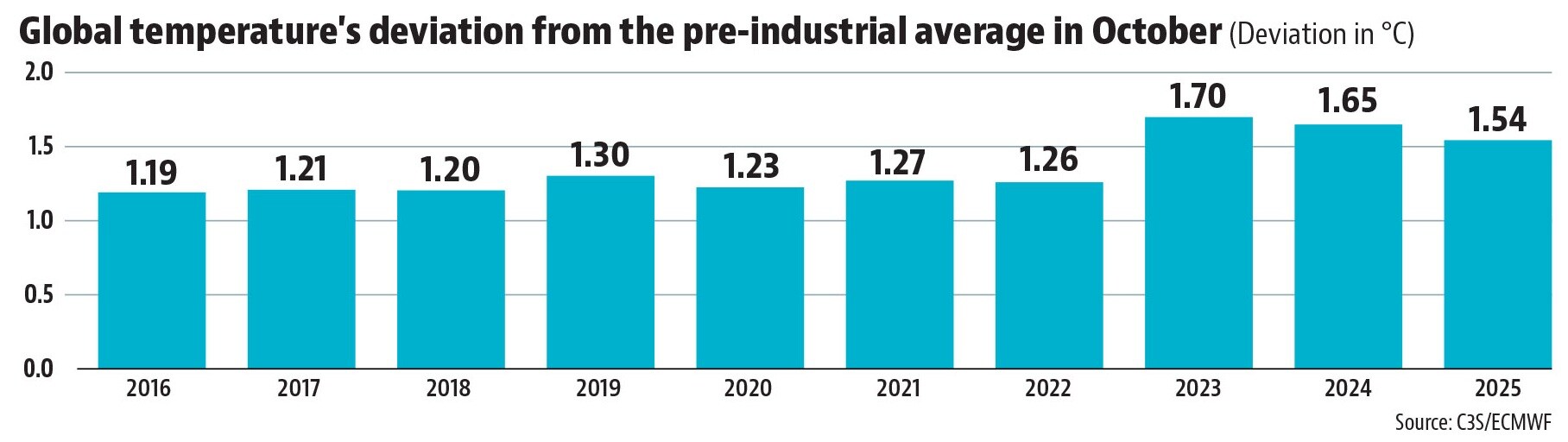
 2025 is the third consecutive year when October has recorded 1.5°C warmingGlobal temperature datasets are published by multiple agencies. The ERA5 data published by the Copernicus Climate Change Service (C3S) of the European Centre for Medium-Range Weather Forecasts (ECMWF) is the one that becomes available the earliest among the six tracked by the World Meteorological Organization (WMO). Daily ERA5 data for October , finalised this week, shows that the month was 1.54°C warmer than the pre-industrial average. This makes October this year the third warmest October month after 2023 and 2024, and also the third consecutive year -- the only month for which this has ever happened – when the month has recorded more than 1.5°C warming.
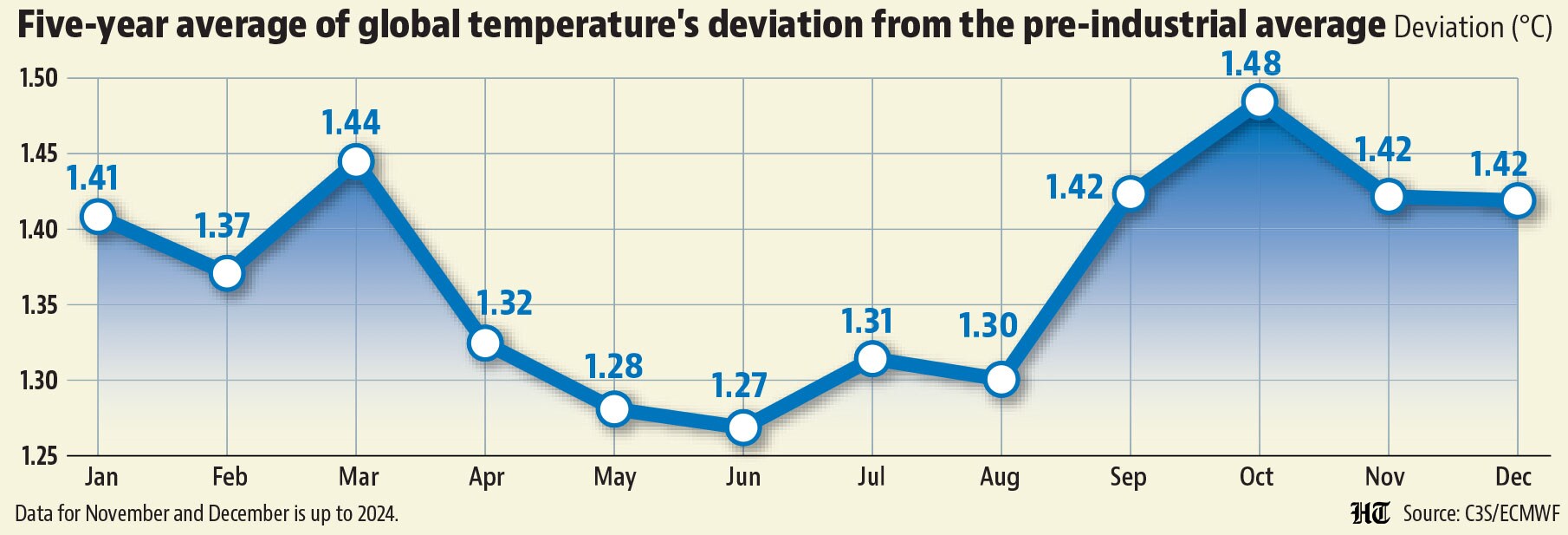
- Five-year average of October warming is now 1.48°C, the highest among all monthsWith October breaching the 1.5°C threshold in three consecutive years, the five-year average of warming in the month is now 1.48°C. This is the closest any month is to breaching the 1.5°C threshold on a somewhat long-term basis. The next closest months are September, November, and December whose latest five-year averages (September 2020-2025, November and December 2019-2024) are nearly tied at 1.42°C so far.
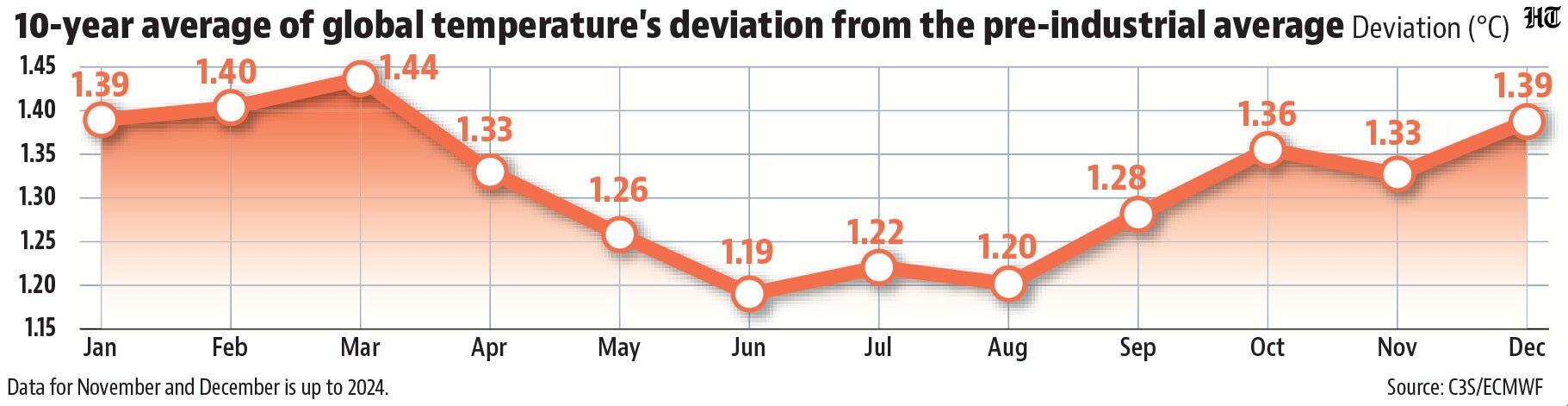
- To be sure, October is still far from the 10-year average threshold being breachedWhen the world agreed to contain the planet’s temperatures under 1.5°C of pre-industrial average, it was not talking about a day’s, month’s or even a year’s average temperature. There are 27 months in the dataset when the 1.5°C threshold has been breached and 2024 was the first year when this threshold was breached on an annual basis. The idea was to track temperatures on a long-term basis and that is generally taken to be at least a ten-year average. On this count, the 10-year average for October 2025 is still 1.36°C, which makes it only the fifth warmest month by long-term warming as of now.
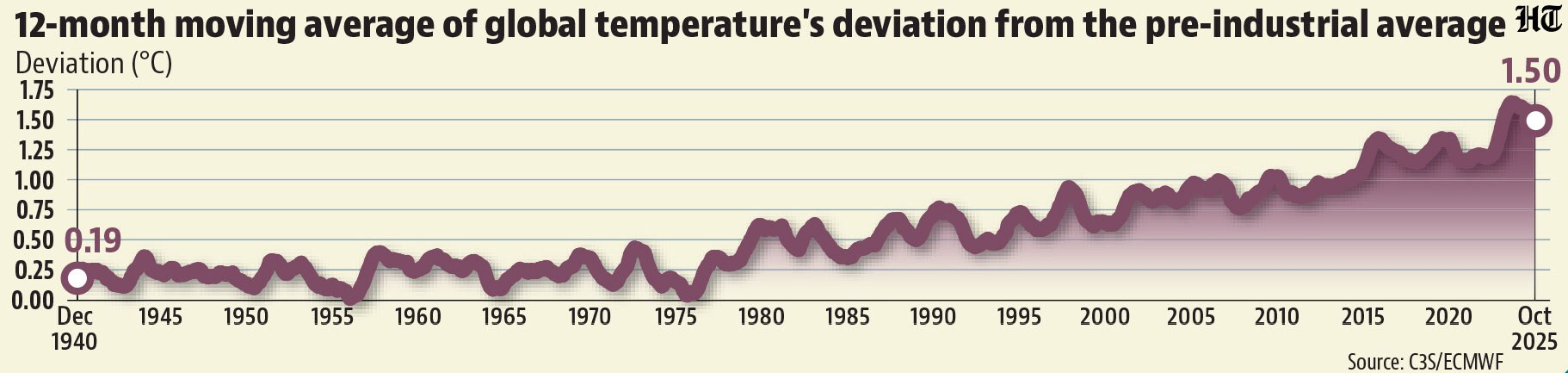
- And 2025 might not cross the 1.5°C barrier on an annual basisThere is at least one bit of good news in October recording 1.54°C warming this year. If the warming in the month had been higher, it would undo the relative cooling seen in the preceding five months. All months from May to September recorded a warming under 1.5°C. This led to the 12-month moving average dropping to exactly 1.5°C by October. If November does not record 1.6°C warming, this moving average will drop below the 1.5°C threshold for the first time since December 2023.
- But the long-term trend is clearTo be sure, even if 2025 does not cross the 1.5°C threshold at the end of December, it will be very close to that number. The January-October average is 1.47°C despite no help from cyclical factors like an El Nino, which is a warming of the equatorial Pacific Ocean that gives an upward bump to global temperatures with a small lag. In fact, some of the relative cooling this year might be the result of the opposite of El Nino, a cyclical cooling of the equatorial Pacific called La Nina that pushes global temperatures down. That this year is headed to a warming close to 1.5°C despite some cooling impact of La Nina means that the underlying trend of long-term warming is here to stay.


Unlock a world of Benefits with HT! From insightful newsletters to real-time news alerts and a personalized news feed – it's all here, just a click away! -Login Now!


