
 E-Paper



Problematics | Catch me if you can, with luck or skill
Probability puzzles sometimes appear more complex than they actually are. This one is deceptively simple.

 Prefer HTon Google


One of the best puzzles ever created, which I shall not name today, provides the inspiration for the adaptation that you will solve this week. I shall identify the original puzzle next week, but it is quite possible that many readers will notice the similarity today itself.
I have seen at least two versions of the original puzzle, and have created two adaptations of my own. One of my adaptations is below; the other one I will present to you at a later date.
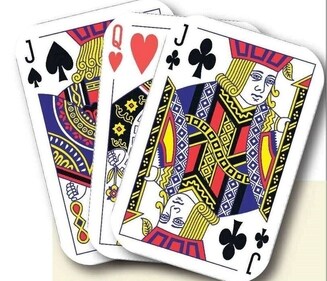
#Puzzle 41.1
You are at a party where one of the guests, a smart alec, is trying to impress everyone with a card trick. He displays three cards — a Queen and two Jacks — to the audience, juggles them several times between his hands, then deals them face down on the table. He asks one of the guests to guess which card is the Queen. The guest does, and gets it wrong. The smart alec repeats the trick several times, but no one can ever guess the right card.
Suspecting there’s something in the way the trickster holds the audience’s gaze, you offer to play the game blindfolded. He agrees. Your eyes are blindfolded while the other guests watch him juggle around the three cards and set them face down again.
Once the blindfold is removed, you look at the three cards, have no idea which one is which, and select one at random. The probability that it is the Queen is 1/3, you figure.
The smart alec, however, changes the rules suddenly. Instead of turning up the card you chose, he turns up one of the other two. It’s one of the Jacks. The trickster now gives you a choice: either stick to the card you originally picked, or switch to the other face-down card.
Which option gives you a higher probability of success?
#Puzzle 41.2
Take A = 1, B = 2, etc, all the way up to Z = 26. Also, take the “value” of any three-letter word as the product of its letter values. For example, CAT = 3 x 1 x 20 = 60; DOG = 4 x 15 x 7 = 420.
Now write down any three-letter word of your choice, calculate its value, and send it to me. The word with the highest value wins.
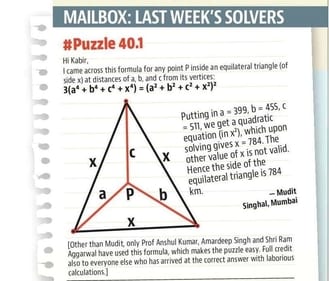
#Puzzle 40.1
Hi Kabir,
I came across this formula for any point P inside an equilateral triangle (of side x) at distances of a, b, and c from its vertices:
3(a⁴ + b⁴ + c⁴ + x⁴) = (a² + b² + c² + x²)²
Putting in a = 399, b = 455, c = 511,
we get a quadratic equation (in x²), which upon solving gives x = 784. The other value of x is not valid.
Hence the side of the equilateral triangle is 784 km.
— Mudit Singhal, Mumbai
[Other than Mudit, only Prof Anshul Kumar, Amardeep Singh and Shri Ram Aggarwal have used this formula, which makes the puzzle easy. Full credit also to everyone else who has arrived at the correct answer with laborious calculations.]
#Puzzle 40.2
Hi Kabir,
The simplest approach is to look at it this way. Every knockout match eliminates one player, irrespective of the stage at which it is played. Therefore, for a knockout tournament with 100 players, 99 matches are required to eliminate 99 players, leaving one player as the champion.
— Prof Anshul Kumar, Delhi
[Again, other than Prof Kumar, only Pankaj Varma (Panchkula) and Hurditya Dand (Mumbai) have used this simple bit of reasoning. All others have gone via 36 + 32 + 16 + 8 + 4 + 2 + 1 = 99, which was unnecessary.]
Solved both puzzles: Prof Anshul Kumar (Delhi), Mudit Singhal (Mumbai), Amardeep Singh (Meerut), Sri Ram Aggarwal (Delhi), Gaurav Gummaraju (Navi Mumbai), Mukesh Arora (Gurgaon), Akshay Bakhai (Mumbai), Ashirbad Paikaray (Hyderabad), Shreeya Das (Delhi), Yadvendra Somra (Sonipat), Sunita & Naresh Dhillon (Gurgaon), Shishir Gupta (Indore), Sandeep Bhateja (Hoshiarpur)
Solved #Puzzle 40.1: Makarand Dhekane
Solved #Puzzle 40.2: Hurditya Dand (Mumbai), Pankaj Varma (Panchkula), Dr Sunita Gupta (Delhi), Anil Khanna (Ghaziabad), Nalin Sinha (Gurgaon), Bhoomi Tyagi (Navi Mumbai), Akshat Balyan (Sonipat), Nipun Bamania (Mumbai), Kanwarjit Singh (Delhi), Maulik Jain (Delhi), Musarrat Rai Handa (Faridabad), Y K Munjal (Delhi), Sandeep Varghese (Thane West), Anay Gupta (Indirapuram), Amar Lal Miglani (Mohali), Mayobhav Pathak (Gurgaon), Pulkita Mukherjea, Rajesh Chandiramani, Krunal Makwana, Mihir Joshi, Narender Kumar Aggarwal, C Subba Rao, Shaurya Oberoi
Problematics will be back next week. Please send in your replies by Friday noon to problematics@hindustantimes.com


