
 E-Paper



Problematics | I hold the four aces
A card trick that is ideally played on an unsuspecting audience at a party. Can you work out how it works?

 Prefer HTon Google


Over a year and a half, we have solved enough puzzles together to agree that tough does not necessarily mean best. We solve puzzles here because we enjoy the exercise, and the ones that give us the most fun are therefore the best.

The following puzzle, whose creator I shall credit next week, is deceptively simple. The steps required to set up the situation, however, provide us with all the fun we need. I hope readers like it as much as I do.
Also Read: Problematics | How to win at Scrabble
#Puzzle 89.1
At yet another party, you once again meet the familiar smart alec who has played so many tricks on you before. He is back with his pack of cards, a standard one with 52 cards, all face down. He selects four victims to play his new trick on, and you are on top of the list.
“Take this deck,” he tells you, "cut it in two, and place the upper part on the table."
You set down a handful of cards into a pile. “This is Pile A,” the trickster says, taking the rest of the deck from you.
He hands the remaining cards to the second victim, whom he instructs similarly: “Cut these in two and place the upper cards on the table.”
Victim #2 does so. “This is Pile B,” the trickster says, pointing to the second pile.
He takes the remaining cards and hands them to the third victim. “Divide these into two piles. The cards on the top are ‘Pile C’. Those remaining are ‘Pile D’,” he says, completing the classification.
He now calls upon the fourth victim: “Pick up Pile D and deal the top three cards face down on the table.” Victim #4 does as instructed. “Deal the next card on top of Pile A, the next on top of Pile B, and the next on top of Pile C. When that is done, place the remainder of Pile D on top of the three cards you dealt on the table.”
Once these instructions are followed, the smart alec returns to Victim #3. “Pick up Pile C and deal three cards face down on the table. Now deal the next card on top of Pile D, the next on top of Pile A, and the next on top of pile B. Then place the remainder of Pile C on top of the three cards you dealt on the table.”
The pattern is becoming familiar now. The trickster instructs Victim #2 to deal three cards from Pile B face down on the table, then one card each on top of Piles C, D and A, and finally place the remainder on top of the three cards dealt on the table.
When it’s your turn, you know what to do. You deal three cards from Pile A on the table, place one card each on top of Piles B, C and D, and finally place the remainder of Pile A on top of the three cards on the table.
Now the trickster calls upon each of you to turn up the top card in your respective piles. These cards, as it turns out, are the four aces.
Being familiar with his methods, you confront the smart alec: “You arranged the cards beforehand!”
Your tormentor grins. “That’s right,” he concedes. “But in which positions were the four aces placed in the beginning?”
#Puzzle 89.2
As a return gift, you play a trick on the smart alec this time. Show him 16 balls of identical size, eight red and eight blue, and place them into two bags, four red and four blue in each. Then you blindfold the man and ask him to pick up one ball from each bag.
For once, he does as is he is told.
“What is the probability,” you ask him, “that at least one of the two balls you have taken out is red?”
MAILBOX: LAST WEEK’S ANSWERS
#Puzzle 88.1
Readers have interpreted the puzzle in two different ways. One is my intended interpretation, which is that the “other end” means the point up to which the batter will run. The other interpretation is that “the other end” means the end of the crease. Although that was not what I intended to convey, I agree now that the wording of the puzzle can convey that meaning.
Below, we are looking at only the simpler (intended) interpretation. The other interpretation makes the puzzle somewhat complicated (which is not the solvers’ fault). In the interest of fairness, anyone who has taken either of the approaches is listed among the correct answers, as long as their calculations are sound.
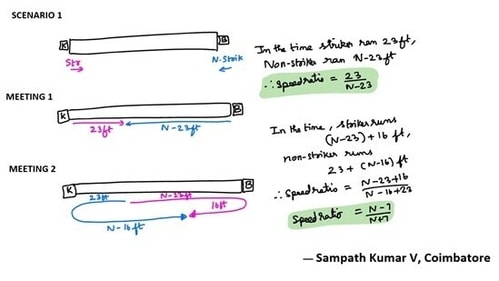
Hi,
My answer to the first puzzle is explained in the illustration.
In the time the striker runs 23ft, the non-striker runs N – 23 ft; speed ratio = N/(N – 23)
In the time the striker runs (N – 23) + 16ft, the non-striker runs 23 + (N – 16) ft;
speed ratio = (N – 23 + 16)/(23 + N – 16) = (N – 7)/(N + 7)
Equating the speed ratios,
N/(N – 23) = (N – 7)/(N + 7)
Solving (N ≠ 0), we get N = 53ft.
— Sampath Kumar V, Coimbatore
#Puzzle 88.2
Hi Kabir,
The anagrams are
AIMLESS REBELS = LES MISERABLES
AS ONE IS RUTHLESS = THE SUN ALSO RISES
MADE A BED = ADAM BEDE
MRS ALI EARNS = SILAS MARNER
TELL TIME NOW = LITTLE WOMEN
Taking the second letter from each novel, the sixth book = HEIDI.
— Dr Sunita Gupta, Delhi
The anagrams were apparently tough, because very few got them all. Among those who have solved the first puzzle, a few have got some of the anagrams, but not all. Special mention to Jaikumar Inder Bhatia and Disha Bhatia, who got all five anagrams, but not the sixth one. Their submission came very late, and I could include their names only because this week’s Problematics itself is being published late.
Solved both puzzles: Dr Sunita Gupta (Delhi), Shishir Gupta (Indore)
Solved Puzzle #88.1: Sampath Kumar V (Coimbatore), Yadvendra Somra (Sonipat), Kanwarjit Singh (Chief Commissioner of Income-Tax, retired), YK Munjal (Delhi), Akshay Bakhai (Mumbai), Sundarraj C (Bengaluru), Professor Anshul Kumar (Delhi)
Solved #Puzzle 88.2: Ajay Ashok (Mumbai)
Problematics will be back next week. Please send in your replies by Friday noon to problematics@hindustantimes.com


