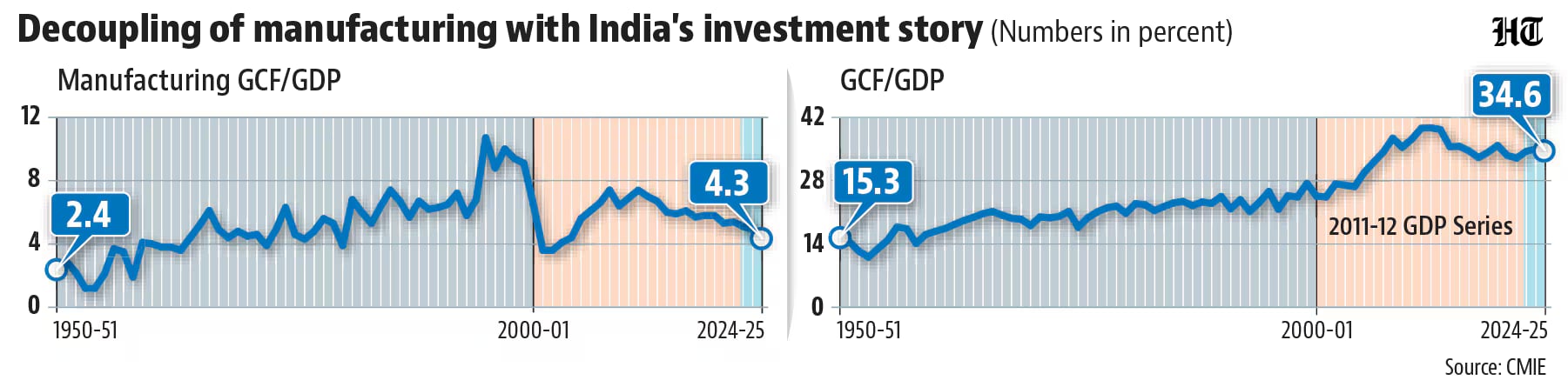
 India does not have an investment problem; it has an investment in manufacturing problemThat investment kickstarts future growth is a well-accepted fact in economics. China is the best example of this in the recent past. In fact, many economists accuse China of suppressing domestic consumption to boost investment. India has been battling a laggard private investment climate for the last decade or so. While this story is well known, a sectoral reading of the situation provides a crucial insight. India has not done badly regarding the overall investment rate in the economy. This shows in the share of Gross Capital Formation (GCF) in GDP. However, what has become a bigger problem is the marginalization of manufacturing in the overall investment being made in the Indian economy. Comparing overall GCF and manufacturing GCF in GDP shows this clearly. While a long-term comparison of these two variables requires clubbing data from various GDP series, which often entail breaks from previous trends, it is the only way to do this comparison.
- Manufacturing’s supply side crisis of investment shows in big industry’s falling demand in bank creditSector-wise allocation of bank credit data supports the supply side story of falling manufacturing investment in the Indian economy. In 2007-08, the earliest period for which this data is available, bank credit to large industry was 12.6% of GDP. This increased consistently to reach about 18% by the early 2010s. It fell steadily thereafter, reaching lower than its 2007-08 levels by 2019-20 and further to 8.6% by 2025-26. Credit to micro, small and medium industries, however, does not show a similar trend and has largely remained steady. The falling credit demand from large industry has led to a situation where housing credit (only a part of personal credit) has already overtaken it and even agricultural credit has come pretty close to overtaking it. That Indians are borrowing more to build houses and almost as much to grow crops as they are for factories speaks volumes about capital allocation in India.
- Manufacturing did not make India’s post-reform growth storyIf manufacturing has been losing investment momentum, as shown here, even when India’s domestic manufacturing value added has been fading relative to imports and the merchandise trade deficit has been rising, what explains the absence of policy urgency to solve the problem? The answer is found in its absence in India’s growth turnaround post-reforms. A basic comparison of sector-wise drivers of growth from 1966-67 to 2025-26 in the 2011-12 GDP series proves this. Manufacturing’s growth contribution, despite the supposed deregulatory momentum from reforms, has largely been flat. India’s real growth driver has been the financial services, real estate and professional services sector.
- Skewed growth in finance was balanced with welfare to manage political peaceFinance and professional services generated not just growth but also white-collar jobs and higher tax revenues. This fiscal cushion funded by finance and professional services, allowed the provision of palliatives to manage economic pain stemming from the lack of a mass employment generating economic transformation. Before the recent proliferation of cash transfer schemes to win elections, came the large-scale expansion of India’s welfare programmes, which is seen in things such as rapidly increasing transfers on centrally sponsored schemes etc. The end result of such policies is best seen in a ratio which captures India’s basic political economy dilemma: rural living standards versus urban. A comparison of average Monthly Per Capita Expenditure (MPCE) in rural and urban areas since 1993-94 shows that the rural-urban ratio fell from 0.61 in 1993-94 to 0.52 in 2003-04, the last survey round before the shock defeat of the Atal Bihari Vajpayee government in the 2004 elections, famously referred to as an indictment of the India Shining campaign. The trend reversed in the subsequent rounds, with the rural-urban MPCE ratio reaching 0.59 in 2023-24. Herein lies India’s core political economy dilemma: it managed political peace by using resources from an elite-services driven growth but now risks losing the larger economic competition unfolding in the world, which the last part of this series will discuss.
The first part of this series flagged manufacturing as the key challenge in boosting India’s economic gap vis-à-vis China. It also highlighted that the problem lies in a lag in per worker productivity and a growing tendency to prioritise trade rather than domestic value added. What really explains this problem despite incremental reforms since 1991? The problem is often seen as an issue within the sector rather than relative to other sectors. This does not help. The data is clear.
Unlock a world of Benefits with HT! From insightful newsletters to real-time news alerts and a personalized news feed – it's all here, just a click away! -Login Now!
Unlock a world of Benefits with HT! From insightful newsletters to real-time news alerts and a personalized news feed – it's all here, just a click away! -Login Now!
Advertisement
{{/htLoading}}{{#usCountry}}