
 E-Paper



Shortage of personnel plagues justice system | Number Theory
.
Updated on: May 19, 2025, 09:33:55 IST

 Prefer HTon Google
Share via


Copy link

Complaints about the slow progress of cases, tedious legal processes, and the hassle of filing complaints with the police is commonplace is India. But to analyse the efficiency of the law and justice system, it is necessary to look at whether the institutions are overburdened and if yes, to what extent? The India Justice Report (IJR) 2025 which was released last month gives an insight into this question.

Shortage of personnel plagues justice system
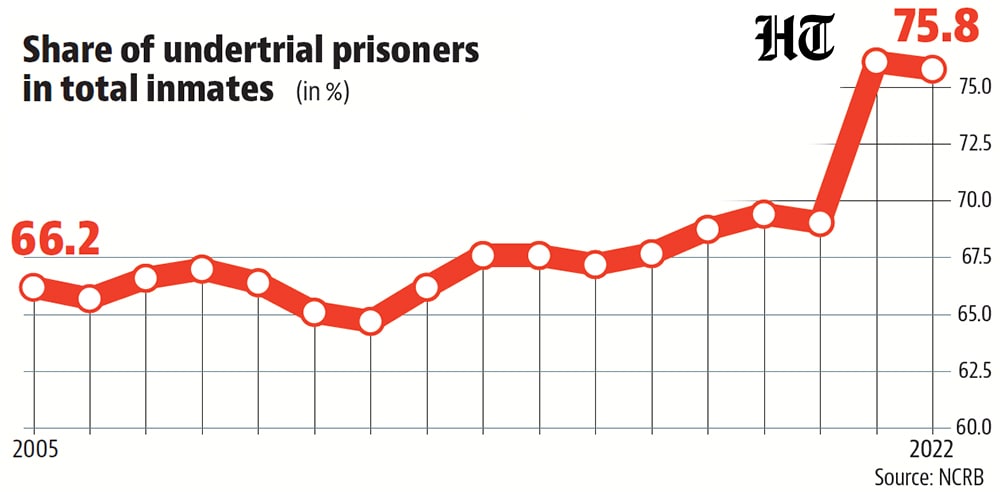
 There is a major backlog concern within the justice systemOf the total number of people in prisons in India, a significant majority are under trial, which reflects the large volume of cases which are still in progress. In 2022, of the total inmates in all prisons across the country, the share of convicts was only 23.3% while the share of undertrials was as high as 75.8%, as per the latest Prisons Statistics India report by the National Crime Records Bureau (NCRB). As a result, the pendency numbers continue to remain high, mounting every year across all levels of courts.
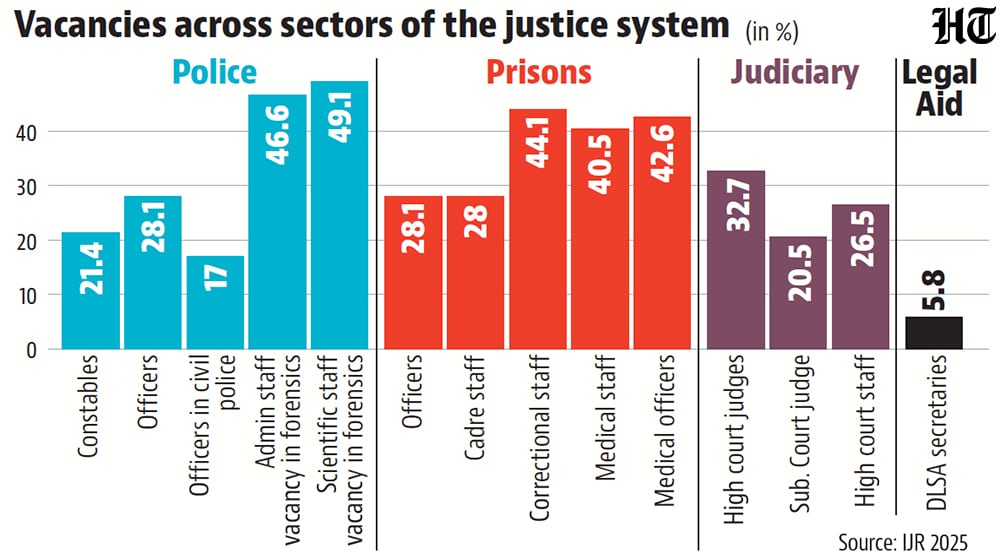
- This is caused in part by a shortage of personnel in the systemAccording to the IJR 2025, these problems are in large part because of a shortage of personnel across various levels of the justice system – from law enforcement to the judiciary. The report broadly covers four pillars of the justice system – police, prisons, judiciary, and legal aid. Of these, the numbers for employed staff in the police, prisons, judiciary, and legal aid show that several of them do not meet the required benchmark number. Prisons and police specifically have significantly high vacancy numbers in certain roles with scientific staff in forensics having a vacancy of 49.1% and correctional staff in prisons having a vacancy of 44.1%. To be sure, not all of the undertrials in prisons could be locked up because of shortage of staff. On May 6, the Supreme Court asked all high courts to provide data on appeals made on those criminal cases which had been reserved for over four months. This was after four convicts that were sentenced to life imprisonment and are awaiting judgment on their appeals since 2022 filed a petition. What makes the shortage of personnel worse is the uneven representation. For example, the home ministry has set a benchmark of three sub-inspectors and ten constables in every police station. No state or Union territory apart from Delhi crosses the first threshold. And as for women constables, 17 of the 36 states and union territories do not cross the benchmark. The share of women in prison staff is merely 13.6%, while the share of women judges in high courts is 14%.
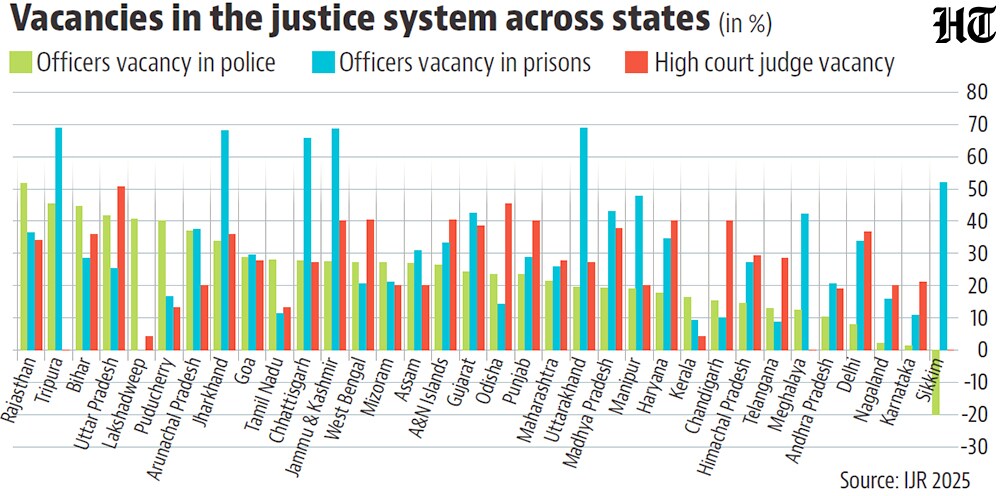
- But some states fare better than othersTo be sure, the problem of staff shortage is not equally concerning for all states. The IJR 2025 scores all the states out of ten based on the different metrics assessed. For the larger states surveyed by the report, Kerala has a score of 6.95 out of ten when it comes to vacancies, followed by Karnataka (6.31) and Maharashtra (5.75). The states with the least scores in this aspect are Uttar Pradesh (3.55), West Bengal (3.56), and Jharkhand (3.66). In terms of diversity, the best-performing states are Karnataka (7.26), Andhra Pradesh (6.67), and Tamil Nadu (6.55), while the worst are West Bengal (2.95), Jharkhand (3.21), and Uttar Pradesh (3.38).
- There is disparity between rural and urban areas tooNot only is there a disparity across states, even within a state there is a stark difference between rural and urban regions. According to the IJR 2025, policing machinery continues to be concentrated more in urban areas and in the period from 2017 to 2023, the number of rural police stations declined while those in urban areas increased. The seventh report of the National Police Commission published in 1981 laid out the standards and norms for police stations such as the limits in jurisdiction and density of population to be covered by particular station. The report states that a police station should not be required to police more than a population of 60,000 people and if it registers more than 700 crimes annually, another police station may be created. It also said that specifically for rural areas, a police station should not have a jurisdiction of more than 150 kilometres. But the IJR 2025 shows that nearly all states with the exception of Bihar, Kerala, Tamil Nadu, and Goa do not meet this criterion.

Unlock a world of Benefits with HT! From insightful newsletters to real-time news alerts and a personalized news feed – it's all here, just a click away! -Login Now!


