
 E-Paper



The Canada election result explained in three charts | Number Theory
The trends so far suggest that Canadian politics might be heading towards greater bipolarity with larger national question subsuming minority identity assertion
Updated on: Apr 30, 2025, 08:33:05 IST

 Prefer HTon Google
Share via


Copy link

The Liberal Party in Canada is all set for a fourth consecutive term in power thanks to a change of guard and tailwinds from US President Donald Trump’s aggressive rhetoric and trade policies vis-à-vis the US’ northern neighbour. The results would have been unimaginable even a few months ago. The trends so far also suggest that Canadian politics might be heading towards greater bipolarity with the larger national question subsuming minority identity assertion. Here are three charts which explain the result in detail.
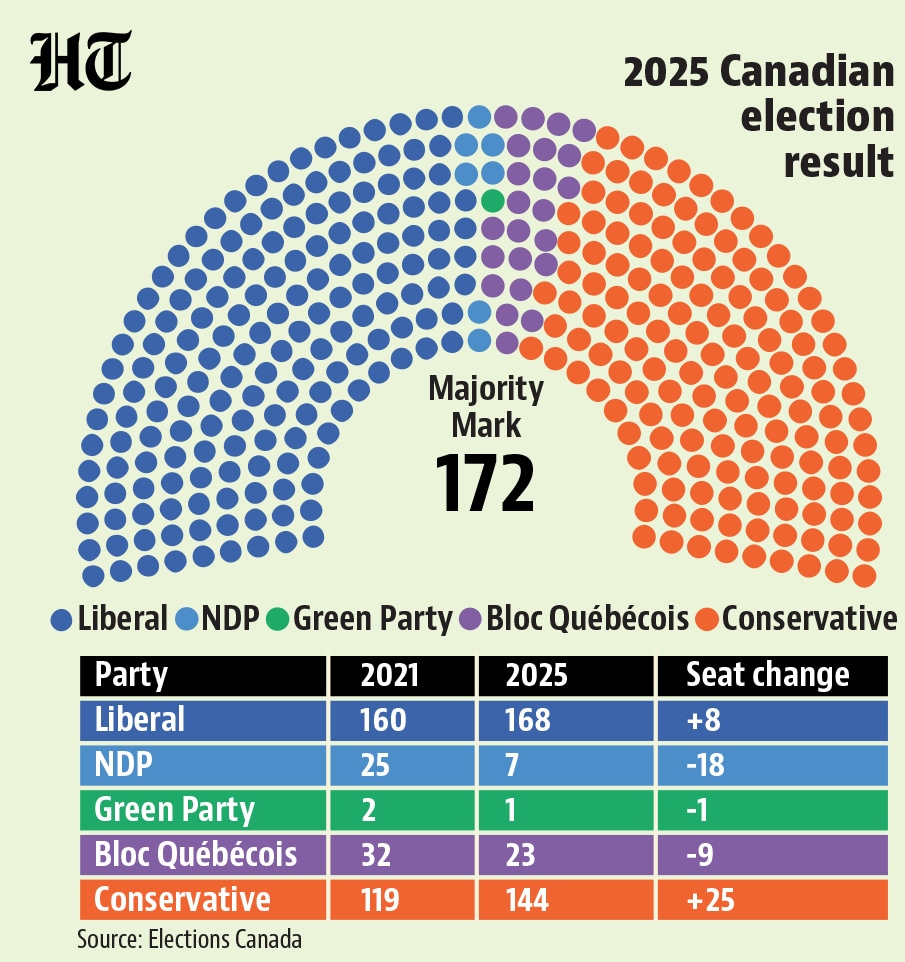
 The Liberal Party has increased its seat count but is still short of a majorityOfficial data from Commissioner of Canada Elections shows that Liberals were leading 168 seats when it paused counting at 3am ET. This is just short of the 172 seats needed to win a majority in the Canadian Parliament. This means that the Liberals will have to yet again rely on smaller parties to form the government. To be sure, both the Liberals and the Conservatives--who were ahead in 144 seats--have seen a rise in the number of seats won this time at the cost of smaller parties such as the New Democratic Party (NDP) and Bloc Québécois (BQ). While a detailed analysis of the result is awaited, gains for the top two parties at the cost of smaller players suggest a polarisation in Canadian politics. This is not surprising given the context in which the elections were held. See Chart 1
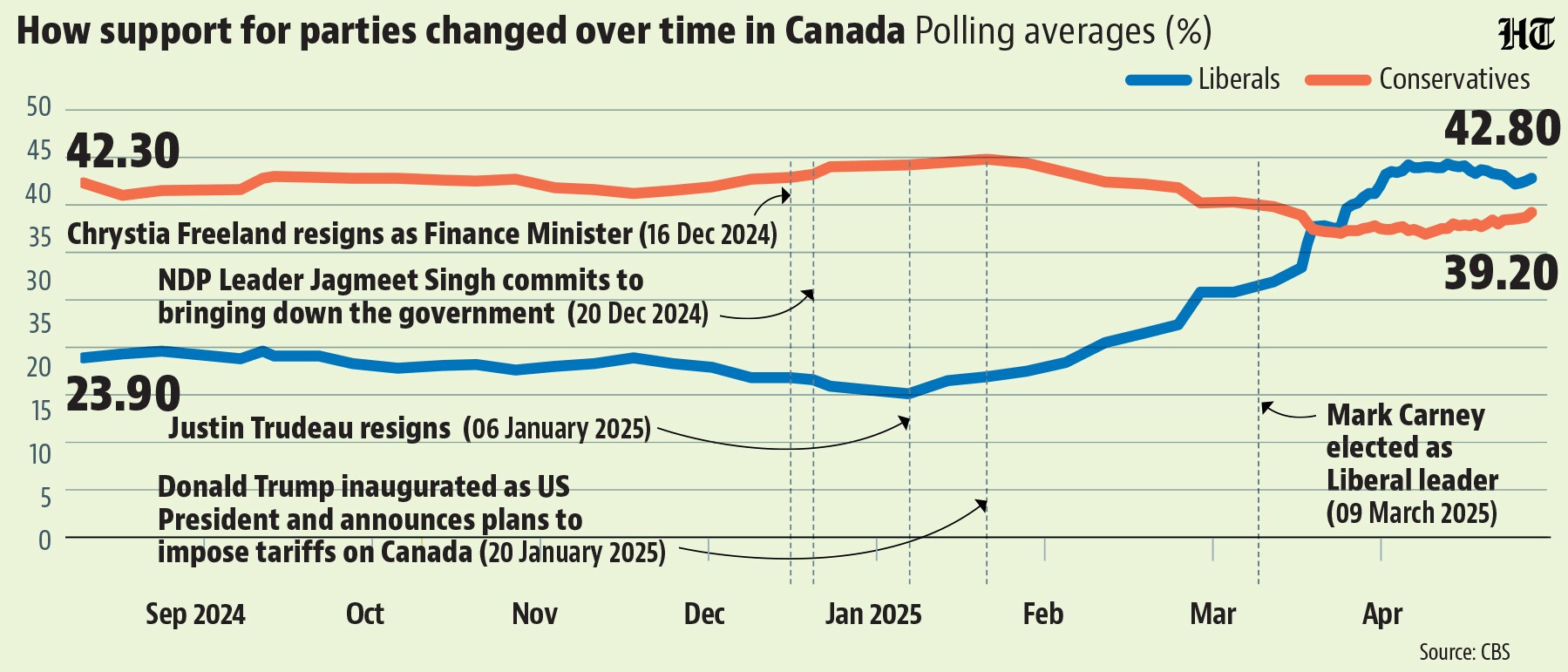
- Trump 2.0 resurrected the Liberals in CanadaMonday’s results must have come as a shocker for the Conservative Party, which was the principal opposition party before the elections. Polling data, as recently as January showed the Conservatives leading the Liberals by more than 20 percentage points. It was perhaps this looming disaster which forced the incumbent Prime Minister Justin Trudeau to step down paving way for Mark Carney to take over in March. To be sure, more than leadership change, what seems to have resurrected the Liberal Party’s fortunes is the role played by US President Donald Trump. Not only did Trump slap tariffs on Canadian exports to the US and accuse it of being a base for smuggling drugs into US, he has also repeatedly spoken about annexing Canada as the 51st state of the US, questioning the very sovereignty of the country. The reversal in the Liberal Party’s fortunes started immediately after Trump’s inauguration. As far as the Conservatives were concerned, it did not help that their leader Pierre Poilievre, led an election campaign with the slogan of “Canada First”, which was strongly reminiscent of Trump’s America First one. A poll conducted between April 24 and 27 by Abacus Data showed that 45% of Canadian voters believed that the Liberals are better suited to deal with Trump and the impact of his decisions, compared to 34% who thought the same of the Conservatives. It also helped the incumbents that Mark Carney, who succeeded Trudeau, was an acceptable figure across demographics. In a polling by ResearchCo over April 26 and 27, 48% male and 43% female voters said Carney would be the best option for being Canada’s Prime Minister, compared to 38% male and 32% female voters who said the same of Poilievre. See chart 2
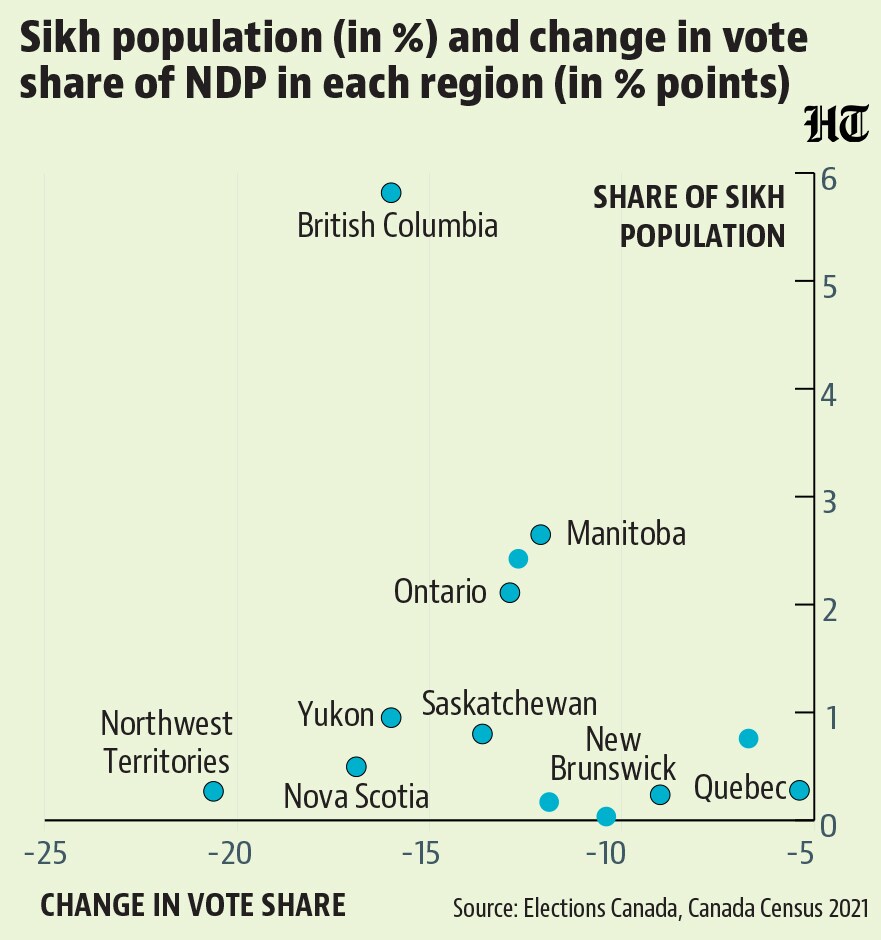
- NDP and Jagmeet Singh have lost the most in this electionOnce all the ballots have been tallied, the 2025 Canadian election will be remembered as a straight duel between the Liberal and Conservative parties. This showdown emerged largely because of the NDP’s dramatic collapse in support—and, to a lesser extent, the Bloc’s waning fortunes—which both main parties readily capitalised on. In the early hours in British Columbia, NDP leader Jagmeet Singh, known for his pro-Khalistan and anti-India stance, confirmed he would step down, as his party was almost certain to lose national status . Singh himself was poised to lose his own seat. The NDP, which emerged as a kingmaker in 2021, has seen a decline in its vote share in all regions of Canada, even those with a sizeable Sikh population. In British Columbia, for instance, where the share of Sikh adherents in the population is as high as 6%, the NDP vote share has fallen as much as 16.1 percentage points. Other regions with sizeable Sikh populations such as Alberta, Manitoba and Ontario have also seen such declines, showing that the Sikh and South Asian population of Canada largely stuck with the Liberals rather than the NDP led by a leader of their own ethnicity. See chart 3


Unlock a world of Benefits with HT! From insightful newsletters to real-time news alerts and a personalized news feed – it's all here, just a click away! -Login Now!


