
 E-Paper



US@250: Leveraged at the top | Number Theory
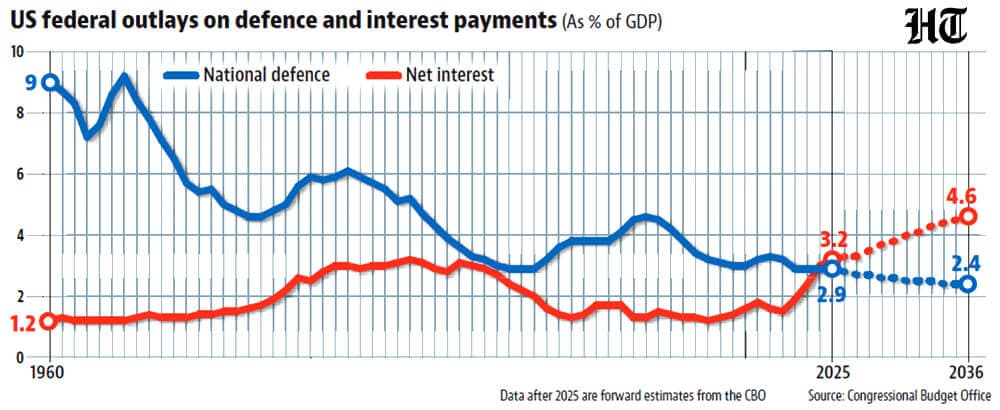
A super power is believed to enter a phase of decline when it starts spending more on serving its debt (interest payments) than its military spending.
Updated on: Jul 3, 2026, 07:16:57 IST

 Prefer HTon Google
Share via


Copy link

On July 4, 1776, 56 delegates signed the Declaration of Independence at what is now known as Independence Hall in Philadelphia. July 4 has since been celebrated as Independence Day in the US. July 4, 2026 marks 250 years of the US. To paraphrase Hagrid from the first Harry Potter film, it is not every day that a global super power turns 250 and is still a super power. The only other country which can claim to have had a global influence like the US is its erstwhile coloniser Great Britain. The latter started losing its global influence by the time the First World War ended. What is the US like, to the world, its people and India, at its 250th? This is what this three-part series will try to answer with numbers.

US@250: Leveraged at the top
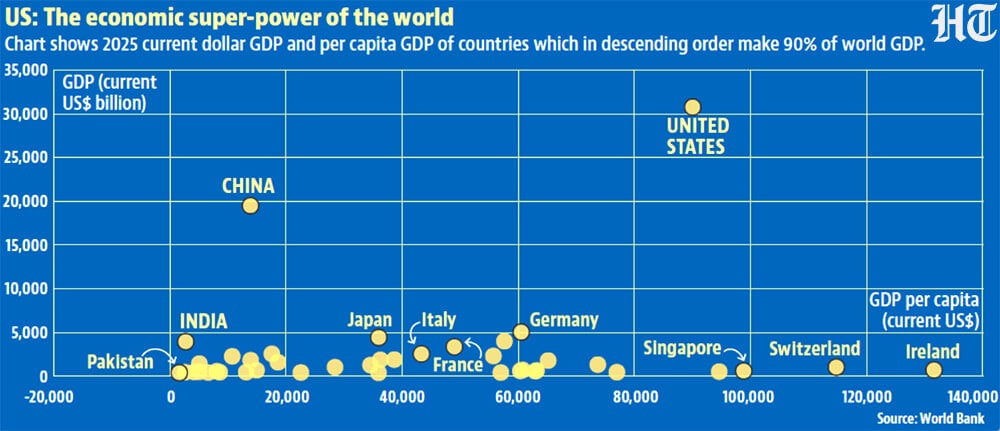
 US’s economic supremacy is still unmatched in the worldLately, much of the economic commentary rightly focuses on US’s economic vulnerabilities, especially concerning Chinese dominance in manufacturing, trade and tech. A lot of this commentary is justified. But none of this should sidetrack us from appreciating US’s economic dominance in the world in terms of the two variables that matter most: GDP and per capita GDP. Not only is the US 1.6 times ahead of China, the second-ranked country, in terms of absolute GDP, its per capita GDP is 6.5 times China’s . Both America and Americans are significantly richer; that is the point. Even if China were to one day catch up with the US in terms of overall GDP – most analysts do not see this happening in a reasonable time given that China is past its peak growth phase – it is unlikely to match US’s living standards as captured in the per capita GDP numbers.
- Growing leverage, more than China, could be the US’s undoingFor more than a decade, the US has viewed China as its principal strategic rival. There are regular doomsday simulations of a military conflict with China over Taiwan, supply chain relations turning into crippling dependencies and, of course, the trade deficit the US has been running. All of these problems might be secondary to the central contradiction facing the US’s position as the superpower of the world. In strategic parlance, this is often described as Ferguson’s Law. A super power is believed to enter a phase of decline when it starts spending more on serving its debt (interest payments) than its military spending. The idea was proposed in a 2025 paper published by Niall Ferguson which was also published as an essay in the Wall Street Journal. “The crucial threshold is the point where debt service exceeds defense spending, after which the centripetal forces of the aggregate debt burden tend to pull apart the geopolitical grip of a great power, leaving it vulnerable to military challenge… The striking thing is that, for the first time in nearly a century, the U.S. began violating Ferguson’s Law last year”, it says. The roots of the US’s growing debt burden are found in its economic contradictions, as was pointed out in a recent piece on Alan Greenspan’s economic legacy in these pages.
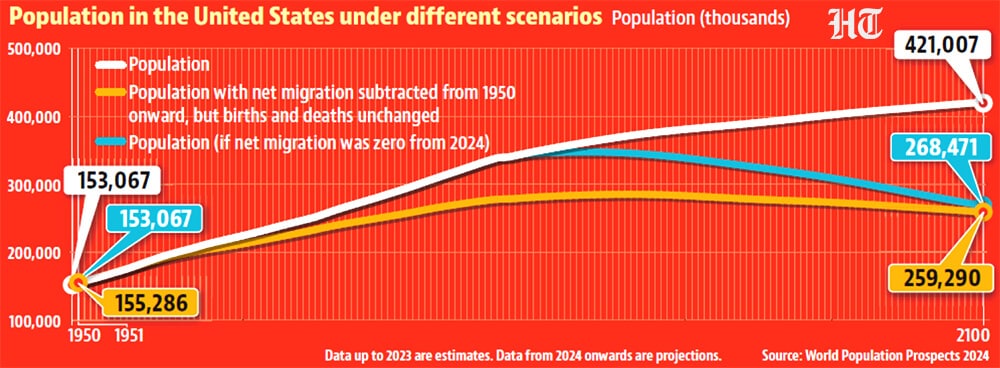
- US isn’t just leveraging fiscally, its also leveraged demographicallyIf one were to flag just one historical event which cemented the US’s position as a global super power, it would be that it is the only country to have ever used a nuclear weapon in a war. US would never have had the atom bomb if not for a set of scientists who fled Nazi persecution from Europe and eventually landed in the US. To be sure, much of the US economic prowess before the World Wars was built on a different kind of migration: slave trade. US’s dependence on migrants for its economic dynamism continues to this day. It is the largest attractor of a highly-skilled workforce which has built its technological dominance. As the US becomes more isolationist and part of it turns hostile to its migrants – Donald Trump’s politics is the epitome of this tendency’s mainstreaming – it will have to learn to balance its economic dependence on migrants and the social hostility against them. Data from the United Nations World Population Prospects (WPP) 2024 report shows that if net migration were to become zero from 2024 onwards, the US population would start decreasing as soon as 2035. Another simple exercise is also useful. If one subtracts all population growth via net migration since 1950 onward, the US’s 2024 population would be 19% less than it is. Days before the US turns 250, the US Supreme Court blocked an attempt by Trump to deny birthright citizenship in the US.




Unlock a world of Benefits with HT! From insightful newsletters to real-time news alerts and a personalized news feed – it's all here, just a click away! -Login Now!


