
 E-Paper



What data tells us about regime changes | Number Theory
.
Updated on: Jun 30, 2025, 09:12:19 IST

 Prefer HTon Google
Share via


Copy link

The latest flare up in conflict between Iran and Israel, and later the US, saw those within the US and Israeli dispensation initially calling for the orchestration of a regime change in Iran. While US President Donald Trump has since turned ambivalent on the issue, the US is no stranger to orchestrating regime changes. HT looked at the numerous US-backed regime changes across the world over the last 75 years to see what kind of governments were overthrown, and how those countries fared after.
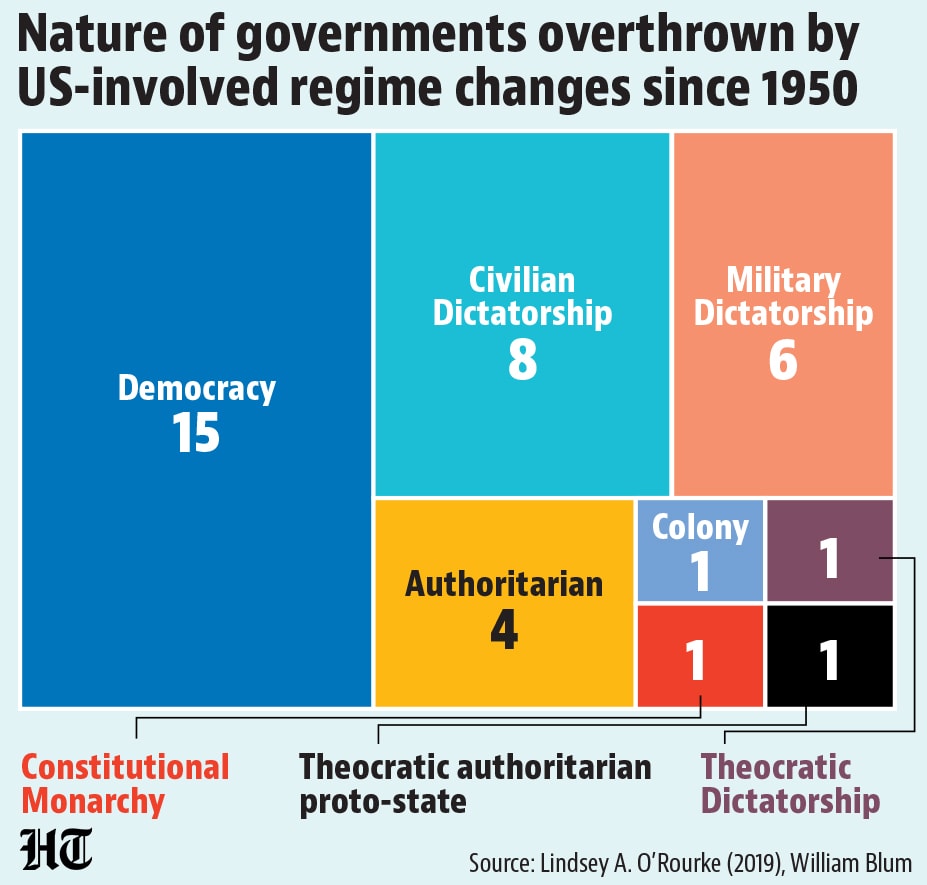
 US interventions were not just about supporting ‘free peoples’ who are resisting subjugationIn the 19th and early 20th centuries, US leaders invoked the Monroe Doctrine (1823) and its Roosevelt Corollary (1904) to justify interventions in Latin America. President James Monroe warned European powers that any extension of their system to the Americas would be “dangerous to our peace and safety”. Theodore Roosevelt later asserted that the US was an “international police power” in the Western Hemisphere to curb chronic instability. It was, however, President Harry S. Truman who laid the groundwork for post-1950s regime-change operations under the garb of protecting democracy. Announcing aid to Greece and Turkey in 1947, he declared, “It must be the policy of the United States to support free peoples resisting attempted subjugation by armed minorities or by outside pressures.” To be sure, US’s interventions have not always been in defence of democracy. An HT analysis—drawing on Lindsey A. O’Rourke’s 2019 book Covert Regime Change and William Blum’s Master List of US regime-change operations—shows that, since 1950, the United States has successfully carried out at least 37 regime changes operations worldwide. That total would rise substantially if unsuccessful attempts and other forms of foreign intervention were included. In 41% of these cases, the overthrown regime was democratic, suggesting motives beyond aiding “free peoples”. This rationale was made explicit by Henry Kissinger in 1970: “I don’t see why we need to stand by and watch a country go communist because of the irresponsibility of its own people.”
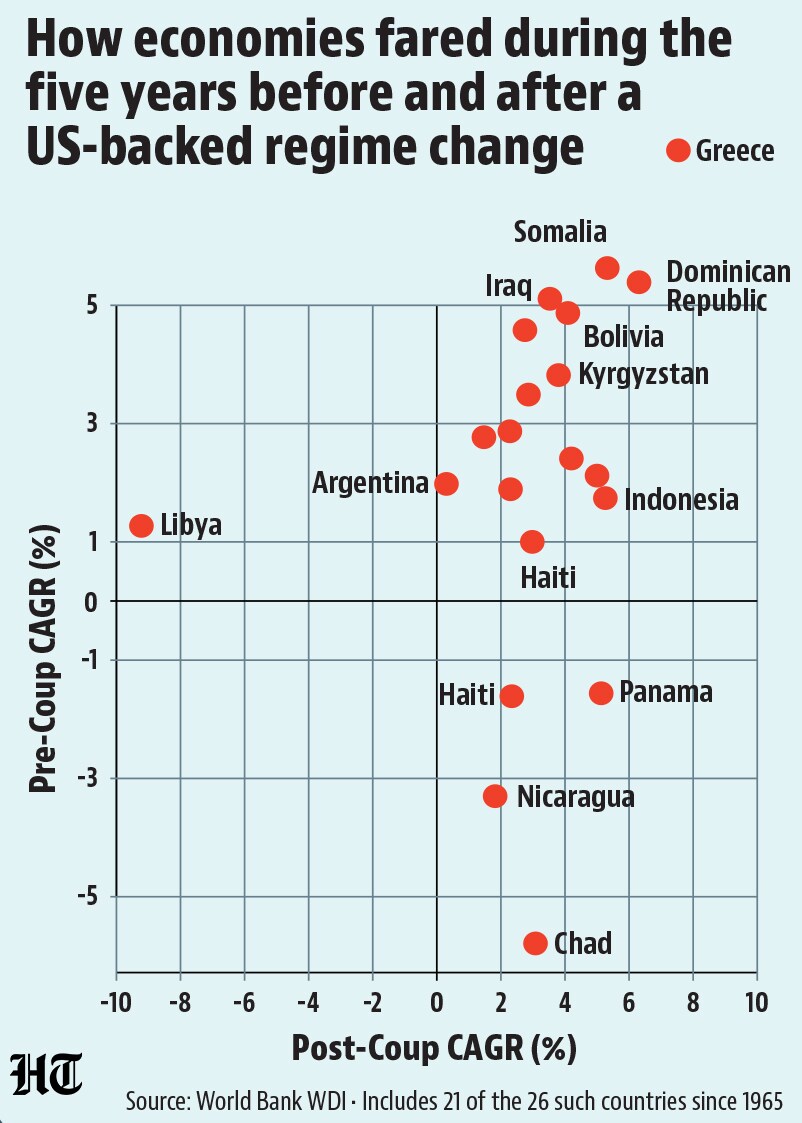
- Do countries that had US-backed regime changes see better economic growth following it?To answer this, HT calculated the compound annual growth rate (CAGR) of real GDP for the five years before and after the regime change in 21 of the 26 such countries since 1965. For the countries which saw regime changes pre-1960 data isn’t available in the World Bank database. The median post-coup CAGR was 3.08%, compared with 2.41% in the five years preceding the coup. Four countries recorded negative growth in the lead-up to the regime change, whereas only one—Libya, after Muammar Gaddafi’s fall in 2011—experienced negative growth afterwards. However, this does not imply that economies consistently boomed post-intervention. In 11 of the countries analysed, the post-coup CAGR was actually lower than the pre-coup rate, as the volatility post these events often hamper growth. To be sure, the lower economic growth rates before the regime change in several cases were due to the US-led international sanctions against these countries preceding it, and the higher economic growth rates after are often a result of the removal of these sanctions and increased trade and investments from the West in the immediate aftermath
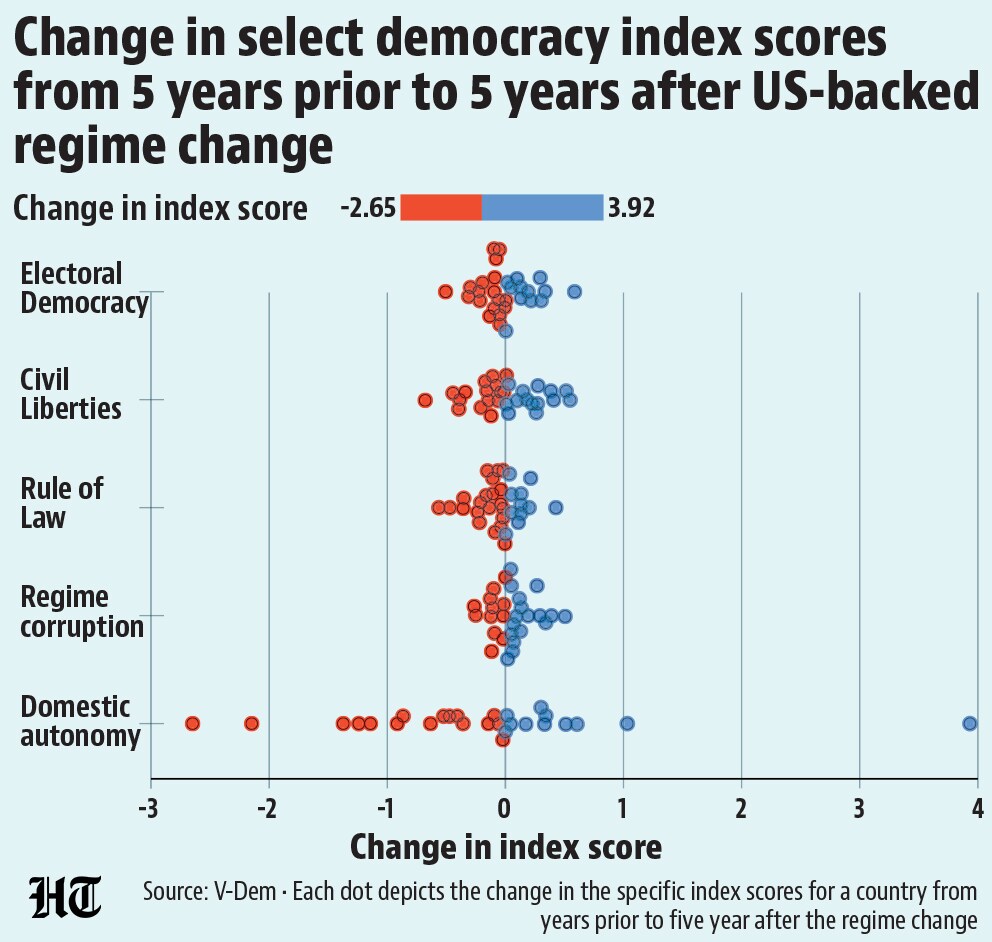
- But sovereignty and rule of law often suffers post regime changeA comparison of key V-Dem (the Varieties of Democracy project) indices shows that five years after these interventions most countries saw declines in electoral democracy, civil liberties, rule of law and domestic autonomy compared to five years before the regime change—though corruption scores sometimes improved. V-Dem is a comprehensive, expert-coded dataset used to measure multiple dimensions of democracy across countries and over time, which makes it ideal for assessing how these interventions affected the polity of these countries. Rule of law and autonomy suffered the most, with 21 of 34 countries, for which data was available, backsliding on rule-of-law and 16 of 28 on autonomy. While some of the deterioration could be a result of deliberate weakening of institutions and constitution – for example, Iraq’s 2003 Coalition Provisional Authority dissolved the judiciary and ruled by decree, and Chile’s 1973 junta suspended the constitution, closed Congress and set up military tribunals – part of it could just be the chaos because of the fall of dictatorial but capable administrators.


Unlock a world of Benefits with HT! From insightful newsletters to real-time news alerts and a personalized news feed – it's all here, just a click away! -Login Now!


