India launched its first universal proof of identity, the Aadhaar card, in 2010. There are 1.42 billion Aadhaar cards in India today, although only 1.33 billion are estimated to belong to living people. To be sure, the first attempt at issuing widespread identity cards began a decade and a half before, with the Election Commission issuing photo voter identity cards. The ongoing Special Intensive Revision (SIR) controversy in Bihar might end up discounting both the Aadhaar and an already issued
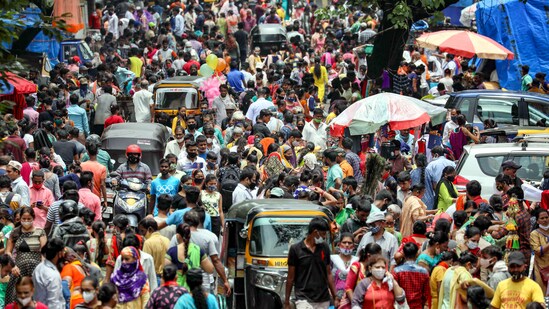
A crowded market in Mumbai. (PTI File Photo)
What share of population could be off the grid?
Only 31% of adults likely had matriculation certificates in 2011
The 2011 census data shows that only 31% of adults had completed secondary level of schooling, which is usually the first level of education where a student in India is registered with a recognised board (read government). The proportion of secondary school educated adults was lower among rural Indians, women, and among Scheduled Castes (SCs) and Scheduled Tribes (STs). The census does not record Other Backward Classes (OBCs) and non-SC-ST-OBCs separately. A breakup by religion shows that while Hindus are close to the national average in finishing secondary school, as expected from their share in population, Christians, Jains, Sikhs, and Buddhists are ahead of the national average. Only Muslims and other minority religions are far behind the national average.
Even relatively rich states had a poor level of secondary school pass adults
States like Chhattisgarh, Rajasthan, Odisha, Bihar, and Madhya Pradesh had just around 23% of adults educated up to that level. However, it is not the case that the more urban or rich states were very far from having universal secondary school education (and therefore a certificate).
Younger people are more likely to have finished secondary school but it is still far from universal
This can be seen from the age-wise breakup of secondary educated people in the 2011 census. The overall proportion for adults with at least secondary education is largely low because of older age groups. The proportion was 40.7% for the 15-19 age group, 44.6% for the 20-24 age group, and 38.1% in the 25-29 age group. This number decreased for every subsequent age group becoming as low as 14% for the population aged 60 and above.
This is exactly why something like SIR can create more problems than solve
India has been pushing the envelope on documentation of citizens on various fronts now via things such as Aadhaar, registration or births and secondary school certificates. Because a lot of these databases are nationally connected, they are easier to verify than proofs such as domicile certificates or ration cards. Legality notwithstanding, any move that makes the progress of the past couple of decades redundant in the eyes of the state will only erode the collective belief in the system and create unnecessary panic.
Abhishek Jha is Assistant Editor-Data at Hindustan Times. He uses statistical programming to generate newsworthy insights from large datasets. He is part of the team that produces Number Theory, a daily data story feature of the paper’s print edition. Since March 2024, he has been writing Weather Bee, a weekly column for the Hindustan Times website. He is a chemical engineer by training, who specialises in stories related to weather, climate, and the environment. Jha has been at HT since 2018, where he offers data-driven perspective and analysis on politics, environment, weather, climate, economy and society. His work includes data coverage of elections in India and abroad, including the 2019 and 2024 Lok Sabha elections; the disasters and extreme weather resulting from changing climate, such as floods, droughts, heat waves, cold waves, and dwindling snow cap in the Himalayas; the factors that drive poor air quality in northern India; the changing patterns of land use; the Covid-19 pandemic and its impact on labour market conditions; the changing pattern of consumer spending seen in the new consumer spending surveys; and social norms seen in the surveys such as the National Family Health Survey.
Roshan Kishore is the Data and Political Economy Editor at Hindustan Times. He heads the newsroom's data journalism team, which produces Number Theory, a daily data-driven feature for the print edition and the HT app. Number Theory uses data analysis and story-telling based on it to add value to the newsroom’s daily coverage by putting stories in a larger context on a range of issues, including politics, macroeconomy, markets, global affairs and climate. Under his leadership HT’s data journalism work has established itself as a niche product in Indian journalism and pushed the boundaries of marrying academic rigour with news sense and speed. Along with writing and editing data stories, he has also been writing a weekly political economy column called Terms of Trade for HT Premium. A trained economist with an MPhil degree from Jawaharlal Nehru University, Kishore has also been a visiting fellow at the Centre for Advanced Studies of India (CASI) at the University of Pennsylvania. Along with his journalistic work, his writings have also appeared in journals such as the Economic and Political Weekly and working papers for CASI and UNESCAP.
Unlock a world of Benefits with HT! From insightful newsletters to real-time news alerts and a personalized news feed – it's all here, just a click away! -Login Now!
Unlock a world of Benefits with HT! From insightful newsletters to real-time news alerts and a personalized news feed – it's all here, just a click away! -Login Now!
Home/Editors Pick/What share of population could be off the grid? | Number Theory
{{^htLoading}}
Advertisement
{{/htLoading}}
SHARE THIS ARTICLE ON
{{#usCountry}}{{/usCountry}}
Notifications
Get breaking alerts directly from the newsroom
Notifications are on!You'll be notified when news breaks