E-Paper



Who’s backward? Who’s not? | Number Theory
This is the first of a two-part series which tracks the role of caste in lack of economic affluence in India.

 Prefer HTon Google


Who is economically privileged in India is a question which can evoke strong views. The empirical basis for answering this question is not so easy. India does not have official data on income distribution. The consumption expenditure survey, which is often taken as a proxy for income in India, significantly undercounts the rich. Sources such as the income tax returns database are released at a very summary level and do not lend themselves to granular analysis. The problem becomes even more difficult when one needs to look at the relationship between economic affluence and caste in India.
With the government’s decision to hold a caste enumeration along with the new census, questions about the relationship between caste and economic affluence are bound to attract more interest. In this two-part series, HT has used some intuitive proxies to see whether economic affluence has any relationship with caste in India. The first part of the series will use three proxies to track lack of economic affluence and caste and the second part will use other proxies to track the relationship between economic affluence and caste.
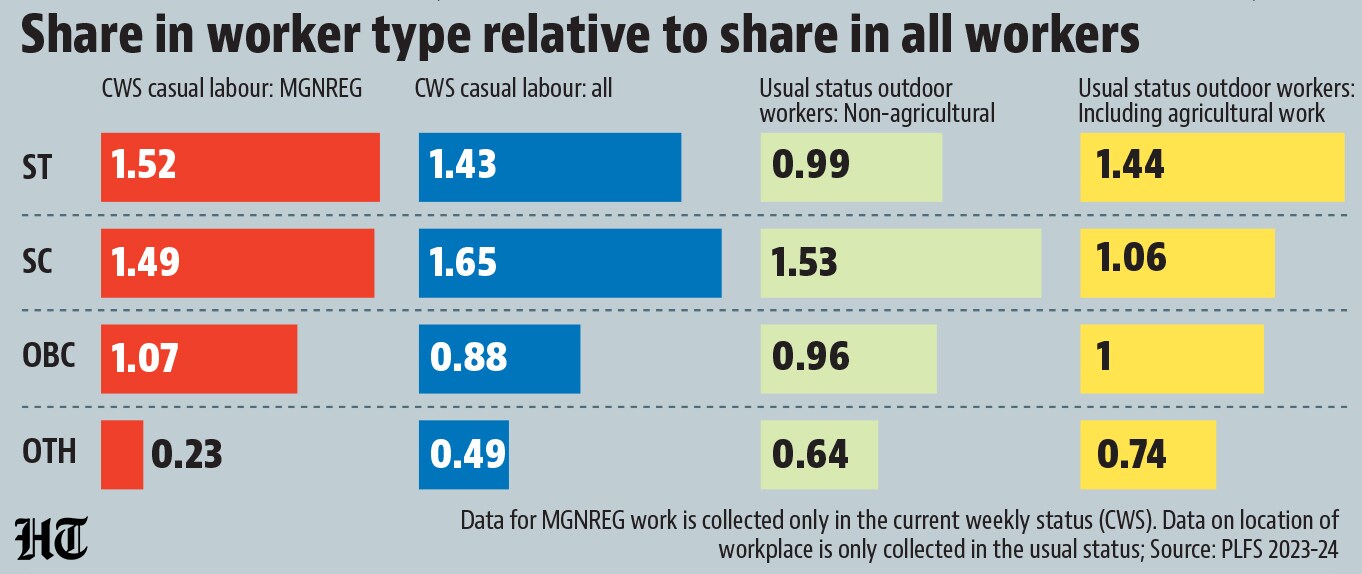
 Who is more likely to be doing MGNREGS work or working outdoors?A lot of welfare benefits in India are allegedly cornered by people who do not need them (or so goes the popular narrative). When it comes to such things as subsidised provisioning of goods (food grains) or assets (houses or LPG cylinders) it makes economic sense for a non-eligible person to try and get them. However, there is one welfare scheme in India which is extremely unlikely to see non-deserving claimants. It is the Mahatma Gandhi National Rural Employment Guarantee Scheme (MGNREGS) which entails doing manual work in villages for what are often lower than market minimum wages. Unless a person is really desperate and unskilled to do any other work, it is unlikely that they would ever take up MGNREGS work. Data from the Periodic Labour Force Survey (PLFS) asks people whether they worked in MGNREGS. While the overall share of reported MGNREGS workers is not very large – responses were only sought on the basis of work done in the past week – a comparison of social group wise relative shares shows that Scheduled Tribe (ST), Scheduled Caste (SC) and even Other Backward Classes (OBCs) have a much higher share of MGNREGS workers than non-SC-ST-OBCs. Almost a similar trend can be seen in the relative share of casual workers (most insecure and least paying) and those who work outdoors (such as farmers in villages or street vendors in cities).
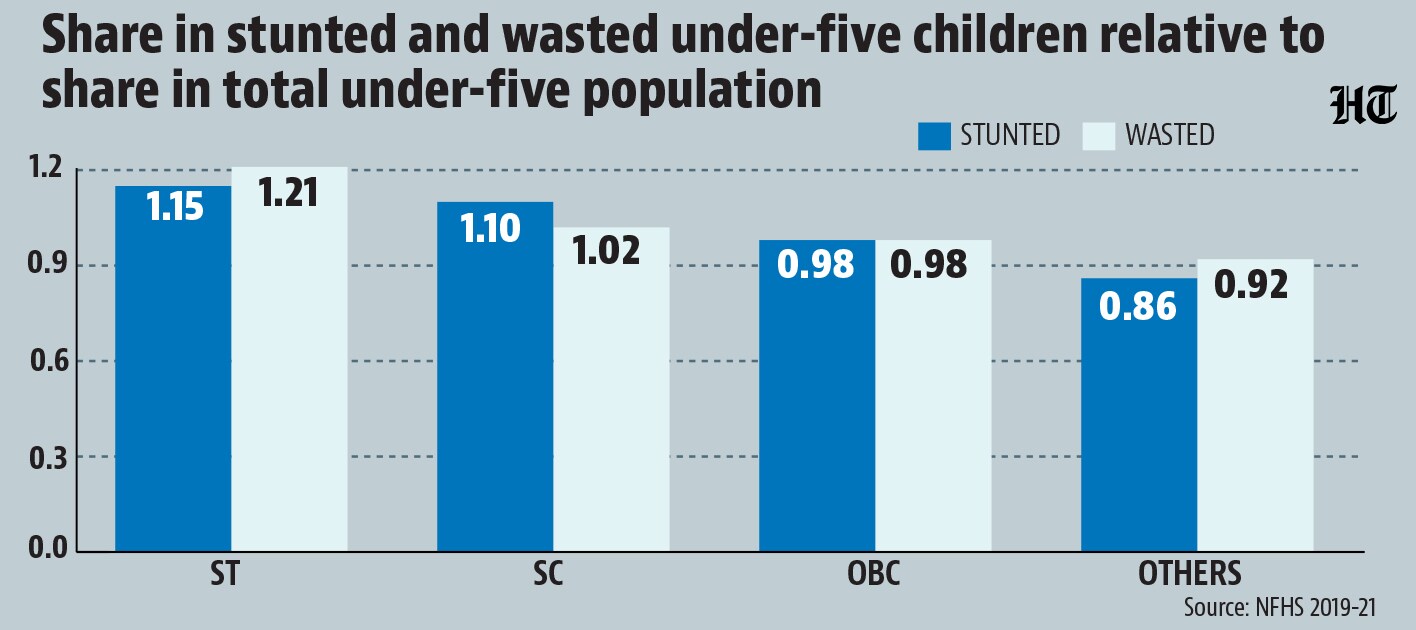
- Whose children are more likely to be malnourished?The presence of malnourishment in children under five years, seen in indicators such as prevalence of stunting (low height for age) or wasting (low weight or height), is very likely to be a result of the economic inability of a family to buy adequate food for their children. Data from the 2019-21 National Family and Health Survey (NFHS) shows that SC and ST children are more likely to suffer from wasting and stunting than non-SC-ST-OBC or even OBC children.
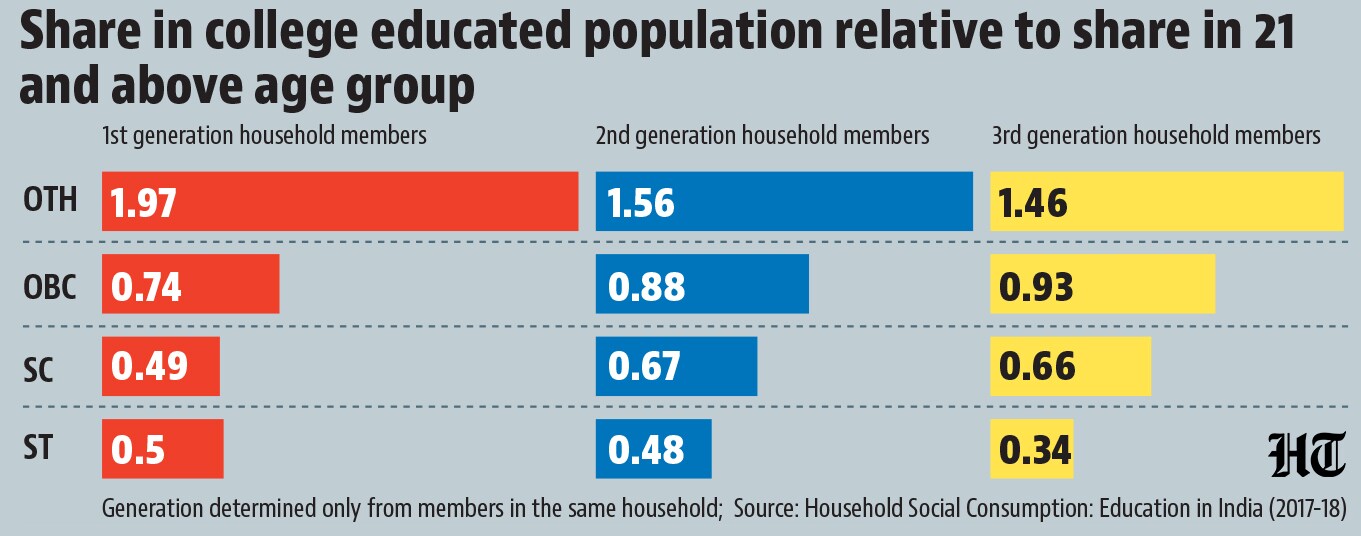
- Who is more likely to have a non-college educated family members in every generation?Education is perhaps the biggest factor in inter-generational upward mobility. Being born to parents who did not go to college is likely to be a big disadvantage in the next generation’s professional advancement. The NSSO report on Household Consumption of Education in India allows us to look at the educational qualification of household members in every generation. The data shows that SC-ST groups have a large disadvantage when it comes to relative share in first generation household members who went to college. While the disadvantage exists for younger cohorts (second and third generations) as well, it has come down compared to the first. To be sure, the database does not have three generations (grandparents, parents, children) in every household, which is defined as a group that lives together and eats food from the same kitchen in NSSO surveys, rather than a family.