
 E-Paper



Why today's World Economic Outlook will be keenly watched | Number Theory
.
Published on: Apr 22, 2025, 08:48:21 IST

 Prefer HTon Google
Share via


Copy link

The International Monetary Fund will release the April 2025 edition of its flagship World Economic Outlook (WEO) today. The WEO is the most important institutional economic forecast for the world and is keenly watched by everybody. Today’s WEO will be among the most keenly watched ones in a very long time because of the global economic uncertainty after US President Donald Trump’s announcement of reciprocal tariffs and many subsequent flip-flops on the issue. Here are three charts which set the context of the WEO and what to watch out for in the numbers that will be released 6.30pm India time on Tuesday.

Why today's World Economic Outlook will be keenly watched
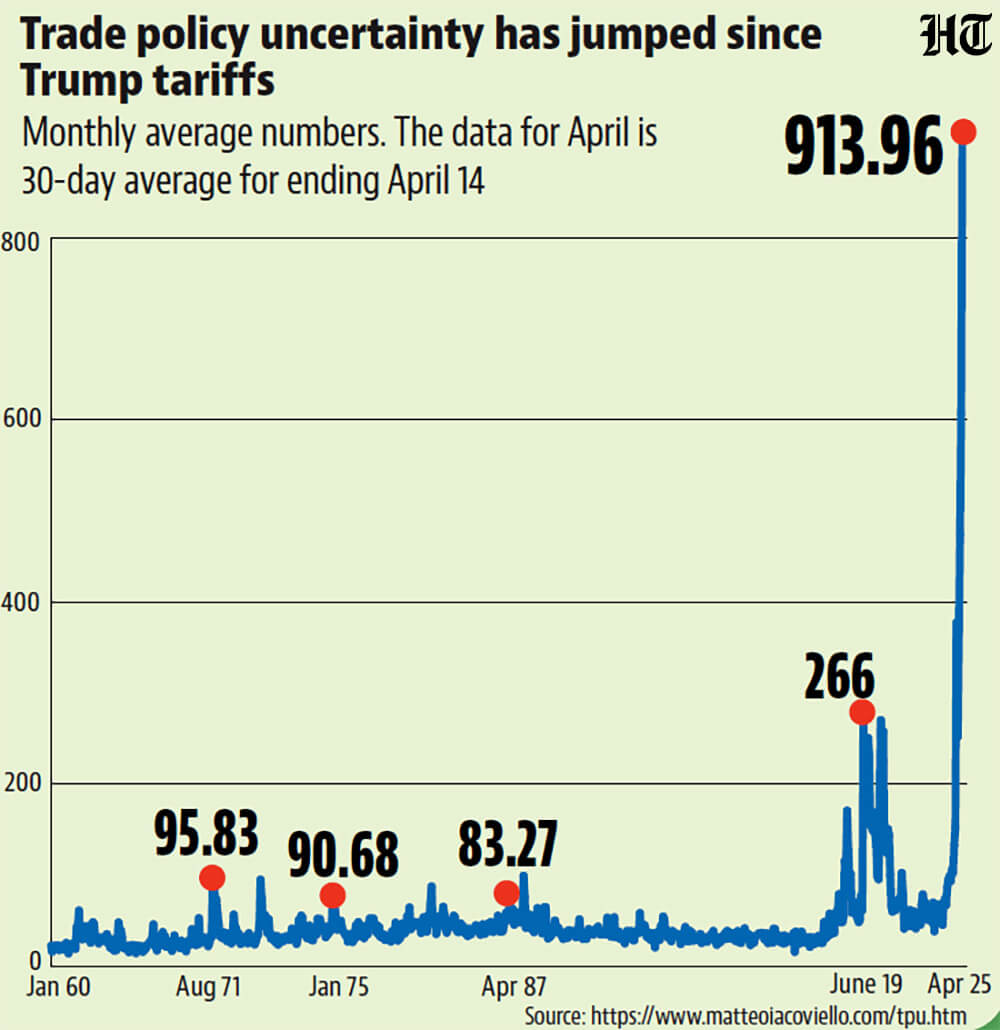
 WEO is being released when trade policy uncertainty has reached an all-time high“Trade policy uncertainty is literally off the charts,” Kristalina Georgieva, managing director of the IMF (International Monetary Fund) said while speaking ahead of the customary spring meetings of the IMF and the World Bank in Washington DC on April 17. “Uncertainty is costly. The complexity of modern supply chains means imported inputs feed into a broad range of domestic products. The cost of one item can be affected by tariffs in dozens of countries. In a world of bilateral tariff rates, each of which may be moving up or down, planning becomes difficult. The result? Ships at sea not knowing which port to sail to; investment decisions postponed; financial markets volatile; precautionary savings up. The longer uncertainty persists, the larger the cost”, Georgieva added, unequivocally flagging the costs of the ongoing tariff wars.
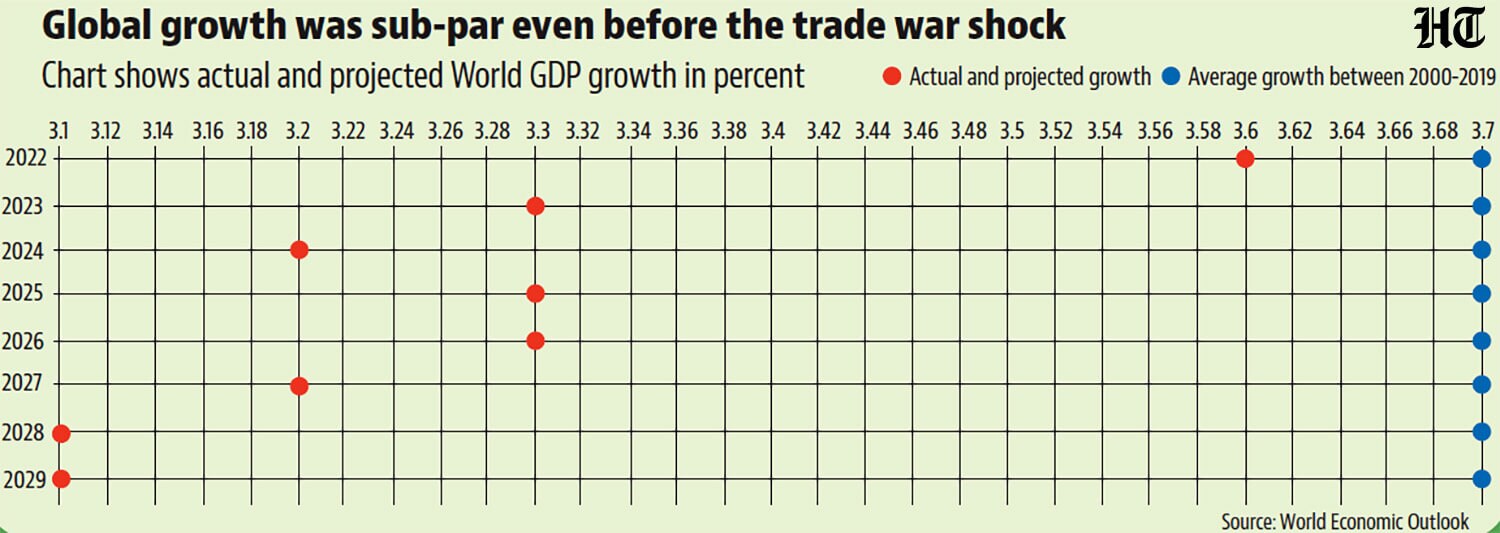
- Global economy was facing sub-par growth even before this spike in uncertainty“Global growth is expected to remain stable, albeit lacklustre. At 3.3 percent in both 2025 and 2026, the forecasts for growth are below the historical (2000–19) average of 3.7 percent and broadly unchanged from October”, the January 2025 update to IMF’s October 2024 WEO had said. Global GDP growth in 2023 was 3.3% and estimated at 3.2% in 2024. IMF had warned against the headwinds from trade wars even in its January 2025 update to the WEO. “An intensification of protectionist policies, for instance, in the form of a new wave of tariffs, could exacerbate trade tensions, lower investment, reduce market efficiency, distort trade flows, and again disrupt supply chains. Growth could suffer in both the near and medium term, but at varying degrees across economies”, the report said.
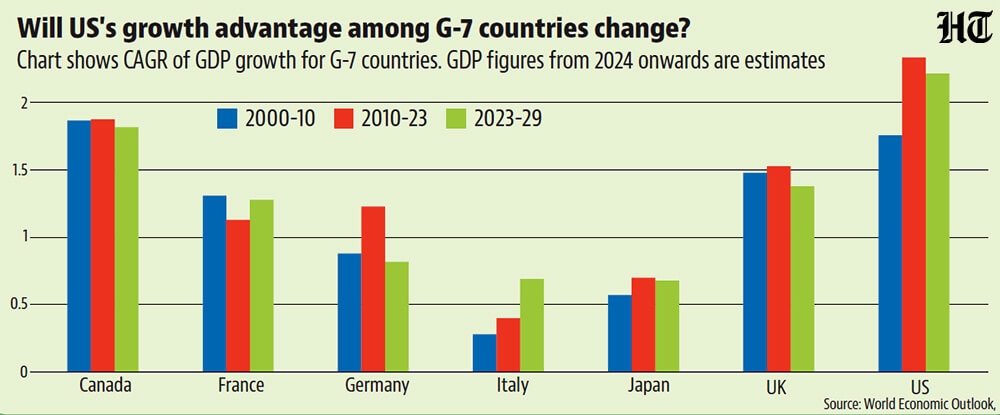
- Will IMF project a recession for the US?This will be the most keenly watched number in today’s WEO forecasts. That the US is the world’s biggest economy and an American recession could trigger widespread panic in global markets is only one of the reasons for this. Even the sub-par global growth in the in the January 2025 update of the WEO was banking on a large support by US. “The (growth) forecast for 2025 is broadly unchanged from that in the October 2024 World Economic Outlook (WEO), primarily on account of an upward revision in the United States offsetting downward revisions in other major economies”, the January 2025 WEO had said. This means that a lower than expected growth in the US will be a double whammy for the global economy which was over reliant on it in any case. Will IMF downgrade its growth forecast for the us into a recession? “We will quantify these costs in our new World Economic Outlook, to be released early next week. In it, our new growth projections will include notable markdowns, but not recession. We will also see markups to the inflation forecasts for some countries,” Georgieva said in her remarks on April 17, suggesting that the US is more likely to see an adverse growth-inflation balance than an outright recession.
- Will India’s growth forecast see a downgrade as well?IMF’s January 2025 WEO update has projected a GDP growth of 6.5% in 2025-26 and 2026-27. These numbers were the same in the October 2024 WEO as well. This made India the fastest growing major economy in the world in the WEO projections. While India’s fastest growing status is unlikely to be in jeopardy – no major economy other than India had a growth rate higher than even 5% -- it remains to be seen how much of a downward revision, if at all, is made to India’s growth forecast in the latest WEO. The Monetary Policy Committee of the RBI, which met earlier this month, brought down its 2025-26 growth forecast for the Indian economy to 6.5% from 6.7%.


Unlock a world of Benefits with HT! From insightful newsletters to real-time news alerts and a personalized news feed – it's all here, just a click away! -Login Now!


