
 E-Paper



World’s billionaire and millionaire cities | Number Theory
Do some cities have more super-rich people than others? Are low taxes key to attracting the super-rich? Here is a brief summary
Updated on: Jan 12, 2026, 09:08:22 IST

 Prefer HTon Google
Share via


Copy link

New York mayor Zohran Mamdani plans to tax the city’s super-rich to fund his promises. The mecca of capitalism isn’t the only global metropolis caught in the debate around taxes and the super-rich. The Labour government’s tax policies have triggered similar debates in London. Do some cities have more super-rich people than others? Are low taxes key to attracting the super-rich? Here is a brief summary.

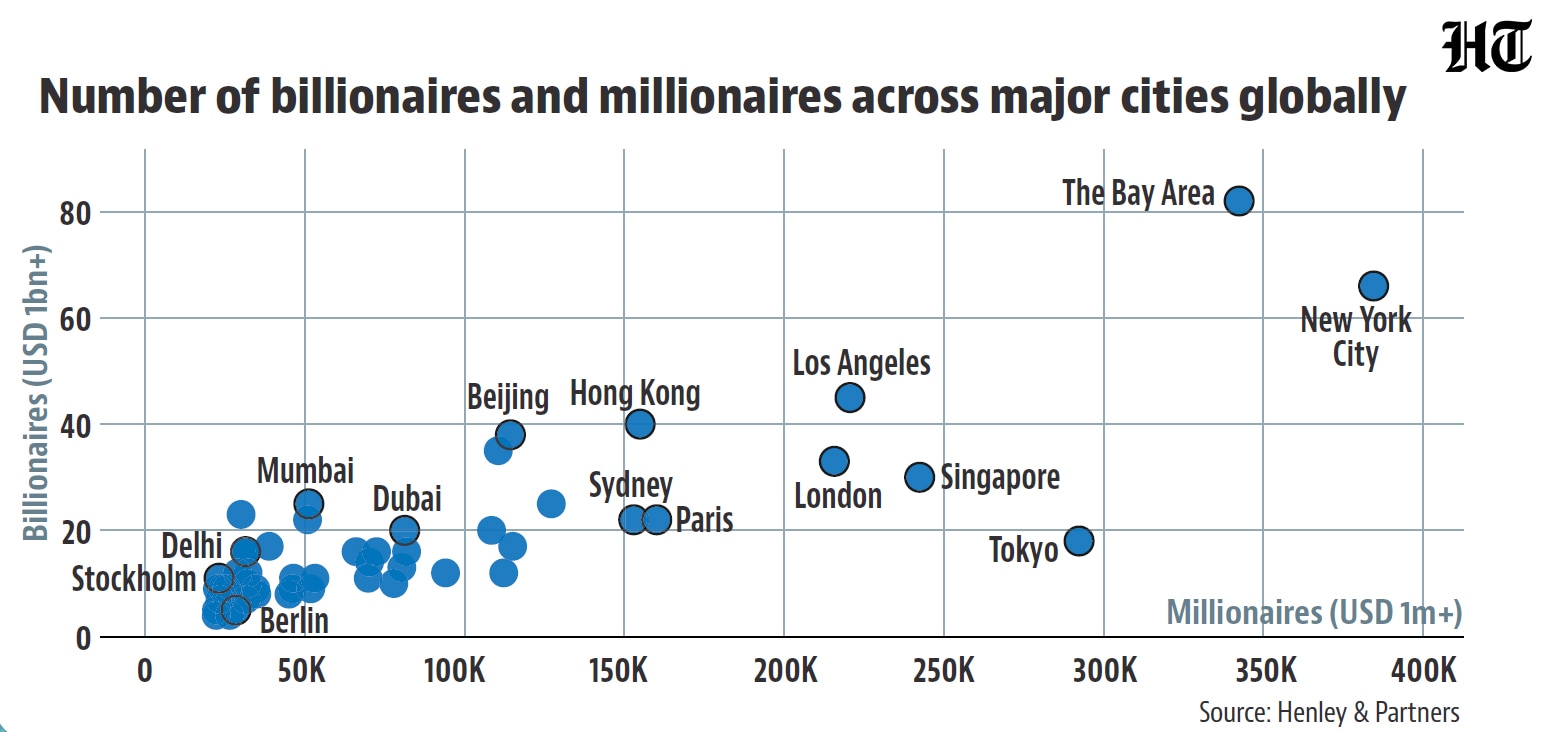
 The richest citiesNew York is not just home to a large number of billionaires but, more importantly, has the deepest pool of millionaire households anywhere, giving it a broad and durable high-income base. That sets it apart from places like the San Francisco Bay Area, where extreme wealth is more concentrated among a smaller group, largely reflecting the fortunes created by the technology sector. London, too, remains a major global wealth centre by headcount, though its profile looks different from New York’s, with fewer billionaires and a thinner spread of very high earners. In Asia, cities such as Singapore, Beijing and Shanghai combine sizable affluent populations with significant ultra-wealthy cohorts, while Dubai has positioned itself as a hub for top-end wealth despite a smaller overall base. Mumbai and Delhi feature lower down the rankings by sheer numbers, but they stand out for their higher concentration of billionaires relative to their smaller millionaire bases, showing how private wealth in India is more narrowly held than in older global financial centres.
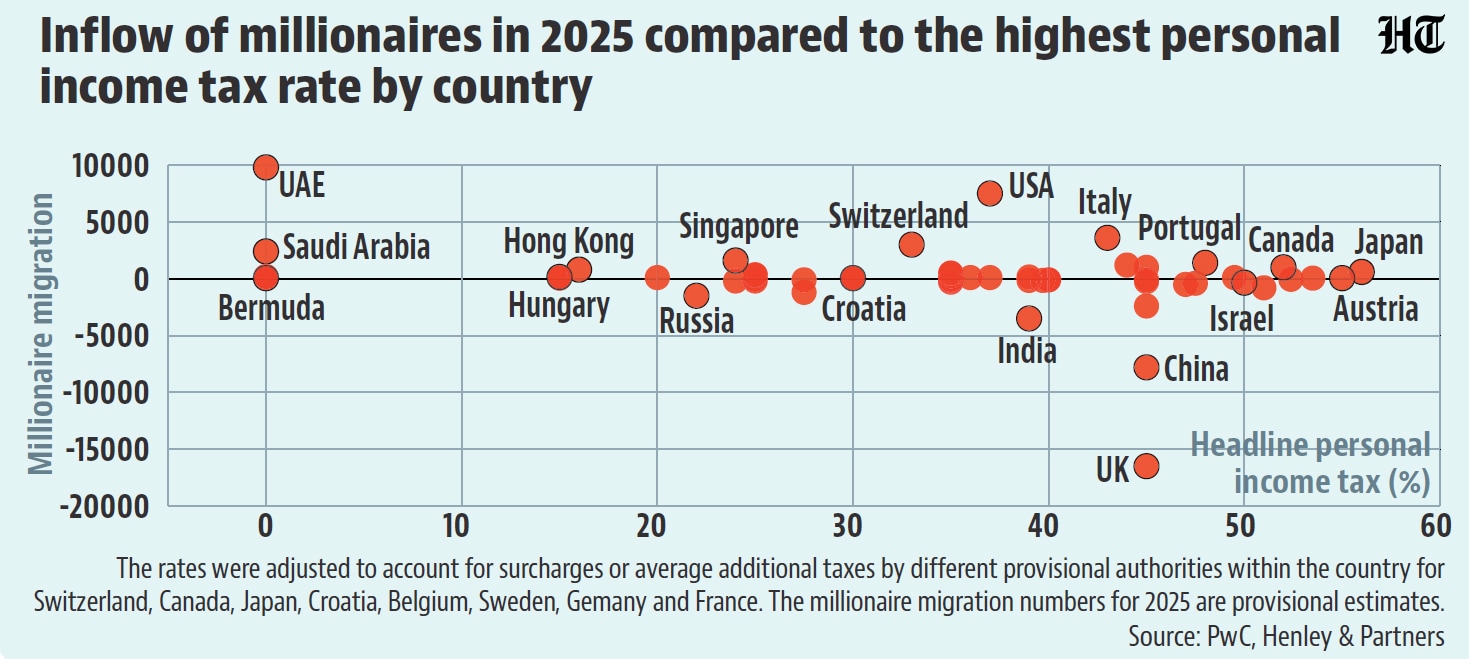
- Where the rich are moving and how taxes fit inThe movement of the rich across borders helps explain why tax debates have become so politically charged. The UAE, with no personal income tax, stands out as the biggest magnet for millionaires, drawing 9,800 newcomers in 2025. But low taxes alone do not tell the whole story. The US continues to record net inflows of wealthy individuals despite a high federal top rate, reflecting the pull of its large economy and opportunities. Parts of Europe also present a more nuanced picture. Italy, Portugal and Greece have attracted affluent newcomers even with relatively high headline rates, helped by preferential tax schemes for new residents and investor programmes. By contrast, the UK is estimated to have seen the largest net outflow of millionaires globally in 2025, with many analysts pointing to high tax rates on income, capital gains and inheritance, the abolition of non-domicile tax privileges and Brexit-related economic uncertainty as key drivers behind this trend. France and Germany are also experiencing modest outflows, reflecting perceptions of less competitive tax and business environments compared with low-tax hubs such as the Gulf.
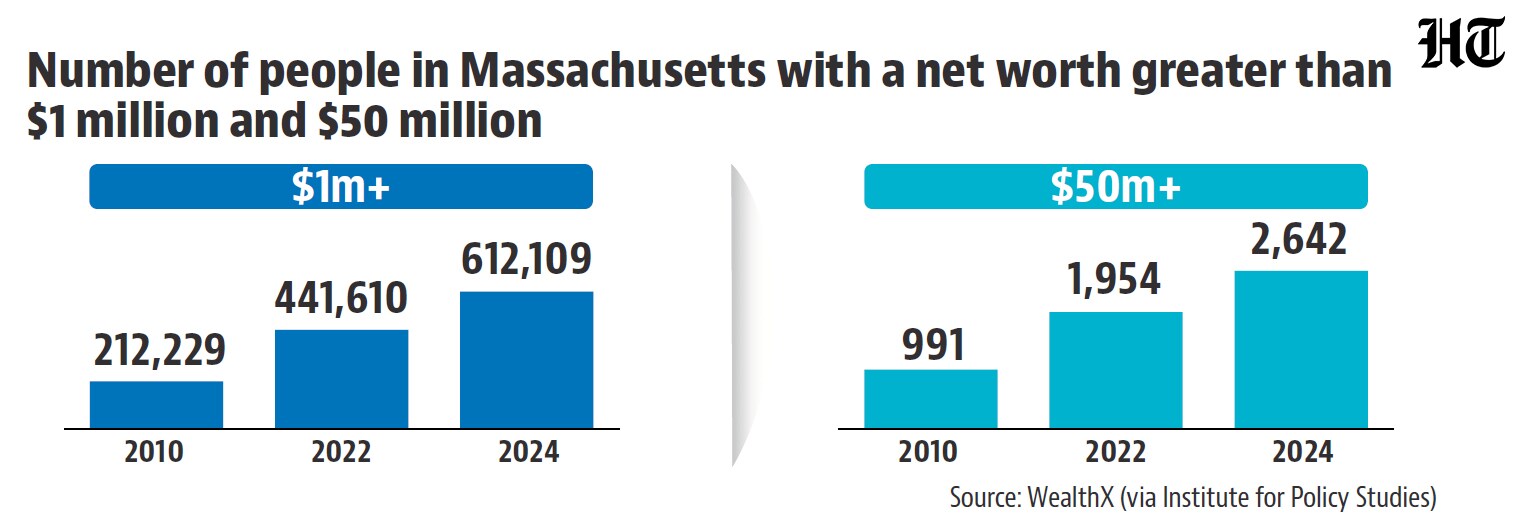
- Do higher taxes really lead to a ‘mass exodus’ of the wealthy?Academic evidence suggests that wealthy individuals do respond to higher taxes, but the scale of that response is typically modest and rarely large enough to undermine public finances. Studies using administrative tax records show that tax increases can raise outmigration at the margin, particularly among the richest households, but the numbers involved are small. An NBER study of California’s 2012 tax hike on incomes above $1 million found that the policy was associated with a one-time increase in departures of around 535 top-bracket taxpayer households out of a base of about 67,000 millionaire households. The associated revenue loss was derived to be about $200 million, or just over 4 percent of the roughly $5 billion in annual revenue the tax was expected to raise—it eventually ended up raising $5.8 billion in its first year, and more in future years—according to the Center on Budget and Policy Priorities. Evidence from Europe points in a similar direction. A 2019 study of Denmark’s former wealth tax finds that behavioural responses, including changes in wealth accumulation and some mobility, were concentrated among the richest households, while responses among the broader affluent population were modest. Recent US experience reinforces this pattern. In Massachusetts, where a surtax -- an additional tax levied on top of an already existing tax -- on incomes above $1 million took effect in 2022, revenue from the levy exceeded $1.8 billion in its first year, funding education and transport spending. Over the same period, the number of residents with net worth above $1 million rose from about 210,000 in 2010 to over 610,000 in 2024, according to the progressive think-tank, Institute for Policy Studies.


Unlock a world of Benefits with HT! From insightful newsletters to real-time news alerts and a personalized news feed – it's all here, just a click away! -Login Now!


