
 E-Paper



IIT Madras students have a solution for easier air relief missions
This innovation can cut down operation time at disaster hit areas.

 Prefer HTon Google


Deploying aircraft for disaster rescue or relief missions can be tricky. It takes at least seven to eight hours for an aircraft to carry out operations, preventing other aircraft from reaching airbases with relief supplies. Now, a group of 18 students at the Indian Institute of Technology Madras has designed a cargo ground build-up system (CGBS) that can cut down operation time from eight hours to less than 90 minutes. It’s a transportable vehicle which can be moved quickly in and out of the aircraft, cutting out the need for manual labour to offload relief material.
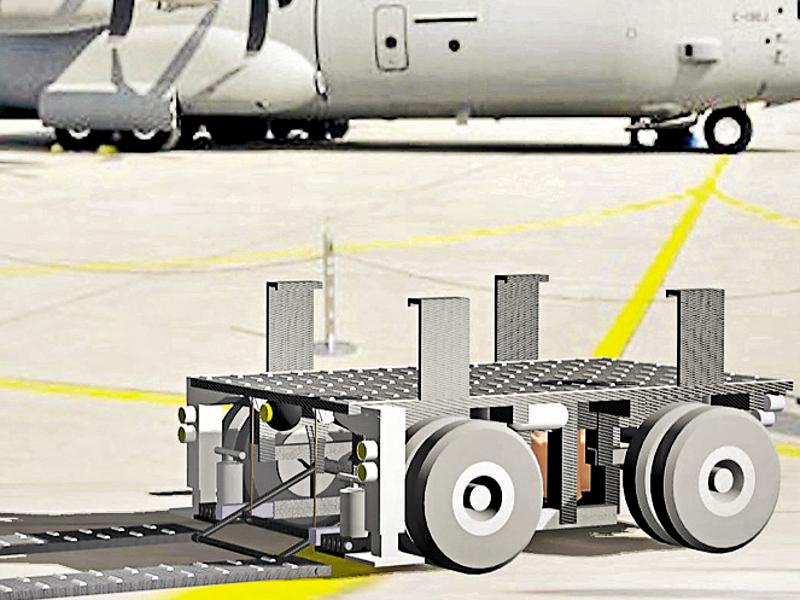
“If we reduce the operational time, more aircraft with important resources can reach disaster-hit areas. One plane is not enough to supply everything. We have come up with CGBS, a compact and easily transportable vehicle that will help the military offload equipment in much lesser time,” says Anupam Chandra, a student of engineering design, IIT Madras, who is working on the project.
American global aerospace company Lockheed Martin had invited Indian students in September 2014 to come up with concepts for using their C-130 aircraft that they had supplied to the Indian Air Force. It is used to transport relief materials, including food, medical aid, and generators to power relief camps and technical equipment for the military, to disaster-hit areas.
While the main airbases for the C-130 aircraft are well-resourced for loading and off-loading cargo, often, the disaster zones are not equipped to handle aircraft landing and cargo handling. So, the materials are tied-up in the air-cargo pallet, which are then manually offloaded by local military officials and distributed to the relief camps.
Out of 10 teams that had applied, five, including IIT Madras, were given a grant of $25,000 to design the system. In March 2016, the high-level design and analysis of their concepts were approved by a panel comprising members from Lockheed Martin, TATA Advanced Systems, Defence Research and Development Organisation and US Air Force. Lockheed Martin has given the team $60,000 for the prototype.


