The first phase of polling for 58 constituencies spread over 11 districts in West UP saw an average voter turnout of 61.6% on Thursday (as of 10.30pm) with Shamli district recording the highest polling percentage of 69.4% as the seven-phase state assembly election got underway.
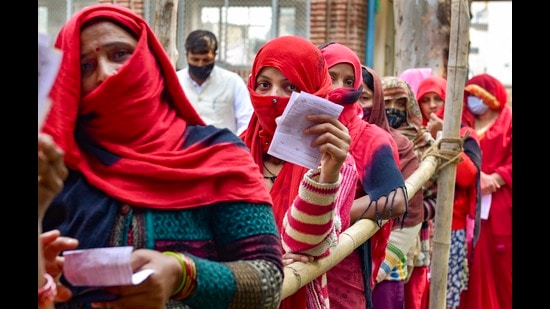
In 2017, the polling percentage was 63.47% for these 11 districts. The second phase of polling will be held four days later on February 14 in 55 constituencies.
Catch all latest updates related to assembly elections here
Polling was peaceful barring complaints of electronic voting machines (EVMs) malfunctioning, slow voting and scuffle between supporters of the Samajwadi Party-Rashtriya Lok Dal (SP-RLD) alliance and the Bharatiya Janata Party (BJP) in some places. There were complaints about names missing from voter’s list in the three districts of Mathura, Aligarh and Agra in the Braj region.
{{/usCountry}}Polling was peaceful barring complaints of electronic voting machines (EVMs) malfunctioning, slow voting and scuffle between supporters of the Samajwadi Party-Rashtriya Lok Dal (SP-RLD) alliance and the Bharatiya Janata Party (BJP) in some places. There were complaints about names missing from voter’s list in the three districts of Mathura, Aligarh and Agra in the Braj region.
{{/usCountry}}Angry villagers in Dayampur village of Meerut Cantt constituency abstained from voting till the afternoon. They were demanding construction of a village road.
“Polling was peaceful and there was no report of any untoward incident,” Uttar Pradesh chief electoral officer Ajay Kumar Shukla said at a press conference in Lucknow after the conclusion of polling.
Among the assembly constituencies, Shamli’s Kairana recorded the highest turnout of 75.12%. The constituency had been in the news over the Hindu exodus issue raised by the BJP. The Jat-dominated Khatauli constituency in Muzaffarnagar also saw a high turnout of 69.70%.
Samajwadi Party (SP) president Akhilesh Yadav urged the Election Commission to take immediate action wherever there are allegations of EVM malfunctioning or slow polling in Uttar Pradesh. For this part, chief minister Yogi Adityanath thanked voters for participating in the “festival of democracy.”
The districts that voted on Thursday amid heavy deployment of central and state forces were Shamli, Muzaffarnagar, Baghpat, Meerut, Ghaziabad, Hapur, Gautam Buddh Nagar, Bulandshahr, Aligarh, Mathura and Agra.
Over one lakh personnel of the Uttar Pradesh police and home guards, besides 800 companies of paramilitary personnel were deployed for the first phase, according to officials.
The central paramilitary forces were deployed at the strong rooms where EVMs were stored after polling, the CEO said.
Also Read | Amid Hijab row, Modi talks welfare of Muslim women in west UP
A total of nearly 2.28 crore (22.8 million) voters were eligible to exercise their franchise in the first phase.
As many as 623 candidates, including 73 women, were in the fray for the 58 seats and 151 candidates have criminal record, the UP CEO said.
During polling, 0.62% ballot units, 0.62% of control units of EVMs and 1.44 % VVPATs were changed due to faults, he said.
Thirty-seven of these 58 constituencies are spread over eight districts of the Meerut and Saharanpur divisions and 21 constituencies are in three districts of the Braj region.
In 2017, the BJP, which swept to power in Uttar Pradesh, had won 53 of these 58 seats. The BSP had won two and the SP three.
People not only voted enthusiastically but also spoke openly about their issues and choices even as Prime Minister Narendra Modi addressed his first physical rally in Saharanpur, chief minister Yogi Adityanath in Sambhal, Samajwadi Party-RLD alliance leaders in Bijnor and Congress general secretary Priyanka Gandhi Vadra campaigned in Rampur and Moradabad.
The political messaging of all the leaders centred on farm laws, security of women, law and order.
Earlier in the day, the chief minister in a video message had urged voters not to make any mistake as UP will turn into Kerala, West Bengal and Kashmir. This created a national controversy with the opposition leaders condemning UP’s comparison with the three states.
Voting which had started slow due to dense fog in the morning picked up momentum as the sun came out bright in the day.
The highest average turnout of 69.42% was recorded in the sensitive Shamli district, which along with Muzaffarnagar, had witnessed riots in 2013. Muzaffarnagar district recorded 65.9% turnout.
The average percentage of voting on all seats in the nine other districts was: Bulandshahr 65.1%, Baghpat 63.50%, Meerut 63.3%, Mathura 62.9%, Aligarh 61.4%, Hapur 60.5% , Agra 60.2%, GB Nagar 57.1% and Ghaziabad 54.2%
As much as 65.63% votes were polled in the sensitive Thanabhawan constituency and 67.50% in the Shamli constituency, all in Shamli district.
In Muzaffarnagar district, the highest turnout of 69.70% was recorded in the Jat-dominated Khatauli while 64% votes were polled in Muslim-dominated Meerapur, 67% in Budhana, 66.34% vote in Charthawal, 63% in Purqazi and 61.30% in Muzaffarnagar Sadar.
Sardhana, a communally sensitive constituency, in Meerut district also recorded 62.30% voting. In Meerut district’s Siwalkhas assembly seat, a record 66.50%% votes were polled.
In Baghpat, the political home turf of the Rashtriya Lok Dal, 61.35% votes were polled. In Chhaprauli, 57.10% votes were polled, 62.30% in Baraut and 64.66 % in Baghpat.
In comparison to rural areas, the urban hubs in West UP — Ghaziabad and Gautam Buddh Nagar districts —recorded moderate turnout of voters.
The important candidates in the first phase included UP ministers Sri Kant Sharma (Mathura-Vrindavan), Laxmi Narain Chaudhary (Chhata in Mathura), Kalyan Singh’s grandson Sandeep Singh (Atrauli in Aligarh), GS Dharmesh (Agra Cantt), Suresh Rana (Thanabhawan in Shamli), BJP national vice-president and former Uttarakhand governor Baby Rani Maurya (Agra Rural) and Congress leader Pradeep Mathur (Mathura-Vrindavan).
Kairana in Shamli was considered a sensitive area where BJP candidate Mriganka Singh is pitted against the Samajwadi Party-Rashtriya Lok Dal alliance’s Nahid Hasan. The BJP leaders, especially Mriganka’s father the late Hukum Singh, had raised the issue of Hindu exodus in Kairana during the Samajwadi Party regime in 2016 and the party played up the issue once again in the 2022 poll campaign.
Reactions
After the first phase of polling, chief minister Yogi Adityanath said: “The first phase of UP assembly elections-2022 has been completed peacefully today. Hearty thanks to all the respected voters who participated in the festival of democracy by exercising their invaluable vote. Your vote will strengthen the foundation of New Uttar Pradesh. Bharat Mata Ki Jai (Long Live Mother India).”
Bhartiya Kisan Union leader Rakesh Tikait, after casting his vote in Muzaffarnagar, said, “Peace has replaced the 2013 situation” in Muzaffarnagar and the poll result will be different this time.”
The BJP had swept to power at the Centre in 2014 and in UP after the 2017 assembly elections amid an apparent falling out between the Jat and Muslim communities in the aftermath of the violence in western part of the state in 2013.
Also Read | Amid slugfest over Yogi Adityanath’s ‘Kerala’ remark, data offers reality check
Union minister and Muzaffarnagar MP Sanjeev Balyan, Baghpat MP (BJP) Satyapal Singh, Uttar Pradesh sugarcane minister Suresh Rana and BJP’s former state president Laxmikant Bajpai cast their votes along with their family members. Balyan said people will vote for the government which prevented “riots” and initiated development in the state.
Suresh Rana said the BJP will win more than 300 seats and the alliance has no impact on the election. Bajpai predicted the BJP will win an absolute majority.
Deputy chief minister Keshav Prasad Maurya claimed that BJP could win 50 to 54 of the 58 seats.
“From what we are gathering, the BJP could win up to 54 of these seats,” Maurya said.
RLD chief Jayant Chaudhary also sent a message to voters through Twitter. He appealed to the voters to elect a government which talks about “your welfare, which can protect your rights and keep the society united, create opportunities for youths and ensure safety for women and protect their honour”.
Chaudhary could not cast his vote in Mathura was he was busy campaigning elsewhere for the second phase of the polls, te party’s Mathura district president Babu Lal confirmed. But the RLD chief’s wife voted in Mathura.
“Charu Chaudhary, wife of the RLD president, did cast her vote (in Mathura)” said Babu Lal.
Arrangements
To ensure free and fair polling, the Election Commission of India conducted live webcasting at 11,658 booths. Polling was monitored by district returning officer of the 11 districts, the UP CEO, Lucknow, and Election Commission of India, New Delhi.
The Election Commission had arranged adequate electronic voting machines (EVMs) and voter- verified paper audit trail (VVPAT) for polling at 26,027 booths and 10,853 polling centres.
In view of the Covid pandemic, polling was conducted under Covid guidelines announced by the Election Commission of India. Thermal scanners, hand sanitizer, gloves, face mask, face shields, PPE kits were stored for polling personnel at the booths, CEO said.