
 E-Paper



Classical mein bahut anand hai: Samarth Nagarkar
US-based musician Samarth Nagarkar was born in Bengaluru, grew up in Mumbai and has studied in Kolkata. Besides spending a year here, he has a special bond with Lucknow as well.


US-based musician Samarth Nagarkar was born in Bengaluru, grew up in Mumbai and has studied in Kolkata. Besides spending a year here, he has a special bond with Lucknow as well.
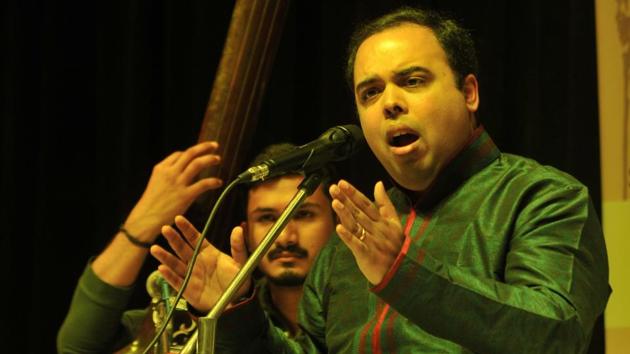
“I have a musical connection with this city. My first guru, Pt Dinkar Kaikini, was a student of Archarya SN Ratanjankar. Ratanjankarji studied and trained in Lucknow. So, my musical connection with Lucknow goes back a long way. Then, I lived in Lucknow for around a year as I was heading the KK Kapoor Sangeet Research Academy. That was in 2009-10. In that period, I performed at some shows but it has been 10 years,” he tells.
Nagarkar and tabla player Ehren Hanson were here to perform at musical event organised by Global Lucknow at Jaipuria Institute of Management auditorium.
In Mumbai, Nagarkar has learned music from Pt Kaikini and then at ITC Sangeet Research Academy in Kolkata under Pt Ulhas Kashalkar. “After my stint in Lucknow, I moved to the US. Initially, I used to tour the US for performances. Then I got an invitation to teach at a few music schools. So, I come to India in winter, tour Europe in summer, but for a majority of the season I am in the US.”
Currently, he is in Lucknow as part of a month-long tour, where he will be doing nine concerts across India. He was also invited for a seminar and a workshop at Bhatkhande Music Institute Deemed University. An expert of Hindustan Classical Music, his music has influences of the Gwalior Gharana, Agra Gharana and Jaipur Gharana. Nagarkar’s expertise is in khayal and different ragas, besides light thumri, dadra, ghazal and bhajan.
“I am a traditionalist and it’s very important for trained musicians to help educate people in a way that they can appreciate Indian classical music better. It’s a time when people are getting distracted BY fusion and popular music, which is also good. So, young musicians like us who have a good understanding of music under this paramapra, it’s our responsibility to take traditional music to people and show its beauty,” he said.
Talking about film and classical music, he said, “Popular music is a different genre and has no comparison with classical music. Classical ‘mein bhi bahut anand hai’ (there is lot of joy in it). Fortunately, we are living in 2020 and there are enough ways to make a decent living within each genre. The only thing is that one should specialise in whatever one does.”
‘After finding tabla, I lost my mind and never found it!’
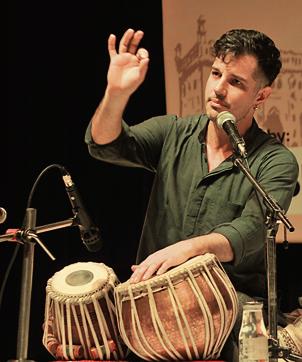
American tabla artist Ehren Hanson’s introduction to the instrument was quite by chance. “I will say it was completely fate that decided my connection to the instrument. It is difficult for me to spell out whether I chose the tabla or it chose me,” he said.
“I was around 15 when I heard a tabla recording. I did not know what the instrument was or its details. I just rewound it again and again and kept playing it back. I asked my brother what this music was and he told me it’s a tabla which was there in my room! A few days back, I went to buy a drum set and got this deal of buy one and get one free. So, I bought a drum set and got a table free. Then, I wasn’t aware it was a tabla and it came as a pair,” he recalled.
Since then he has never looked back. “In 1995, my life changed. I lost my mind and have never found it since. I searched for a local guru, found Misha Masud and studied under her for four years. I had a dream to learn with Pt Anindo Chatterjee so I wrote a letter to him (in Kolkata) and after two attempts he accepted me.”
He left his studies to go and learn under him in September 1999. Hanson trained under him for 5-6 months and since then, he returns every year to India, or his guru goes to the US and stays with him. “In 2005, I received a fellowship of the American Institute for Indian Studies and again came to India for three years. Since then I come to India for studies, practise and performances. It has now become my second home,” he said.
I started Anindo Chatterjee School of Tabla in the US. He performs solo and collaborates with different artistes too. He has performed in Senegal, South America, Europe, India, and will next be going to Cuba.


