Cast: Ia Sukhitashvili, Kakha Kintsurashvili, Merab Ninidze
Director: Dea Kulumbegashvili
Star rating: ★★★★★
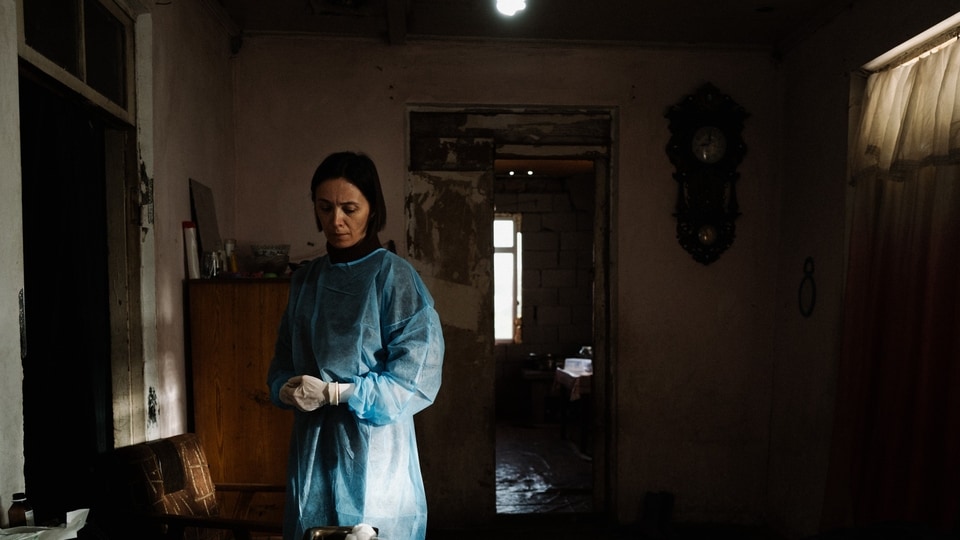
A tense, ominous foreboding grips the frames of April, Georgian writer-director Dea Kulumbegashvili’s sophomore feature, one that unravels over the course of the 134 minutes of this visceral, unforgettable film. It opens within a dark space where a humanoid creature walks crouched- who is it? What does it represent?
Ia Sukhitashvili in a still from April, now available to watch on Mubi.
This interrogative spirit is not particularly eluded as Dea sets up the harrowing character study of an obstetrician, Nina (Ia Sukhitashvili, terrific), whose undercover job as an abortion provider in rural Georgia makes her the target of vicious attacks and an imminent investigation.
The premise
April discovers a world that is elusive in its mix of beauty and capacity for violence. Both exist simultaneously. Here in the countryside, it is all hushed. The reproductive rights of women are limited, and Nina has no answer to the question as to why she has to be the one to get embroiled in this conundrum. What can she do now? The inquiry begins when Nina takes the lead in delivering the child of a young woman from Lagodekhi.
The shot of the delivery is real, and shockingly important in the subtext of the film- Dea establishes the realities of the procedure with zero chance for dramatic detail. It is how it is. The child is stillborn, and Nina realises that the pregnancy was not registered earlier. The father is furious, and the scene plays out in a breathtaking single shot as Nina is spat upon, confronted for her other job of performing illicit home abortions. There will be an investigation. She makes for a rather easy target.
What works
Produced by Luca Guadagnino, April is ambitious and arresting. It draws out the specifics of this one case and places the inquiry into the misogyny and orthodox socio-political systems at play. The context here is necessary, with the Ministry of Health in Georgia having introduced the law in 2023 that abortion is available on request up to 12 weeks of pregnancy, but even then, the decision is made by the clinic under discretion. The hostility that Nina has to face is ungovernable; it makes her an anomaly in the midst of conformists.
Working with cinematographer Arseni Khachaturan, Dea confronts Nina's subjectivity with a keen eye, but thankfully, from a reserve. We observe along with her less than we observe her, standing in the corridors of the hospital, all by herself, or seeking casual sex from strangers on the highway. The empathy is not extracted for Nina, she does not want any of it in the first place. What she wants is to be left alone, from the overwhelming anxieties of her work and find some respite from the desperation at times.
Almost Michael Haneke-esque in its austerity, April still finds few moments of unrequited beauty in a giant field filled with red blossoms, or in an interaction with a child- so innocent and happy. The sublime exists somewhere in the midst of the rot of oppression. What can we do about it? This is a film that cements Dea Kulumbegashvili as a major voice, a singular filmmaker who wants to lead with ferocity as well as mystery, whose voice demands to be heard. April is a hypnotic and strikingly important piece of work, and very much a modern masterpiece in its own right.
Santanu Das is a Senior Content Producer at Hindustan Times with over 5 years of experience, writing on films, pop culture and film festivals. He has a keen interest in writing about South Asian independent films and has covered several film festivals, including Sundance and CPH: Docx. He also brings a sharp perspective to the monthly column called The Fault in Our Stars, where he writes about a recent film/series and what stops the ‘good’ from becoming ‘great’.
A gold medalist from Banaras Hindu University, Santanu completed his postgraduate studies in English from Jadavpur University. He is also a Rotten Tomatoes-certified film critic. When not watching films or speaking to celebrities, Santanu can be found reading a book. Some of his favourite films are Aparajito, Ponyo and The Double Life of Veronique. His favourite books include The Corrections, The God of Small Things and A Room of One's Own.
Santanu continues to write passionately about films and celebrity culture. He brings a relatable, as well as critically informed, lens to entertainment and culture for a wide audience.
Find him on LinkedIn: santanudasfilm
Instagram: @santupechaRead More

 E-Paper