
 E-Paper



Water wars: Disputes over sharing natural resources
The water-sharing dispute between Karnataka and Tamil Nadu is one of several tussles between different states. A deeper dive into what's at stake for neighbours

 Prefer HTon Google


A decade after a tribunal settled a long legal battle over the Cauvery River between Tamil Nadu and Karnataka, the two states stand before yet another tribunal, this time to settle a water-sharing dispute concerning the river Pennaiyar.
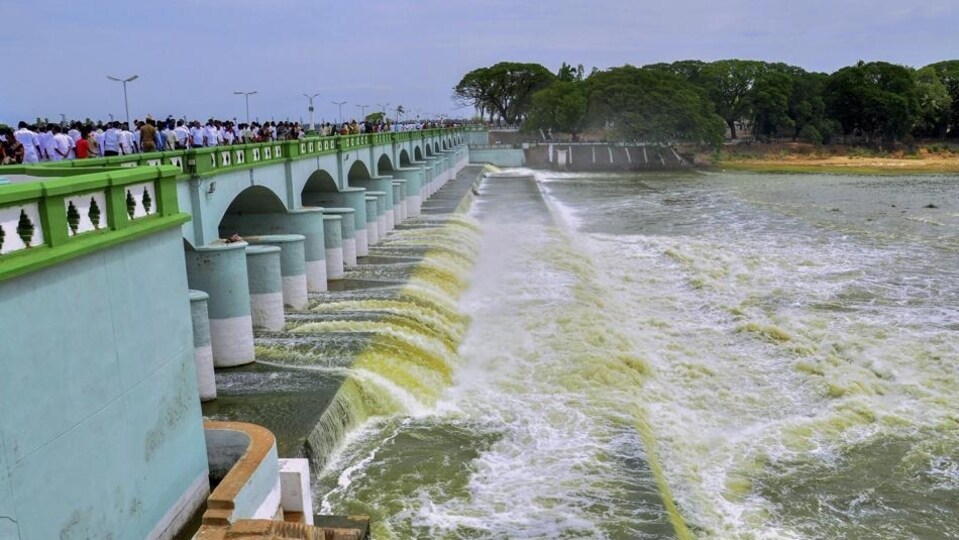
Like Cauvery which originates in Karnataka and irrigates the rice bowls of Tamil Nadu, the Pennaiyar originates at Nandidurg in Karnataka and flows eastward through Andhra Pradesh, Tamil Nadu and the neighbouring Union Territory of Puducherry before reaching the Bay of Bengal.
Tamil Nadu moved the Supreme Court against Karnataka in 2015, and again, in 2018, over two primary issues in the inter-state Pennaiyar river and both cases are still pending. As the lower riparian state, Tamil Nadu argues it is affected by the actions of Karnataka, the upper riparian state. In 2007, Karnataka had sanctioned a dam with a capacity of 500 mcft to supply water to several of its drought-prone villages, and some part of the dam has been built.
The Pennaiyar river, once called Dakshina Pinaki river, is the only water source for Tamil Nadu's industry-heavy town of Krishnagiri. The river enters Tamil Nadu in Krishnagiri and flows through districts like Cuddalore, Villupuram, Dharmapuri, Tiruvannamalai and Kallakurichi, irrigating more than four lakh acres. More than 2,000 acres of agricultural land in Krishnagiri alone would be affected by the dam, Tamil Nadu’s minister for water resources Durai Murugan said in 2021.
“There is a substantial amount of subsurface flow from this river collected through infiltration galleries for domestic water supply and agricultural purposes,” said J Saravanan, a hydrogeologist, based in Chennai. “This is a dry river (for the most part of the year with water flow during the monsoon) so it does not have much urban runoff so when that is restricted it will have a telling impact on the domestic water supply here (in Tamil Nadu) and there will be an impact in the quality of groundwater too.”
In 2018, the Tamil Nadu government filed an interlocutory application in the top court against the Karnataka government’s work to construct a dam across the Markandeya River, a tributary of Pennaiyar. The specific complaint is against the dam and diversionary structures such as diverting surplus water from Varathur tank, executing the lift irrigation scheme at Ellamallappa Chetty tank to fill up Hoskote tank upstream and setting up a pumping facility to take water from the main river at Belahalli.
“The diversion structures to divert water from Pennaiyar is in violation of the [1892 Madras-Mysore] agreement,” said a TN official not wishing to be named. “It affects Tamil Nadu’s rights and interests when various works are undertaken up the upper riparian state in Pennaiyar and its tributaries.”
To take up new irrigation works across the inter-state rivers, the erstwhile states of Mysore and Madras (present-day Karnataka and Tamil Nadu) entered into an agreement in 1892. In clause 2 of the agreement, the upper riparian state could not build any new structure, divert or store waters without the consent of the lower riparian state.
In 2020, the Indian government constituted a negotiation committee headed by the chairman of the Central Water Commission but no decision could be reached in the two meetings of the committee, the official quoted above, said.
Karnataka had objected to the tribunal at that time even as Tamil Nadu reiterated its favour for the formation of the tribunal to the Jal Shakti ministry on four occasions. Subsequently, the Additional Solicitor General Aishwarya Bhati informed the top court last December that “there is no likelihood of settlement by negotiation” and “the Central Government is likely to constitute a Tribunal to resolve the dispute”. The court asked the Union government to set up a tribunal on March 14, but the tribunal is yet to be formed.
The way forward
On July 4, the Union government filed an affidavit in the Supreme Court that the cabinet is yet to take a decision on the formation of an Inter-State River Water Disputes Tribunal to resolve the Pennaiyar river dispute between Tamil Nadu and Karnataka. HT has seen a copy of this affidavit.
After hearing the matter on May 2, the Supreme Court granted a month's time to constitute the tribunal and issue a gazette notification based on the request of the Union government.
As directed by the Supreme Court, the Union government submitted a proposal to the Cabinet Secretariat for “consideration and approval” for the formation of the tribunal under the Inter-State Water Dispute Act, 1956, the affidavit stated. “[The] Union Cabinet is yet to take a final decision in the matter,” it added.
Political parties in Tamil Nadu such as the Pattali Makkal Katchi, despite being a National Democratic Alliance ally, attributed the delay to the Bharatiya Janata Party-led Union government’s fear of a setback in Karnataka that went to polls in May. The Congress, which won the election in Karnataka, and the Dravida Munnetra Kazhagam (DMK), which is in power in TN, are allies. This makes the river disputes between the two states a trickier issue.
In 2015, the Tamil Nadu government filed an Original Suit in the Supreme Court that sewage and industrial effluents from Bengaluru were being let into Cauvery and Pennaiyar which was likely causing huge damage and suffering to inhabitants here. A final report submitted by the Central Pollution Control Board to the top court has confirmed the pollution in the two rivers, the Tamil Nadu government registered in the assembly in 2021.
“The Tamil Nadu government is closely pursuing the issue,” said the official quoted above. “The Tamil Nadu Pollution Control Board is collecting water samples from Cauvery and Pennaiyar Rivers near the inter-State boundary between Karnataka and Tamil Nadu to monitor water quality. Similarly, the Central Water Commission is also collecting samples at Billigundulu.”
The Cauvery Technical Cell cum Inter-State Waters Wing formed in 1990 which assists the state government in dealing with all water-sharing disputes is helping TN to defend its rights in water sharing in the Pennaiyar river too.
A look at some other hot-button disputes
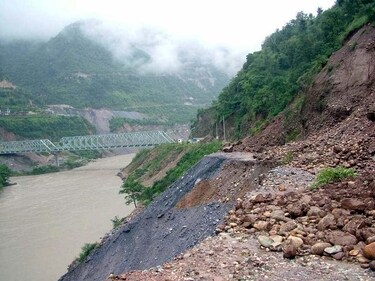
Punjab-Haryana: The states of Punjab and Haryana are locked in a bitter legal battle over the distribution of water flowing through the 211-kilometre-long Sutlej Yamuna Link (SYL) canal constructed more than four decades ago. In April 1982, the then PM Indira Gandhi launched the construction of the canal from Kapoori village in Punjab — 121 kilometres now lie in that state, while 90 kilometres go through Haryana.
The SYL Canal off-takes from Sutlej River downstream of Nangal Dam, near Bilaspur town of Himachal Pradesh that shares a border with Punjab, flows southwards and merges into river Yamuna in Karnal, Haryana. The proposal states that 3.46 MAF of water will flow into the canal. However, at present, the canal in Punjab is dilapidated as wild vegetation has grown and its banks have been eroded, making the canal no longer fit for the passage of water in some places.
On the Supreme Court’s insistence, the chief ministers of Punjab and Haryana met twice, in October last year and in January, to negotiate the distribution of the river water. The meetings have so far proved inconclusive.
Contradicting Haryana's claim for more water, the Aam Aadmi Party (AAP) government in Punjab led by chief minister Bhagwant Mann in April announced that the state doesn't have surplus water to share with any state.
"Haryana is currently getting 14.10 MAF (million acre-feet) of water from Satluj, Yamuna and other rivulets whereas Punjab is getting only 12.63 MAF,” Mann said in April, when seeking a re-assessment of the river water distribution. Announcing plans to move the SC with a fresh plea, he also proposed that a Yamuna Sutlej Link (YSL) canal be constructed to allow the flow of water into Punjab, as the flow of the river Sutlej has dipped.
Haryana had initially moved the Supreme Court in 1996 because Punjab refused to complete the canal and make water flow in it. In 2002, the SC ruled in favour of Haryana and directed Punjab to construct the SYL canal within a year. In 2004, the SC reiterated its earlier decision asking Punjab to construct the SYL Canal. The same year, Punjab passed a law 'Punjab Termination of Agreement Act, 2004' by which it cancelled the agreement with Haryana over SYL. By this act of state legislative assembly, the Congress party government led by the chief minister Capt. Amarinder Singh annulled several water-sharing agreements. Later, in 2016, the law was declared unconstitutional by the SC, but despite that, the government now led by a SAD and BJP alliance, handed over the agricultural land over which the canal was first built, back to the farmers.
In March, the Centre informed the SC that Punjab has refused to share water with Haryana, as the water was insufficient. Punjab, however, said that Haryana's share remains the same, however since the total flow in the river has reduced, Punjab's share has suffered.
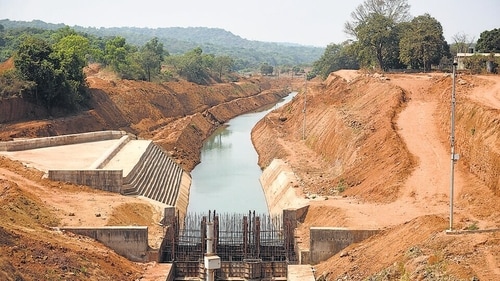
Karnataka- Goa: The Kalasa Banduri project — an ambitious plan to divert waters of the west-flowing streams of the Kalasa and Bandura that are tributaries of the west-flowing River Mahadayi to the east-flowing Malaprabha River — was started by the Karnataka government in the mid-1980s with plans to set up a hydroelectric project of 350 megawatts.
The two rivers, which begin life quite literally next to each other, go on to have very different trajectories. While the Mahadayi flows west enters Goa and meets the Arabian Sea as a free-flowing, almost unhindered river (barring a few check dams), the Malaprabha traverses some of the most arid parts of north Karnataka, that ironically chooses to grow sugarcane, before meeting the Krishna River at Gulbarga in Karnataka.
As envisioned, the Mahadayi multipurpose irrigation projects consisted of three main projects to divert water to the Malaprabha river: Construct a Kotni dam for power generation and diversion of 4 tmc (thousand million cubic feet) of water; construct Kalasa Nala dam to divert 3.34 tmc of water; and construct Haltara and Potli dams for diversion of 0.56 tmc and 1.10 tmc respectively.
Karnataka claimed that the proposed consumption of 34.15 tmc of the Mahadayi water in its territory would not prejudicially affect the interests of the state of Goa or its inhabitants in any manner.
After nearly four decades of disputes between Goa and Karnataka over sharing of the waters of Mahadayi, the Mahadayi Water Disputes Tribunal set up in November 16, 2010, in August 2018 granted Karnataka a total of 13.42 tmc of water in an award granted in in August 2018; their total claim was 36.558 tmc.
Both the Goa and Karnataka governments have, for very different reasons, challenged the final award granted by the tribunal.
While Goa approached the Supreme Court arguing that Karnataka shouldn’t be allowed to divert any water owing to the fact that the Mahadayi river is a water-deficient river, Karnataka moved the Supreme Court arguing that the tribunal erred in granting it only 13.42 tmc of water.
The Goa government has alleged that Karnataka has already begun illegally diverting water via a network of canals that were constructed despite an assurance given by Karnataka in 2017 that no further work would be carried out and has written to the Centre to constitute the Mahadayi Water Management Authority, a body that the Tribunal said was necessary to implement its report and final decision.
On December 29, 2022, the Karnataka chief minister announced during the concluding hours of the legislative assembly’s winter session that the Union Central Water Commission had given its go-ahead to the revised DPR (detailed project report) amid much cheering by the ruling benches. The announcement however prompted Goa to vow to fight for “every drop of the Mahadayi” .
The first budget presented by newly-elected chief minister Siddaramaiah on July 7 has allocated ₹1,000 crore to complete the Mahadayi project.
Odisha and Andhra Pradesh: Vamsadhara River originates in the Rayagada district of Odisha and passes through the Srikakulam districts of Andhra Pradesh. It has a river basin of around 8,000 km sq in Odisha and 2,800 km sq in Andhra.
The total available water for use is around 115 thousand million cubic feet (tmc ft) every year. As per the inter-state river water dispute agreement between the two states, they would have 50-50 share of the available water.
As part of its share, Andhra Pradesh made Gotta barrage on Vamsadhara river at Gotta village of Hiramandalam block in 1970, as part of Vamsadhara project stage-1 to draw 17 tmc ft of water from the river to irrigate 1.48 lakh acres in 398 villages of 12 blocks.
However, what caused a dispute between AP and Odisha was the proposed construction of the Neredi barrage under Vamsadhara stage-II, which, it was feared, would submerge 106 acres of land in Odisha in case of unprecedented floods.
Odisha also objected to the construction of a flood-flow canal at Katragadda in Srikakulam, taking off from the Vamsadhara river, on the grounds that it would result in drying up the river bed and affecting the water table.
Odisha also raised the issue of scientific assessment of available water in Vamsadhara at Katragadda and Gotta barrage and the basis for sharing water.
Following the complaints made in February 2006, a series of meetings between the officials of both the states were held to resolve the issues. The Odisha government moved the Supreme Court in April 2007, seeking a direction to the Centre to constitute a tribunal to resolve the dispute.
On the directions of the SC, the Centre constituted the Vamsadhara Water Dispute Tribunal (VWDT) headed by Justice Mukundam Sharma in February 2010. The tribunal pronounced its draft verdict in September 2017 and permitted AP to construct the side weir at Katragadda and Neradi barrage.
The tribunal also upheld the sharing of 115 tmc ft total yield at Gotta barrage in a 50:50 ratio. In June 2021, the tribunal gave the final report with almost similar recommendations. It asked Odisha to acquire 106 acres of land for the Neradi barrage and hand it over to AP within a year of publication in the official gazette.
It also asked the Centre and the two states to nominate four members for setting up an inter-state regulatory body (supervisory committee) within three months of publication in the official gazette to implement the decision of the tribunal.
However, the final report has not been published in the official gazette by the Centre till date.
Gurpreet Nibber, Gerard de Souza and Srinivasa Rao Apparasu sent reports about the states of Punjab, Goa and Andhra Pradesh


