
 E-Paper



1 Lakh+ Students. 250+ Institutions. 10+ Countries. DIYA's Vision: Prepare Children for the Future of Technology
Chennai's Class 3 students learn robotics by calculating motor RPM and predicting robot speed, emphasising applied education over memorisation.

 Prefer HTon Google


In a classroom in Chennai, a group of Class 3 students gather around a small wheeled robot.
They calculate motor RPM, wheel circumference, and the distance between two classroom walls.
Then they apply a simple formula:
Speed = Distance ÷ Time.
Using that, the students predict how long the robot will take to cross the room.
Then they test it.
It almost always matches.
“These children will never forget this formula,” their teachers often say.
The belief that application matters more than memorisation sits at the core of DIYA (Do It Yourself Academy), a robotics, coding, and AI education company that has spent the last 13+ years helping schools deliver applied technology education by building prototypes of real-world applications.
At a time when India is rapidly introducing robotics, coding, AI, and experiential learning into classrooms through NEP 2020, the country’s education system is entering a major transition. India has one of the world’s largest K-12 (Kindergarten to Class 12) student populations, yet only an estimated 3–5 percent of schools currently offer structured robotics education.
DIYA believes the larger question is no longer whether children should learn technology.
The real question is:
How should children learn technology in a world changing faster than classrooms?
“The shelves are full of robotics kits,” said Udhay Shankar, Founder of DIYA, during a recent conversation on a podcast - The Success Playbook. “The classrooms are still not full of robotics learning.”
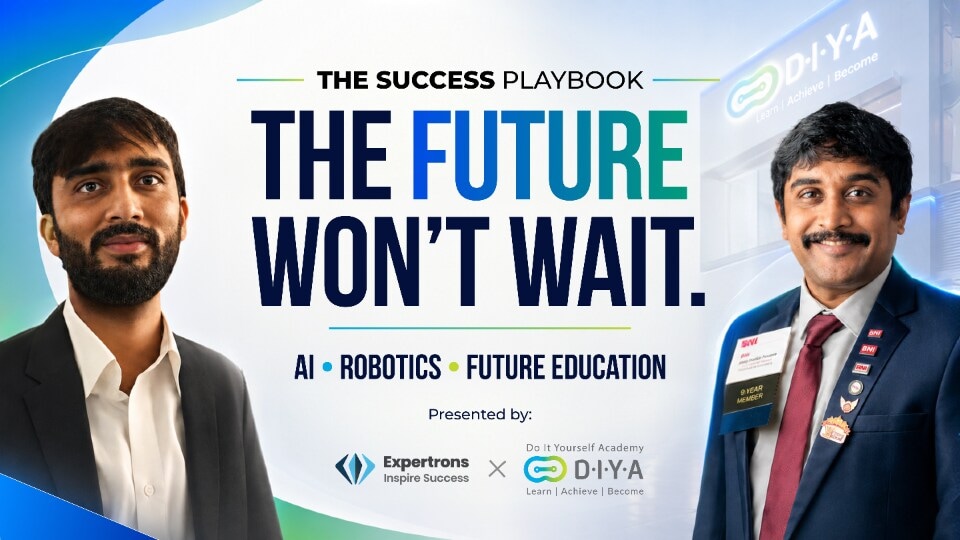
The company’s journey and philosophy were recently discussed on The Success Playbook, a business podcast hosted by Jatin Solanki, Co-founder of Expertrons and Scale100x.Ai.
“We didn’t just want children to learn technology,” Udhay said. “Robotics, for us, is the medium — not the destination. The destination is a child who can think, apply, collaborate, and solve real problems.”
Founded in 2013, DIYA operates as an institution-led learning platform for students aged 5–22.
Its programs span robotics, coding, AI, cybersecurity, IoT, drones, industrial automation, app development, and 3D printing — delivered through a structured pedagogy combining theory, simulation, experimentation, and hands-on implementation.
Students in DIYA programs build working robots, smart devices, automation projects, and engineering models as part of classroom learning.
DIYA has also worked on CSR-led technology education initiatives, including projects associated with Intel, while earning recognition across school innovation and robotics ecosystems for its learning approach.
Today, the company has partnered with more than 250 institutions, impacts more than one lakh students annually, operates across 10+ countries, and reports institutional retention levels between 90–95 percent.
Over the next five years, DIYA aims to impact one crore students, expand across 15+ countries, and scale into a ₹100 crore robotics and experiential learning platform.
Yet the founders believe the larger opportunity lies in solving a problem most schools still face: execution.
While schools increasingly want robotics and coding programs, many still lack trained faculty, structured curriculum systems, implementation capability, and long-term program continuity.
That approach, strategized by Ms. Latika Rangaraj, Partner, DIYA - an Operations and Implementation Expert with more than 30 years of experience - has helped shape DIYA’s operating model.
The company provides curriculum, robotics kits, printed manuals, LMS-based learning systems, teacher training, assessments, project showcases, and operational support through a structured rollout process.
“When I started, robotics was a luxury,” Udhay said. “Today every school is going to have robotics and coding. We are just at 3–5 percent of the curve.”
That early-stage market gap is also driving DIYA’s expansion strategy. As schools increasingly look for implementation partners rather than standalone products, the company is building a city-level expansion network with partners focused on school relationships, operational execution, and long-term recurring learning programs.
The company says demand is no longer limited to metro cities, with increasing interest now emerging from Tier 2 and Tier 3 markets as parents and schools prioritise hands-on technology learning earlier than ever before.
Unlike many ed-tech models dependent on imported hardware, DIYA also designs and manufactures its robotics kits in India.
The roots of DIYA go back to “TRY - The Reformer in You,” a non-profit initiative through which the founders worked with orphanages and government-school students across India using robotics education to bridge learning gaps. Students from that initiative later went on to win a national robotics competition at IIT Madras.
That experience shaped the company’s long-term belief that children understand concepts best when they build, test, and experience them in the real world.
Today, DIYA operates through school partnerships, direct student enrollments, workshops, bootcamps, certification programs, and global immersion initiatives.
The company is now scaling through a partner-led expansion model, offering both center-based and city-level partnership formats ranging from ₹11 lakh to ₹20 lakh investments.
As robotics, coding, AI, and applied technology learning become increasingly important in schools, DIYA believes the most valuable learning may not simply come from textbooks.
It comes from children building, experimenting, solving, and applying concepts in the real world.
The robot inside the classroom may be the tool.
But the real outcome, DIYA believes, is a child who learns how to think, build, and solve for the future.
Note to the Reader: This article is part of Hindustan Times' promotional consumer connect initiative and is independently created by the brand. Hindustan Times assumes no editorial responsibility for the content.


