
 E-Paper



Diwali leaves air three times more polluted in Gurgaon
Experts say though amount of pollutants released has not increased much, decrease in mercury was keeping them from dissipating


Initial data on particulate matter on Diwali indicates that pollution levels in the city went up by at least three times during the festival.
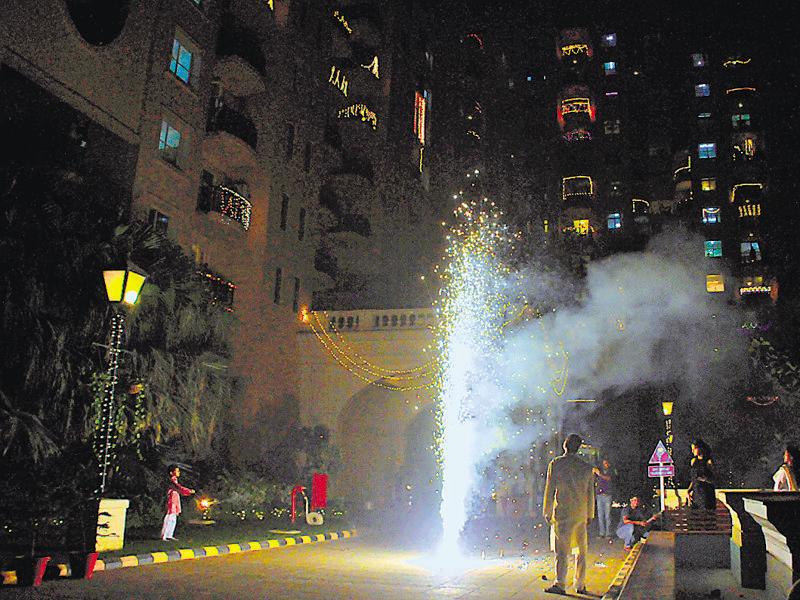
While data specifically for the night of Diwali was not available with the Haryana State Pollution Control Board (HSPCB), figures from a day before and after show an increase in pollution due to bursting of firecrackers. Department officials are preparing a report on the increase in pollution on Diwali and it will be available on Friday.
According to preliminary information, the level of suspended particulate matter PM10 on Tuesday was 140.76 microgram per cubic metre (µg/m³) on Tuesday.
On Thursday, a day after Diwali, the level increased to 361µg/m³. Similarly, sulphur dioxide increased from 1.20 µg/m³ on Tuesday to 8.8 µg/m³ on Thursday.
Sulphur dioxide and suspended particulate matter are pollutants released when crackers are burst.
However, the amount of pollutants released may not be the only cause of the present pollution levels. Experts said that local weather condition also affect pollution in a city.
According to officials, while the amount of pollutants released has not increased much, pollutants are trapped in the atmosphere for a longer time due to a decrease in temperature, causing smog in the city.
“Low temperature and high moisture causes pollutants to remain trapped in the atmosphere for longer periods. This is why the PM10 level is high a day after Diwali,” said Vijay Chowdhary, environmental engineer, HSPCB.
He, however, said after a sustained campaign against the use of firecrackers, especially in schools, this year saw a reduction in their use.
“We moved around the city and took stock of the amount of crackers. It was approximately 10% as that of last year,” Chowdhary said.
Interestingly, while there was an increase in PM10 and sulphur dioxide levels, the nitrogen oxide (NOx), which is caused by vehicular emissions, reduced. NOx levels came down from 22.8 on Tuesday to 10.94 on Thursday.
Experts said heavy traffic due to Diwali shopping had led to a rise in NOx levels till a day before Diwali. The levels fell later as people remained indoors on Diwali and even on Thursday due to it being a holiday for Govardhan puja.
Stay updated with all the Breaking News and Latest News from Mumbai. Click here for comprehensive coverage of top Cities including Bengaluru, Delhi, Hyderabad, and more across India along with Stay informed on the latest happenings in World News.


