
 E-Paper



Constructions choking Gurugram, say experts
According to an August 2018 source apportionment study by The Energy and Resources Institute (TERI), construction and demolition (C&D) work, road dust and allied activities account for 30% of the particulate matter 10 (PM10) in Gurugram’s air, and 20% of PM2.5, during winter.


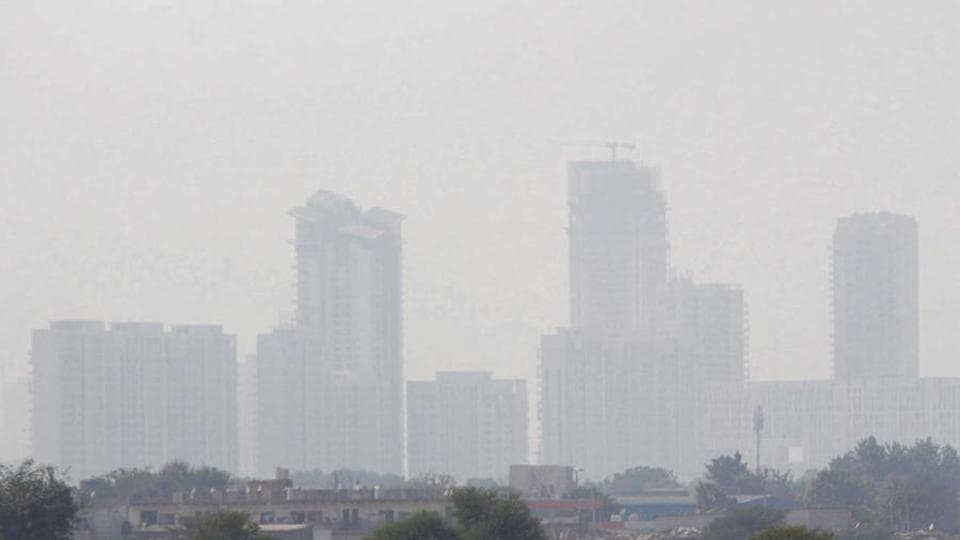
The Supreme Court ban all constructions in Delhi-NCR could make a perceptible dent in local pollution levels, particularly in Gurugram, where construction activities are ubiquitous and rampant, said experts. The apex court slapped a blanket ban on construction, until further notice, on Monday.
According to an August 2018 source apportionment study by The Energy and Resources Institute (TERI), construction and demolition (C&D) work, road dust and allied activities account for 30% of the particulate matter 10 (PM10) in Gurugram’s air, and 20% of PM2.5, during winter.
While the state pollution board (HSPCB) and the town and country planning (TCP) department officials were unable to provide data on the total number of construction sites in the city, a survey of realty websites indicates that there are 1,000 to 1,500 ongoing, large-scale residential and commercial projects in Gurugram.
Kuldeep Singh, regional officer, HSPCB, said, “We are only monitoring construction sites over 20,000 square metres in size. There are hundreds of them across the city. No challan has been issued to them as we have not found any violation since October 25, when the ban on construction work was instated.”
Residents and experts, though, said that construction activities are underway. “Not only are they violating the ban, they are also not following the proper protocol as prescribed in the ministry of environment and forest’s (MoEF) construction and demolition rules, 2016,” said Sachin Panwar, a city-based air quality scientist.
The violations are largely concentrated in the newer sectors, where large-scale realty projects are coming up.
Naru Munjal, a resident of Sector 67, said, “Every night, you can hear and see construction work going on in full swing. The situation before and after the ban is the same.”
Munjal, like many others, does not remember a time when construction work wasn’t conspicuous around the city. Since the early 80s, when the city’s real estate boom began, the noise of bulldozers and cranes has been woven into the fabric of the city.
Construction and demolition work, experts pointed out, isn’t a homogeneous activity, but comprises different emitters of pollution. “The first of these would be excavation of land, which is how most large-scale construction work begins,” said Sumit Sharma, associate director (Earth Science and Climate Change Division) at TERI.
Earthwork tends to displace and loosen topsoil, which allows dust to become easily suspended by wind. Construction sites are also frequented by trucks and smaller freight vehicles, which kick up copious amounts of road dust, in addition to contributing their own tailpipe emissions.
The second important emission from construction sites comes from their use of polluting fuels. “Cranes, excavators, drills... it is all heavy machinery essential to construction, and it is all powered by diesel,” said Sachin Panwar.
Experts said that due to this reason, higher concentrations of NOx and SOx usually observed in ambient air around construction sites. These further react in the atmosphere to form ammonium sulphate and ammonium nitrate, both of which can have a significant impact on local health and environment, experts said.
Construction materials, such as silica, soil, gravel and concrete, primarily lead to fugitive particles ranging in size from PM10 to PM2.5, while diesel combustion leads to the formation of smaller particles, less than 2.5 microns in diameter. “The typical ratio of PM2.5 to PM10 in construction dust is 30 to 70. The air around construction sites is visibly more polluted due to presence of the larger, PM10 particles,” Panwar said, adding that these areas typically have higher concentration of silica, aluminium, iron and calcium particulates.
For those who work and live around construction sites, this poses a severe health risk. “Silica, when inhaled, for instance, leads to silicosis and other restrictive lung diseases, which are hugely prevalent in construction workers, for instance,” said city-based pulmonologist Piyush Goyal.
When finer particles enter the bloodstream, via the alveolar macrophages of the lungs, they are deposited in other organs of the body. “This causes increased degeneration of tissue and reduction in life expectancy, and makes people prone to cardiovascular diseases and strokes,” Goyal said.
As per TERI study, “In PM10 concentrations in Gurgaon, contribution of dust (road dust, construction and other sources) was found to be higher (32%-52%) in summer and lower (23%-30%) in winter.” This, experts said, is due to increased construction in summer. Dust from construction and allied activities accounts for about 49% of Gurugram’s PM2.5 and 50% of PM10 from April to September.
“However, this period also sees higher wind speeds and favourable meteorology, which do not allow the pollutants to accumulate, as happens during winter,” said Sharma.


