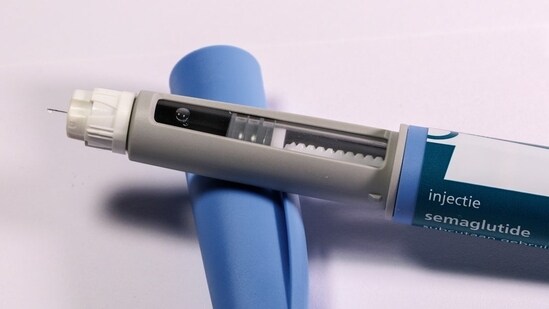
A new kind of instant gratification is catching on in India. Urban consumers, who have grown accustomed to groceries and gadgets arriving within minutes, can now order slimmer waistlines almost as quickly. Online pharmacies promise same-day delivery of weight-loss injections, and demand is booming. In March Eli Lilly, an American drugmaker, launched Mounjaro, its obesity treatment, in India. A month’s supply costs about $180—a quarter of the price in America, though still steep for most Indians. Even so, by September it had become the country’s second-bestselling branded medicine.
For representational purpose only. (Unsplash)
Chart.
India’s craze for slimming injections points to a broader trend. Until recently, GLP-1s, a powerful new class of weight-loss drugs, were confined mostly to rich countries. Yet the World Obesity Federation, a charity, reckons that two-thirds of the world’s 1bn obese adults live in poorer countries. Excess weight is not merely cosmetic: it raises the risk of diabetes, heart disease and cancer. And GLP-1s do more than help people shed pounds; they may also treat sleep apnoea, kidney disease and Alzheimer’s. For poorer countries, wider access to these medicines could transform the treatment of chronic illnesses. That shift may begin as early as next year, with the launch of cheaper generics alongside pill-based versions.
Demand for GLP-1s has been ravenous. Citeline, a research firm, reckons global sales of the drugs will exceed $26bn this year—double the figure in 2024. The market belongs to two firms: Eli Lilly and Novo Nordisk, the Danish maker of Wegovy. Mounjaro and Wegovy were approved by Chinese regulators in 2024, but with supplies tight, the two firms focused first on rich markets, particularly America, which accounts for four-fifths of sales of GLP-1s. Only now are the pair turning to large but poorer markets such as China and India.
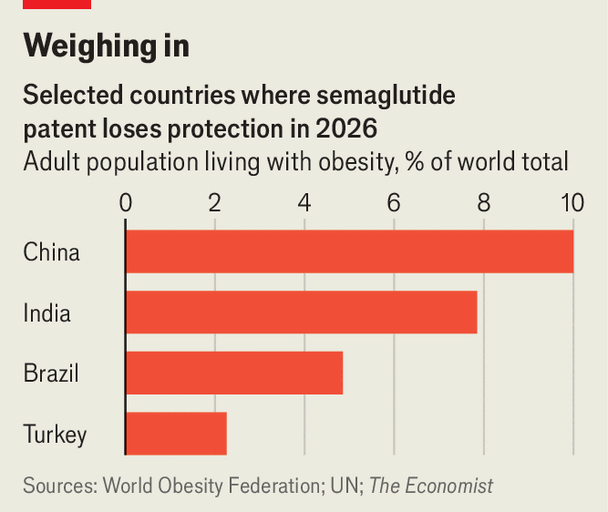
Their duopoly may not last in these places. Patents in most rich countries will protect both drugs until the end of the decade. But in early 2026 those on semaglutide—the active ingredient in Wegovy—will expire in several emerging markets, including Brazil, China, India and Turkey. Indeed, at least a quarter of the world’s obese people live in countries where semaglutide will lose protection next year (see chart).
India’s drugmakers, already the source of a fifth of the world’s generic medicines, are moving fast. At least ten Indian versions of semaglutide are in late-stage trials. Analysts expect the generics to debut at about a third of the original price, with further decreases as competition intensifies.Cheaper drugs will bring treatment within reach of many more patients. Analysts at JPMorgan Chase, a bank, expect India’s GLP-1 market to grow from $179m in 2025 to $1.5bn by 2030. An even bigger prize for India’s drugmakers will be exports to countries where semaglutide’s patents have lapsed. Dr Reddy’s, a local giant, plans to sell a generic Wegovy in 87 countries once the patents expire. Subsidies from the Indian government for makers of GLP-1 drugs will also help.
China, home to more obese adults than anywhere else, will be another giant market. Its state-backed insurance scheme, which covers more than half of all drug spending, excludes weight-loss treatments—making price decisive for patients. Around 20 semaglutide-based drugs are racing for approval. Unlike in India, China’s firms are not merely replicating existing drugs; they are also innovating. In June regulators approved mazdutide, developed by Innovent, a local biotech firm, in partnership with Eli Lilly. In clinical trials it proved about as effective as Eli Lilly’s own version. Western companies are also turning to China for new candidates: in March Novo Nordisk earmarked $2bn to license a promising experimental weight-loss drug developed in the country, and in June Regeneron, an American biotech firm, struck a $2bn licensing deal with Hansoh Pharmaceuticals, another Chinese company.
Weight-loss pills will also arrive in the global south soon. At present patients must inject the drugs weekly, an unpleasant routine that discourages many. But both Eli Lilly and Novo Nordisk have developed pill-based alternatives. Although analysts reckon the pills, once approved, will be priced roughly in line with the injections, they will be especially useful in poorer countries, where the cold supply chains required for injections are often unreliable. Before long, one of the most transformative inventions of modern medicine will be within reach the world over.
Are you a cricket buff? Participate in the HT Cricket Quiz daily and stand a chance to win an iPhone 15 & Boat Smartwatch. Click here to participate now.

 E-Paper