The government on September 29 notified a third round of fuel-efficiency rules for passenger vehicles, which tighten the permitted average fuel consumption of carmakers' fleets by around 16.7% over five years, while leaving them to choose the technologies that get them there.
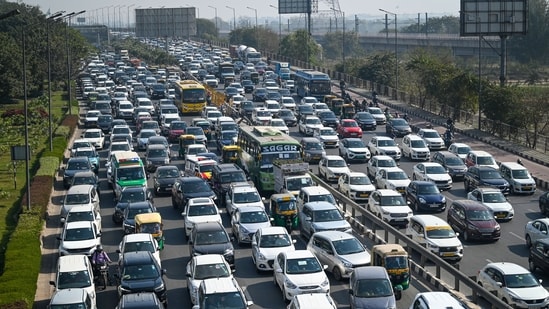
Since 2017, India has used Corporate Average Fuel Economy (CAFE) norms to nudge automakers into making more fuel-efficient vehicles. The idea is that if new cars burn less fuel, they emit lower carbon dioxide. The norms are issued under the Energy Conservation Act, 2001. Cars are a target because, in the power ministry's words, “The passenger vehicle segment accounts for a substantial share of India's transport energy demand and remains an important contributor to fossil-fuel consumption.”
What do these norms mean?
The norms apply to each carmaker as a whole, not to individual cars. The government takes every eligible car a company sells in a year, from its smallest hatchback to its largest SUV, and works out their average fuel consumption. That average must stay within the limit for the year. A company can sell some fuel-hungry models as long as enough efficient ones bring the average down. Each new round of the rules lowers the limit, pushing companies to make their line-ups more efficient over time.
CAFE-III will take effect on April 1, 2027 and remain in force until March 31, 2032. The permitted fleet-average fuel consumption tightens from 3.996 litres per 100 km in 2027-28 to 3.3273 litres per 100 km in 2031-32.
{{/usCountry}}CAFE-III will take effect on April 1, 2027 and remain in force until March 31, 2032. The permitted fleet-average fuel consumption tightens from 3.996 litres per 100 km in 2027-28 to 3.3273 litres per 100 km in 2031-32.
{{/usCountry}}The figure is the most fuel a carmaker's vehicles may use, on average, to travel 100 km in an official laboratory test. For manufacturers that have EVs in their lineup, those electric models help bring the targets closer (because they don't consume any conventional fuel).
The rules give different forms of compliance recognition to electric vehicles, hybrids, alternative fuels and fuel-saving technologies. They are expected to shape the kinds of cars manufacturers develop and sell.
Also read: No PUC certificate, no fuel: What the test measures, and the pollutants it cannot trace
What changes now?
The third phase ties that target more closely to vehicle weight. A heavy SUV needs more fuel to move than a small hatchback, so each carmaker's target is set by a formula that takes into account the average weight of the cars it sells.
Because each car has a different weight and fuel consumption pattern, the norms set a reference weight, against which a company's targets are benchmarked. In this round, the reference weight has been raised to 1,229 kg from 1,082 kg under the current regime.
A company whose cars weigh 1,229 kg on average must meet the headline benchmark. One whose fleet is heavier gets a somewhat higher fuel allowance, and one whose fleet is lighter gets a lower one. The Union power ministry said the higher reference weight, an increase of around 13.6%, reflects the evolving characteristics of India's passenger-vehicle fleet.
The government has also changed how sharply that allowance moves with weight. Under CAFE-III, each extra kilogram of average fleet weight earns a smaller increase in permitted fuel use than before, and each kilogram less brings a smaller cut. Makers of heavier cars therefore get less leeway, while makers of lighter cars face targets closer to the benchmark. The government said this means relatively softer targets for lighter vehicles and greater fuel-efficiency requirements for heavier ones.
Take a carmaker that sells only small hatchbacks of the Alto or Swift kind, and another that sells only large SUVs of the XUV700 or Fortuner kind. The first runs a fleet well below the reference weight, so its target is stricter than the headline benchmark. The second runs a fleet well above it, so its target is looser. By flattening the line linking weight to target, CAFE-III narrows that gap. The hatchback maker's target moves closer to the benchmark, and the SUV maker gets a smaller allowance for its extra weight.
In other words, both carmakers must keep cutting their fleet averages as the limit falls each year, but the SUV maker now has to make bigger gains, whether through more efficient engines, lighter vehicles or more hybrids and EVs in its line-up.
Will every new car have to be more fuel efficient?
Not necessarily. Because the limit applies to the fleet average, a carmaker can keep selling a thirstier model if more efficient ones, including EVs, bring the average down.
Companies can also earn and use compliance credits, which gives them room to manoeuvre as the targets tighten.
Why do EVs and hybrids bring an advantage?
This is where another aspect of the CAFE-III norms are relevant. It is not simply about the car models a company offers, but also how many of what models it sells. The CAFÉ-III rules give extra weight to several cleaner technologies in the fleet-average calculation:
Battery electric vehicles and range-extended electric vehicles (electric cars carrying a small engine that only recharges the battery) carry a volume multiplier of 3.0.
Plug-in hybrids (hybrids whose batteries can also be charged from a socket) and strong hybrids running on flex-fuel ethanol carry 2.5.
Strong hybrids (cars whose electric motor can drive the wheels on its own for short stretches) carry 1.6.
Flex-fuel vehicles (cars whose engines can run on petrol blended with high proportions of ethanol) carry 1.1,
The multipliers are essentially applied on the sale numbers and the final figure determines a carmaker's compliance. For example, a company that sells 90 petrol cars and 10 EVs is assessed as though it had sold 90 petrol cars and 30 EVs.
In this manner, manufacturers get an incentive to develop several electrified powertrains rather than rely on one technology.
Does CAFÉ-III favour only electric cars?
No, and there is an ethanol-blended fuel support nudge here. A new Carbon Neutrality Factor rewards cars that run on fuels made partly from plants or organic waste, such as ethanol-blended petrol and compressed biogas. The carbon in such fuels was originally drawn from the air by plants, so the rules knock a set share off the carbon dioxide these cars are measured as emitting. Cars running on E20 (petrol with 20% ethanol) or higher blends get an 8% discount, flex-fuel ethanol cars get 22.3%, and CNG cars get at least 5%.
What fuel-saving technologies could appear in cars?
CAFE-III expands the list of recognised fuel-conservation technologies to 12 from four currently. The 12 are start-stop systems, regenerative braking, transmissions with six or more speeds, efficient 12V/48V alternators, 12V/48V motor-generators, electric water pumps, electronically controlled radiator fans, exterior LED lighting, high-efficiency air-conditioning, tyre-pressure monitoring, advanced glazing and solar-reflective paint.
Each of these helps in its own way to reduce fuel consumption.
- Start-stop systems switch the engine off at signals and in traffic.
- Regenerative braking turns energy lost in braking into battery charge.
- Transmissions with more gears keep the engine at its most efficient speed.
- Efficient alternators sap less engine power to charge the battery.
- Motor-generators give the engine an electric boost, as in mild hybrids.
- Electric water pumps and electronically controlled radiator fans run only as hard as cooling demands.
- LED lights draw less power than conventional bulbs.
- High-efficiency air-conditioning burns less fuel to cool the cabin.
- Tyre-pressure monitoring flags soft tyres, which raise fuel use.
- Advanced glazing and solar-reflective paint keep out the sun's heat, so the air-conditioner works less.
In other words, expect more of these features.
Manufacturers can claim a reduction of 1 gram of CO2 per km for each eligible technology, up to an overall limit of 9 g/km.
Also read: Incentives for EVs, no new petrol bikes, CNG autos: Delhi's EV policy
What happens if a carmaker misses its target?
The framework introduces a credit-and-debit mechanism. A manufacturer that beats its fleet target generates compliance credits, and one that falls short accumulates debits. Eligible credits can be carried forward within specified compliance blocks, and traded or exchanged between manufacturers.
The first compliance block covers three financial years, 2027-28 to 2029-30. The second covers two, 2030-31 and 2031-32. Credits left unsettled at the end of a block lapse.
Manufacturers can also buy credits through a buyout mechanism run by the Bureau of Energy Efficiency (BEE). The price rises from ₹2,500 per g CO2/km in 2027-28 to ₹4,500 in 2031-32.
What does CAFE-III mean for car buyers?
The norms do not directly set the showroom price or mileage of any model.
Cars sold from 2027 will not all become more efficient at once or by equal margins. CAFE-III instead shifts the incentives carmakers face across their whole passenger-vehicle portfolios, as they weigh progressively tighter targets against how much to invest in EVs, hybrids, alternative fuels and efficiency technologies. Wider support for higher ethanol blending will be likely.
Companies can combine these approaches. As manufacturers plan line-ups for the 2027-32 cycle, buyers could see a wider mix of electrified and alternative-fuel vehicles, along with incremental efficiency technologies in conventional cars. The exact impact on individual models will depend on how each automaker chooses to meet its obligations.