US President Donald Trump is set to host Chinese President Xi Jinping in Washington for a major bilateral summit on Thursday. The two leaders are expected to discuss extending the trade truce they agreed in Busan last year, which expires soon, along with artificial intelligence, Taiwan and Iran.
HT explains where ties between the two powers stand, what is on the agenda and why New Delhi is watching.
How does India view the summit?
New Delhi has historically been comfortable with managed competition between the US and China. The Joe Biden administration’s description of China as the "pacing challenge" for US foreign policy raised India’s importance to Washington. In his second term, Trump has kept up some competition with China, particularly on the economic and technological front.
His administration has also largely dropped the framing of China as America’s prime geopolitical threat, including in its 2025 National Security Strategy, and has sought stable ties with Beijing. Trump has publicly warned Taiwan against independence and was lukewarm in backing Japan during a recent confrontation with China over the island.
A more accommodating policy towards China may leave Washington with less need for countries such as India to balance power in Asia, with some observers asking whether New Delhi’s importance to the US has somewhat declined under this administration.
{{/usCountry}}A more accommodating policy towards China may leave Washington with less need for countries such as India to balance power in Asia, with some observers asking whether New Delhi’s importance to the US has somewhat declined under this administration.
{{/usCountry}}India and others are also wary of Trump’s periodic support for a G2. The idea, much maligned in Washington these days, is that the US and China, as the only two superpowers, get to settle the world’s most pressing problems between them. It could mean America subordinating the concerns of countries such as India, which has a territorial dispute with China, to its need for stable relations with Beijing. Nonetheless, that remains a remote prospect, given the depth of strategic competition and distrust between the two.
“At the central core of China’s perspective of the United States is the deepest possible distrust and the belief in the ultimate malevolence of the United States as a global actor that is the animating feature of your central interlocutors in Beijing more generally and that comes through in some of these discussions,” said Kurt Campbell, former US deputy secretary of state and now chairman of The Asia Group.
India and other Asian nations will watch the summit and its aftermath closely for signs of whether the truce holds, whether the two superpowers achieve substantial breakthroughs that bring more stability and predictability to their ties, or whether the summit falls short of expectations and a more hostile relationship resumes.
“Asian colleagues and senior strategists like their US-China relationship the way they like their morning porridge – not too hot, not too cold. They do not like it when the United States and China veered toward confrontation and public threats. But on the other hand, they probably become equally, but in a different way, unnerved by signs of condominium. That somehow the United States and China will make common cause – in a way, making decisions over the heads of other countries in the Indo-Pacific,” Campbell added.
US-China ties over the past two years
Washington and Beijing head into the summit under an uneasy truce. Just over a year ago, the two were locked in a bruising trade war. The Trump administration levied tariffs as high as 145% on Chinese goods, and China retaliated by curbing exports of highly valuable rare earths to US companies and raising tariffs on American exports. Talks led to a summit between Trump and Xi in Busan, South Korea, last year that produced a one-year truce. Washington cut tariffs, and Beijing promised to ease its rare earth controls and buy more American farm goods.
Trump followed with a state visit to China in May this year, where Beijing agreed to buy 200 Boeing aircraft and large volumes of US agricultural products. Washington, for its part, signed up to Beijing’s framing of the need for a "constructive strategic and stable relationship".
The shift has worried China watchers in the US. They warn that the framing could restrict American freedom of action, and that it tells allies and partners Washington values stable ties with China above backing them against Chinese provocations. Critics also say that the May visit put spectacle before substance and delivered no lasting wins for either side.
Track Live Updates on Trump-Xi Meeting here
Where things stand
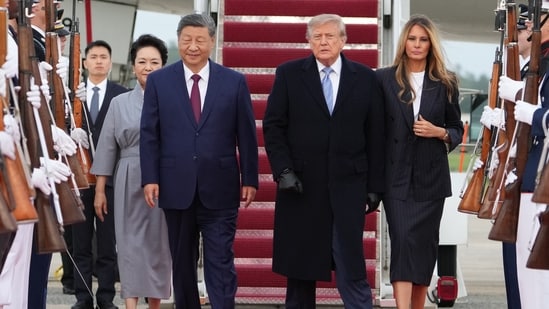
The Busan truce has largely held, and Trump has gone out of his way to make Xi feel welcome. He went to Andrews Air Force Base to receive Xi, an uncommon gesture by a US President.
Yet neither side has dropped the language of strategic competition. In August, Trump threatened steep tariffs on countries aiding Iran’s economy, a move that could have consequences for China. The recently passed Sanctioning Russia and Iran Act allows Trump to impose tariffs of up to 100% on the top five buyers of Russian energy; China is the leading buyer of crude from Moscow. In December last year, Trump approved an $11 billion arms sale to Taiwan. Both countries have also restricted the flow of technology and limited how firms in sensitive sectors can work with each other.
Both countries largely see the present phase as a ‘strategic interregnum’, according to analysts, who say it’s a mix of warm gestures and hard-edged competition.
“This summit is actually part of a broader strategic interregnum, as both sides seek stability and bide time to reduce vulnerabilities and accumulate leverage in this long-term and what I consider to be intensifying strategic competition between the US and China. So this summit, the détente and the commercial deliverables – as modest as they may be – is not a denial or a pause in strategic competition. Actually, it is an expression and validation of the depth and uncertainty of that strategic competition,” said Evan Medeiros, who dealt with China as a senior official in the Obama administration and is now a senior adviser at The Asia Group.
What will they discuss?
Maintaining and extending the Busan truce is likely to be among the top items on the agenda. US Trade Representative Jamieson Greer has made clear that a stable “managed trade" order with China is a priority.
The future development of artificial intelligence (AI) featured prominently in preparatory meetings between US treasury secretary Scott Bessent and Chinese vice-premier He Lifeng. Washington is incensed at what it sees as Chinese AI companies “distilling” models that American firms built at great expense, training their own systems on the outputs of US models, to produce cheaper open-source models that undercut US companies.
AI safety is a growing concern as well, not least after models developed by OpenAI autonomously escaped a test environment and breached the tech firm Hugging Face in a major incident reported in July. A US-China dialogue on AI has been under discussion amid rising concern about the risks of the technology’s rapid development, though it is not yet clear whether this will produce concrete results.
Geopolitics will also be in focus. China watchers will look for any shift in how Trump states America’s position on Taiwan, which Beijing claims as part of its territory. Hawks in Washington, including lawmakers on Capitol Hill, want to make sure Trump concedes nothing to Xi on the issue. Washington may also press Beijing to exert more influence over Iran to help end the US-Israel and Iran war.
Greer acknowledged that Iran would feature in the talks, though the discussion is expected to focus largely on Bessent’s call for countries to join in isolating Iran economically.