
 E-Paper



How DBTs to women are good for the economy
This article is authored by Ujjwal Choudhary.

 Prefer HTon Google


Direct Benefit Transfer (DBT) schemes are often seen as a political tool for influencing electoral outcomes which results in an unproductive allotment of public funds. On the contrary, mainstream economic theories such as the fiscal multiplier effect (sometimes called the Keynesian or expenditure multiplier) suggest that direct transfers actually act as a catalyst for economic growth and they are often more effective and efficient when directed to women.
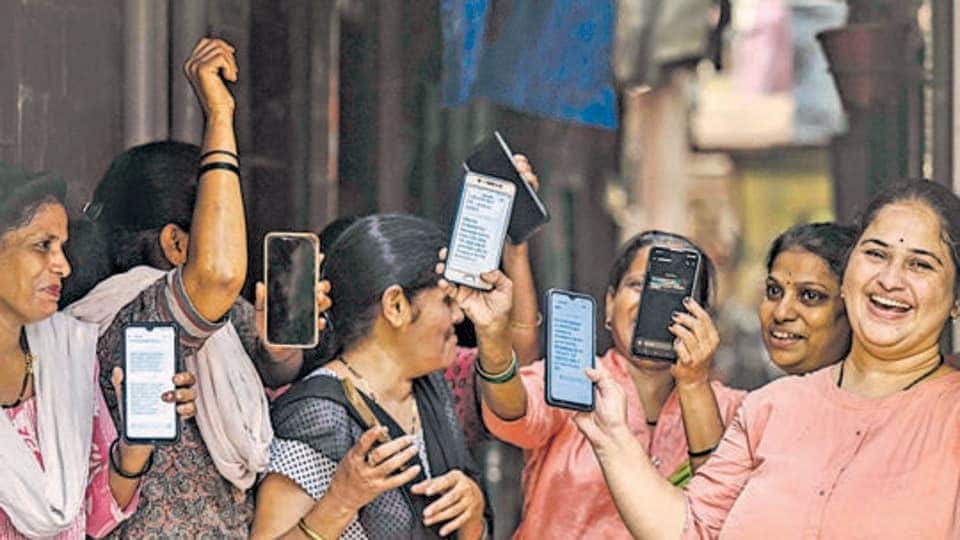
It has been over a decade since the launch of India’s first DBT scheme, which has now become a mandatory manifesto point for any political party contesting elections. Through the DBT ecosystem, India has cumulatively transferred more than ₹50 lakh crore across 324 schemes run by 56 ministries. In FY 2025–26 alone, ₹7.4 lakh crore was disbursed through 729 crore transactions. The JAM trinity, Jan Dhan accounts (54.58 crore, 55.7% held by women), Aadhaar (universal biometric ID), and mobile penetration are fundamental structures driving the DBT initiative which now touches more Indians than any single government initiative in history.
How good is this for the Indian economy? The argument is based on two core ideas: first, it is more efficient than traditional government spending and second, it generates a larger multiplier than tax cuts.
Why is DBT more efficient than traditional government expenditure?
The idea has been studied by economists like Amartya Sen and Anthony Atkinson, and more recently formalised by Abhijit Banerjee and Esther Duflo. Traditional subsidies such as government-incentivised fuel, food or LPG often lose efficiency due to administrative costs, middlemen, and unintended recipients of benefits. Meanwhile, direct cash transfers can reach beneficiaries with lower transaction losses. It has been found that every ₹1 of direct cash transfer delivers more welfare than ₹1 spent on subsidised goods or government services, as the beneficiaries can customise and spend the amount better than bureaucrats making policy decisions on their behalf.
As per the Keynesian fiscal multiplier framework, government spending generates new economic activity in proportion to the amount of money re-spent and is inversely proportional to the amount saved. The key lever here is the marginal propensity to consume (MPC), which is the share of additional income that people spend rather than save.
Now, if a government implements tax cuts, taxpayers (higher income groups) in most cases invest a significant part of the extra amount in equities, gold, or other financial instruments. Meanwhile, lower-income households, who have MPC close to 1, tend to spend most of the additional income on food, fuel, and basic goods, which immediately circulates the money back into the economy. This argument is among the most widely discussed concepts in economics and is backed by Keynesian theory as well as IMF literature.
So, how do cash transfers directed to women improve economic efficiency?
The classic Lundberg–Pollak–Wales (1997) study and findings from Madhya Pradesh found that income deposited in a woman's own account, in her own name, changes how and where it is spent.
Women have a higher MPC on growth enhancing goods such as food, family's nutrition, education and medical care. This leads to both a short-term demand multiplier and a long-term productivity multiplier. The argument can also be backed with Duflo–Banerjee literature which has been simulated in countries like Mexico and Bangladesh.
This unique combination of women led short term demand support, long term human capital formation and financial inclusion acts as a driver for economic growth.
Since its inception, DBT has saved an estimated ₹3.48 lakh crore by increasing operational efficiency and removing ghost beneficiaries. Still, there is room for multiple fundamental reforms.
State-level disbursement should be pegged to their respective revenue in order to maintain fiscal sustainability. The disbursement amount should be linked to inflation. If there is a higher supply of money in the market then the disbursement should be contracted and vice versa.
Policies should be made to address India’s biggest macroeconomic weakness, the wide gap between male and female workforce participation. Schemes should incentivise women who join the workforce.
Currently there are 324 schemes run by 56 ministries. These can be consolidated into a portfolio of schemes for all life-cycle needs (childhood, working age, old age) rather than working in silos.
Data driven analytics and AI can be used to further enhance the beneficiary list by increasing the ease of application for intended beneficiaries and also by removing ghost or duplicate beneficiaries.
Meanwhile, as citizens, we need to confront a bias and acknowledge that a policy does not stop being good economics just because it is also good for politics.
(The views expressed are personal)
This article is authored by Ujjwal Choudhary, public policy consultant specialising in DBT schemes and lifecycle-oriented government welfare policy design and implementation.


