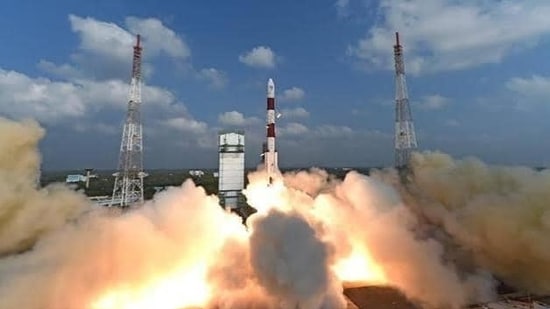
The super-globalised world no longer binds geopolitical competition, but its terrain is so vast that it extends into outer space. In July alone, three major space-related developments have occurred on the Asian landmass; on July 10, China matched the capabilities of the US’s SpaceX Falcon 9 and Blue Origin's New Shepard by launching its ambitious Long March 10 B. The next day, Japan successfully launched its own experimental reusable rocket prototype, achieving a vertical take-off and landing. Both East Asian giants have leapfrogged in rocket science by establishing themselves as space powers. With this massive leap forward, China and Japan became the second and third nations, respectively, to reuse their rockets. The third one was on July 18, when India's private player Skyroot Aerospace successfully launched its Vikram-1 rocket under Mission Aagaman. With this, India became the third country in the world, after the US and China, to reach orbit privately. In terms of the number of satellites India has in orbit (currently 53), it is decent but not large, and nowhere near that of its peer great-power competitors such as the US, China and Russia.
Moreover, China has gained significant momentum in space power. In the last weeks of 2025, according to the International Telecommunication Union, many Chinese satellite operators have applied for more than 200,000 satellite frequencies, which China aims to launch into space by 2035, a year which the Chinese President Xi Jinping has identified as a year in which China would become a world leader in science and technology.
The space competition, which began at the peak of the Cold War, has gained momentum with the rise of China, now a dominant player in space technology and in the number of satellites it has orbiting Earth. According to the General Catalogue of Space Objects, in optical imaging, the US dominates with 454 active satellites, followed by China with 270 and Russia with just 48. In the domain of navigation and positioning, China has a massive lead with its 150 active satellites compared to 42 for the US and 33 for Russia. To make it clear, the Chinese BeiDou navigational system has double the number of satellites, which is 56, compared to 33 with the Global Positioning System. India’s NaviC has 11 satellites, eight of which are functional. Among these three satellites broadcast navigational signals, and five can broadcast one-way messaging signals.
In radar imaging, the US has 31 satellites, China has 66, and Russia has just six. In signal intelligence, the US operates 81 active satellites, China has 109, and Russia has 10. In the technology and training sector, the US has 169 satellites, China has 89, and Russia has 59. Finally, in the missile early-warning systems, the US maintains around 44 satellites, while Russia has three and China has nine. These figures clearly illustrate that the contest is primarily a deep duel between China and the US, with no third global power anywhere close.
{{/usCountry}}In radar imaging, the US has 31 satellites, China has 66, and Russia has just six. In signal intelligence, the US operates 81 active satellites, China has 109, and Russia has 10. In the technology and training sector, the US has 169 satellites, China has 89, and Russia has 59. Finally, in the missile early-warning systems, the US maintains around 44 satellites, while Russia has three and China has nine. These figures clearly illustrate that the contest is primarily a deep duel between China and the US, with no third global power anywhere close.
{{/usCountry}}China’s growing space power and its de facto alliance with India's troubled neighbours, such as Pakistan and Bangladesh, could reduce India's traditional intelligence operations and military might. While China still operates with fewer satellites, about 900-1000, of which only 595 are operational, and the US, on the other hand, has over 10,000 satellites, of which around 90% are the satellites of Starlink. China has also introduced its Starlink rival, the Qianfan programme, in 2024. As of June, the Qianfan constellation has about 200 satellites (more than 160 of the Jilian-1 Hongwai constellation). Both the Satlink and Qianfan satellites are operated in Low Earth Orbit (300-2,000 kilometres above Earth). By 2030, Qianfan plans to expand the constellation to over 15,000 satellites.
This outer space competition among the great powers should be understood from the vantage point of war and the vulnerability it created due to the lack of space-related developments and India’s neighbours, who are behaving like client States of China. In this context, it has become highly critical for the Indian policymakers to invest in the space domains. It is believed that during Operation Sindoor, China assisted the Pakistani military using its navigation satellites. China has also given its support to Iran in ongoing West Asia conflicts, and one piece of evidence was that the rate of significantly higher precision strikes against its targets in the wider West Asian region compared to the 12-day war in June 2025. Chinese commercial systems have deployed their space-based assets to facilitate the Iranian military's solid support to target its enemy locations. Because space is a multi-domain platform connected to nearly every facet of the modern world, heavy investment in this sector is essential to mitigate impending strategic risks. Low-cost drones and cyber capabilities drive modern warfare, but these assets draw their power from space-based systems. New highly offensive military weapons are drones, cyberwar, electronic wars, information wars and electromagnetic wars, all of which are driven by the satellites which are orbiting in space.
In addition, with India’s growing global ambitions and rising geopolitical weight, it is imperative to understand the nature of national security challenges that are exposed to space-based assets. Be it financial markets, navigational systems, intelligence, military security, and so on, all are dependent on space-based assets. Most of the current systems India uses are of Western origin, and it is high time for the Indian security establishment to move beyond its association with the West, especially in the space domain.
ISRO drives the Indian public space ecosystem. Still, the government should provide support and subsidies to private players to manage their affairs, and in this regard, Skyroot's success is commendable. But India needs hundreds of private companies which compete with each other. This should be in the first line of the priority list under the Viksit Bharat mission. India possesses all the foundational ingredients to claim its place as a top-tier space superpower. This is the time to give free space outside of the government, investment through private capital and less bureaucratic hurdles in achieving space missions.
(The views expressed are personal)
This article is authored by Rahul Pandey, research associate/China Desk, Vivekananda International Foundation, New Delhi.