
 E-Paper



SHGs show the way to bridge India’s learning divide
This article is authored by Romonika D Sharan and Priyanka Dale.

 Prefer HTon Google


In a small room in Bihta, Bihar, a mother sits with her six-year-old son, her smartphone open to a learning app. “Earlier, I didn’t know what kind of activities to do with my child,” she explains, “Now I have something that helps him learn.” In Jodhpur, another mother beams as she describes the transformation in her household, “My children used to play games on the phone. Now they study on it.”
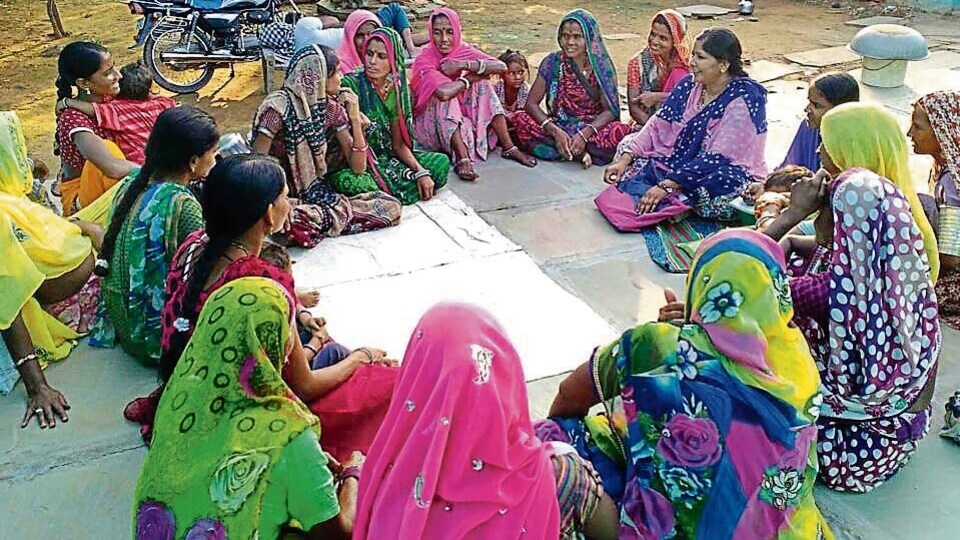
These stories capture a simple but powerful truth that when community trust meets accessible technology, transformation follows. They also reveal an overlooked asset in India’s education landscape: the vast network of women’s Self-Help Groups (SHGs) and the role they can play in addressing the country’s learning crisis.
While India has made significant progress in getting children into schools, time in classrooms hasn’t guaranteed actual learning. According to ASER 2024, more than three-quarters of third graders cannot read at a second-grade level. Over half of fifth graders struggle with the same. This gap hits children from underserved communities the hardest, with consequences that echo across their lifetimes.
Yet two shifts are creating an unprecedented opportunity. First, mothers today are more educated than ever. The proportion who’ve studied beyond fifth grade has nearly doubled since 2010. Second, smartphones have become nearly universal, with over 85% of low-income households owning one. Additionally, nearly three-quarters of children in these homes use smartphones for over 30 minutes daily. Internet data in India is considered amongst the cheapest in the world (at $0.16 per gigabyte), providing conducive infrastructure to reach families directly with learning tools.
The challenge, however, isn’t about access to these tools, it’s adoption. EdTech platforms struggle to reach the last mile. Government partnerships are useful but often time-consuming, especially with no budgets for procuring Information and Communication Technology (ICT) for primary grades. Building a consumer base through direct marketing requires significant investments for a segment with limited paying users. Community-driven models work well but rarely scale beyond their localities, requiring significant resources to replicate and scale.
Rigorous landscaping and analysis were done to find a solution to this challenge and a hypothesis emerged: leveraging partnerships with organisations that already have trusted access to large networks of parents who own smartphones could help EdTech products scale sustainably. These could include gig economy platforms, financial inclusion organisations, and NGOs that mobilise women through SHGs. These organisations bring with them strong trust-based relationships, local credibility, and established infrastructure; factors that can lower the barriers to adoption and build confidence amongst parents. SHGs were therefore an ideal starting point.
India’s 90 lakh SHGs form one of the world’s largest networks, empowering both their members and the wider community. These groups, typically 10-15 women strong, meet regularly, pool savings, and solve local problems. They are trusted voices within their communities, mobilising quickly in times of crisis. In Bihar, for example, SHGs boosted maternal health, increasing antenatal visits by 9% and institutional deliveries by 10%. In Tamil Nadu, SHG members earned nearly twice the agricultural income of non-members. During the pandemic, SHGs ran 10,000 community kitchens, feeding seven lakh people daily. What we wanted to know is if they could also help solve our education crisis?
To test this, Central Square Foundation partnered with Hand in Hand India (HiH), a non-profit working with SHGs across 22 states, to introduce a learning platform called Top Parent to mothers in Bihar, Jharkhand, Madhya Pradesh, Rajasthan and Uttar Pradesh. Top Parent is a free, easy-to-use learning app that supports parents of early learners with fun, bite-sized activities to build strong foundational skills at home. This partnership was facilitated through the LiftEd EdTech Accelerator. The Accelerator is backed by the Michael and Susan Dell Foundation, Reliance Foundation and UBS Optimus Foundation as founding partners, with the British Asian Trust as the programme leader and Central Square Foundation as the design and technical partner.
SHG meetings became the bridge between households and technology, and through the support of HIH SHG facilitators, mothers learned how to download and use the app, and how to support learning at home. The facilitators followed up regularly, and mothers along with their children who engaged consistently were recognised and celebrated.
In just six months, 18,000 mothers were reached, and over 11,000 downloaded and actively used the platform with their children. But the numbers only tell part of the story.
What mattered most was trust. Many mothers were initially afraid of downloading apps, worried about fraud and scams. But reassurances from their SHG facilitators, people they already knew and relied on, made all the difference. The same networks that helped them access credit, now became gateways for their children’s education. Once they began using the app, mothers saw themselves as educators. They spoke enthusiastically about the activities and worksheets, noting how easy the content was to understand and how relevant it felt to their daily lives.
Two powerful lessons emerged from the six-month pilot.
First, embedding digital tools within trusted community networks can dramatically lower barriers to adoption, as digital adoption in rural India cannot thrive on technology alone, it also requires trust. Networks like SHGs provide access to millions of parents who own smartphones and bring with them years of collective trust built through saving together, working together, and supporting one another. By leveraging these existing relationships and involving SHG facilitators to provide hands-on demonstrations, regular nudges, and encouragement during meetings, EdTech solutions can drive sustained engagement. The addition of rewards and recognition further strengthens motivation, allowing platforms like Top Parent to become familiar, trusted learning companions within local communities.
Second, while the Top Parent app was designed for children aged three to eight, its appeal extended to older siblings and children within the community, revealing how learning gaps in foundational literacy and numeracy persist well beyond early grades. Seeing their interest in content for additional grades, Top Parent has begun expanding their content to cater to older children as well. This underscores the need for inclusive learning solutions, and the breadth of the challenge in addressing the learning crisis.
What does this pilot unlock next? The SHG-led model demonstrates how technology can harness the social capital already built within women’s collectives. These networks rooted in trust, reciprocity, and shared experience offer a ready-made foundation for scaling digital learning. When digital tools flow through such trusted social systems, adoption becomes relational rather than transactional.
While initial results from the pilot are promising, the sustainability and scalability of such models need to be explored further by extending this approach beyond SHGs to other community-based networks, like gig-economy platforms, financial inclusion groups, and frontline health workers, each deeply embedded in India’s social fabric. By building on these existing trust ecosystems, technology can reach the last mile, bridging both the digital and learning divides.
The mothers in Bihta and Jodhpur are not merely app users; they are early educators and local innovators. Their journeys show that India’s children can have a thriving future when their learning is improved through technology that is amplified through the collective power of communities that already know how to mobilise, nurture, and lead.
This article is authored by Romonika D Sharan, senior retd. bureaucrat and project director, Policy & Communications, Central Square Foundation and Priyanka Dale, chief general manager, Hand in Hand India.


