
 E-Paper



A UN Day to end child marriage can turn resolve into action
This article is authored by Bhuwan Ribhu, founder, Just Rights for Children.

 Prefer HTon Google


Prerna (name changed) from Rajasthan was doing well in school, a confident child who believed the world was open before her. She could grow up to become an athlete, a scientist, perhaps the president of the country. Then one decision threatened to destroy that future. Her parents decided it to get her married. She wasn’t alone. Three more girls in her school had their names printed on wedding cards.
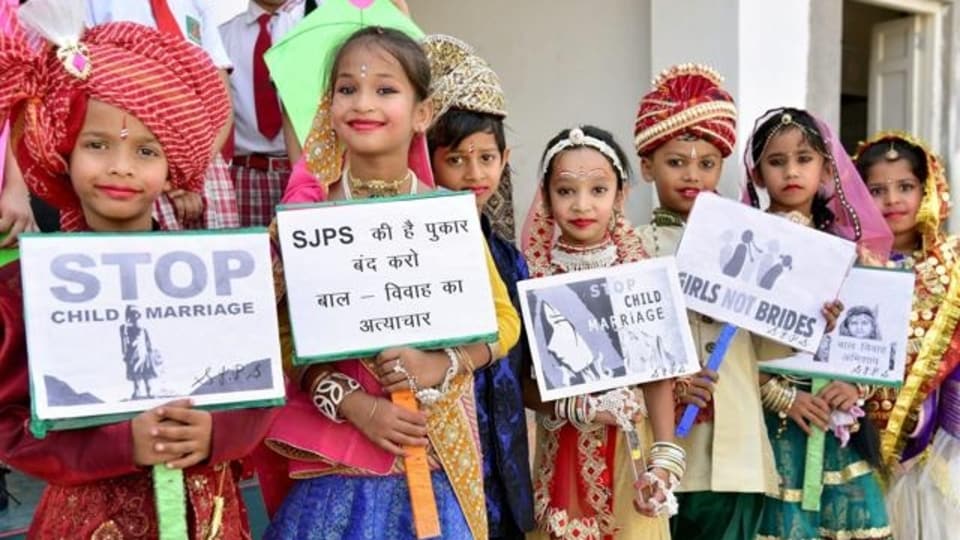
Fortunately, a teacher grew suspicious and, on probing, discovered that these girls, between eight and 14, were being married to boys who were also children. She alerted a Just Rights for Children partner, who informed the local administration. Together, they reached the families and made them understand that child marriage is a crime. The weddings were stopped, and the girls returned to school.
For centuries, child marriage has been treated as a social practice. In reality, it is a crime. It is child rape. Sex with a child is rape, even within marriage.
When a girl is married, she does not have the capacity, consent or autonomy to make that decision. It is a forced union in which she is subjected to sexual abuse and risky pregnancies, and faces loss of education and her future. This violation of human rights does not occur behind closed doors. It unfolds in full public view, where communities gather to celebrate the marriage.
An educated girl becomes a force for prosperity, stability and development. Protecting girls is not one concern among many; it underpins every right we defend and every development goal the world seeks to achieve
Child marriage is not confined to a few regions or cultures; it persists across continents and countries. Globally, an estimated 640 million girls and women alive today were married as children. Each year, 12 million girls marry before the age of 18, or one girl every three seconds. Women who are married as children earn 9% less than those who marry later, according to the World Bank.
In some communities, the practice is driven by poverty and the belief that marriage will secure a girl’s future. In others, it is sustained by social pressure. And where laws prohibit child marriage, enforcement is inconsistent.
Encouragingly, the global conversation around child marriage is changing. It is now recognised as a criminal justice issue. Governments have pledged to eliminate it by 2030 and most countries now recognise 18 as the legal age of marriage.
Yet its continuation raises a serious question: why does it persist on such a scale?
The answer lies in the difference between acknowledgement and action. Declarations alone do not change behaviour. Laws require enforcement. Commitments require sustained attention and pressure on institutions and governments to act. Accountability has to be fixed.
India has emerged as a model for global action, offering a roadmap for protecting children at scale. When the rule of law is applied with a whole-of-government and a whole-of-society approach, change is possible. The country witnessed an unprecedented surge of state-led initiatives and community mobilisation after the Government of India launched the Bal Vivah Mukt Bharat campaign on November 27, 2024.
On the ground, Just Rights for Children (JRC), a network of more than 300 NGOs working across 450 districts, has worked closely with law enforcement to stop or prevent more than 500,000 child marriages since April 2023.
In the past year alone, more than 700,000 girls have returned to school and 2.1 million vulnerable families have been linked to government schemes. Faith leaders have strengthened this progress, with more than 350,000 pandits, imams and pastors pledging to end child marriage, sending a clear message that this crime cannot continue.
That momentum carried forward when JRC launched the Child Marriage Free World campaign in New York in September 2025 during the 80th United Nations General Assembly, mobilising pledges and commitments from individuals and institutions across continents. The global movement has already reached nearly 100 countries.
Intent alone does not end a crime; Focus and accountability do. Therefore, the world must call upon the United Nations to dedicate International Day for a Child Marriage Free World. Such a day would showcase international commitment and mobilise governments and societies to act together.
When a cause has a date, it would signal that the world is serious, that ending this crime is a shared responsibility. It would steer scattered efforts in one direction.
It would push governments to debate progress and actions taken. International organisations would use the day to share data and lessons, while schools, universities and civil society would use it to spread awareness.
Visibility moves resources. A dedicated day would encourage governments and institutions to announce programmes, partnerships and investments. Donors, corporations and philanthropic foundations would also time their commitments to funding initiatives, scale existing programmes and signal priority areas.
Each anniversary would add new commitments, policies and fresh stories of change. It would keep the issue breathing, returning every year until the crime ends, renewing global resolve and realigning efforts.
That is the quiet strength of a global day.
Ending child marriage requires a system that places prevention before protection, protection before prosecution and prosecution with the single-minded focus to create deterrence for prevention.
Prevention begins when a girl remains in school, when scholarships and conditional cash transfers allow her to complete her education, and when vulnerable households gain access to welfare schemes. Without education, children face fewer opportunities and far less control over their lives.
At the moment, India has over 440 million children, including more than 200 million girls. With a prevalence rate of 23.3% (NFHS), millions of girls are at risk of child marriage. If these girls are able to complete their education and enter the workforce, it would significantly boost the country’s GDP.
The world already has the laws and the capacity to end child marriage. What is urgently needed is the resolve to keep returning to this fight until it is won.
Ending child marriage is not the responsibility of one government or one organisation. The commitment must be collective, and the time to act is now.
(The views expressed are personal)
This article is authored by Bhuwan Ribhu, founder, Just Rights for Children.


