
 E-Paper



Modi’s Maldives visit is a reset button pressed with patience
This article is authored by Rishi Gupta, assistant director, International Security, Asia Society Policy Institute, New Delhi.

 Prefer HTon Google


Prime Minister (PM) Modi will be on a two-day visit to the Maldives from July 25 to 26. This will be his first State visit to the island nation in six years, and third one since he took office in 2014. This visit comes in the backdrop of President Mohamed Muizzu’s active pursuance of the ‘India Out’ campaign, premised on getting the Indian military technical staff out from the island nation, who were stationed in Male to help them with operating the helicopters and Dornier reconnaissance aircrafts that India had gifted to the Maldives. After President Muizzu took office in November 2023, he maintained his assertive tone in early statements and interviews. In a fiery interview to the Al-Jazeera, President Muizzu said, ”We may be small but that doesn’t give you the licence to bully us.” The veiled remark had quickly made headlines in India and internationally.
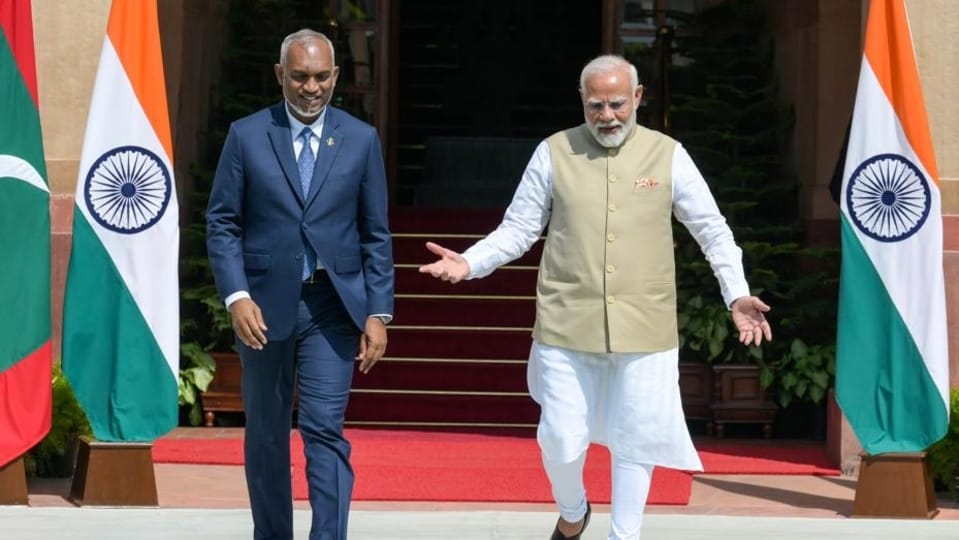
From ‘India Out’ becoming the anthem of Muizzu’s presidential campaign, a veiled remark on India as a bully after he entered office and distasteful remarks by the Maldivian legislators, the neighbourhood watchers in Delhi saw it as a major downturn. But during PM Modi’s forthcoming State visit where he will also be the guest of honour at the celebrations of the independence of Maldives on July 26, both sides would be looking to restore ties, but more than anything, trust-building will be crucial as also solidifying the Comprehensive Economc and Maritimne Security Partnership adopted during President Muizzu’s India visit in October 2024.
While the rise of ultra-nationalism in the Maldives, with an anti-India campaign at its core, has been a significant setback to the friendly relationship between the two countries, it is the China factor that has been of immense worry to Delhi. Undoubtedly, the Maldives’ location in the India Ocean presents Beijing with a greater and closer view of India—posing a threat to India’s security and threatening the idea of a free and open Indo-Pacific. And it needs no guessing that China’s active manoeuvrings such as docking of its so-called research ships in the Maldives and Sri Lanka that are of a dual purpose—one that seeks to secure supply chains and sea lanes of communication for its growing economic, industrial and energy needs, and another that strategically looks at the military presence as a key to dominance—and warrants a response from India which remains the key regional player.
Against this backdrop, PM Modi's much-awaited visit to the Maldives is a clear marker of the ease of working in the relationship—something that seemed missing in the early quarters of President Muizzu’s presidency and hopes for normalcy remained a looming challenge or to some, it was impossible. President Muizzu’s early days in office saw his visits to Turkey, Saudi Arabia, and China, but India was a miss on the priority list. And for all good and bad, the foreign policy observers in Delhi were quick to suggest that visits by any newly elected heads of countries in the neighbourhood other than India be treated as a diplomatic loss for Delhi.
And this pessimism made sense to the Indian media not just in the context of Maldives, but also on Nepal and Bangladesh, whose current leaders took up their first trips to China, and not to India. But one often discredits the role of geography, which by default puts India back as the closest neighbour—whether neighbours prefer or not. Secondly, India’s role as the first responder during freshwater crisis in the Maldives in 2016, earthquake in Nepal in 2016, and 2022 economic crisis in Sri Lanka has proved its reliability. And not to forget, India’s recent financial support to the Maldives, including the rolling over of $50 million in treasury bills by the State Bank of India in 2024 has not gone unnoticed. Therefore, the Indian foreign policy establishment must be credited for its patient diplomacy, which has tactically limited itself from early reactions.
But rapid responses in the media on political developments in the neighbourhood, especially in the case of the Maldives and Nepal, often miss taking the year 2008 into account. After their respective struggles against monarchy and autocracy, both became democracies, and the the rise of a new political opposition was instrumental in shaping multidirectional foreign policy of these countries. While the older guard chose to continue with a pro-India approach, the opposition had to re-invent itself, and China seemed the closest alternative that worked for their political requirements.
Now with India attempting to reconfigure its neighbourhood first approach with patience to build natural synergies with the smaller neighbours and their new political setups, what has changed is Delhi’s recognition that China is no longer just a competitor—it is a persistent strategic presence in the region, which requires uninterrupted diplomatic engagement.
As PM Modi touches down in Malé, Delhi would be seeing it as an opportunity to reorient its approach with more strategic clarity. Undoubtedly, India will have to de-hyphenate political affection from the strategic compulsion, and graduate from the temptation of favouring one party or a specific leader. India’s engagement with President Muizzu must be pragmatic, institutional, and not performative or punitive. Secondly, India must counter Beijing’s strategic buildup with strategic presence —marked by consistent diplomatic engagement, development partnerships, and a sustained security footprint in the region— and not strategic anxiety. China is a hard reality and undoing it must not be a policy option, rather it should be countered through diplomatic posturing, investing in quiet and permanent developmental cooperation would yield results.
Thirdly, India’s smaller neighbours will continue to reinvent themselves through symbolic defiance using the cancel culture towards India-led projects and initiatives. But this must not be a major obstacle for Delhi as it will always be the case for local political parties and entities in shaping their nationalistic outlook. However, even those opposing India’s goodwill initiatives in the Maldives cannot ignore India’s cardinal role as a first responder. But this view only gets reflected when those opposing get elected to serve the government.
Lastly, bilateral paternalism needs to be shifted to the multilateral leadership. India’s regional security architecture in the Indian Ocean Region considers countries like Sri Lanka and the Maldives crucial and through initiatives like SAGAR—Security and Growth for All in the Region, which has been upgraded to MAHASAGAR—Mutual and Holistic Advancement for Security and growth for All in the Region, the multilateral approach gets exhibited on several fronts, including security and growth involving maritime. Also, Maldives faces the acute climatic challenge due to rising sea-levels that pose an existential threat to the Island nation. However, initiatives like MAHASAGAR, not only offer collective resolve to climate-related challenges but also providing safeguard against traditional threats like smuggling and terrorism through sea routes, to building new-age digital public infrastructure.
The views expressed are personal.
This article is authored by Rishi Gupta, assistant director, International Security, Asia Society Policy Institute, New Delhi.


